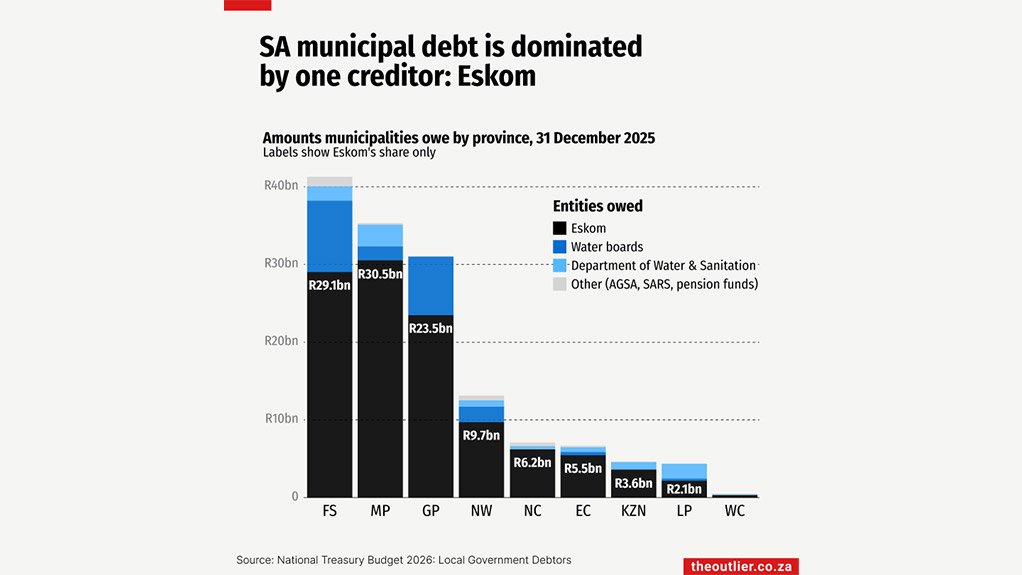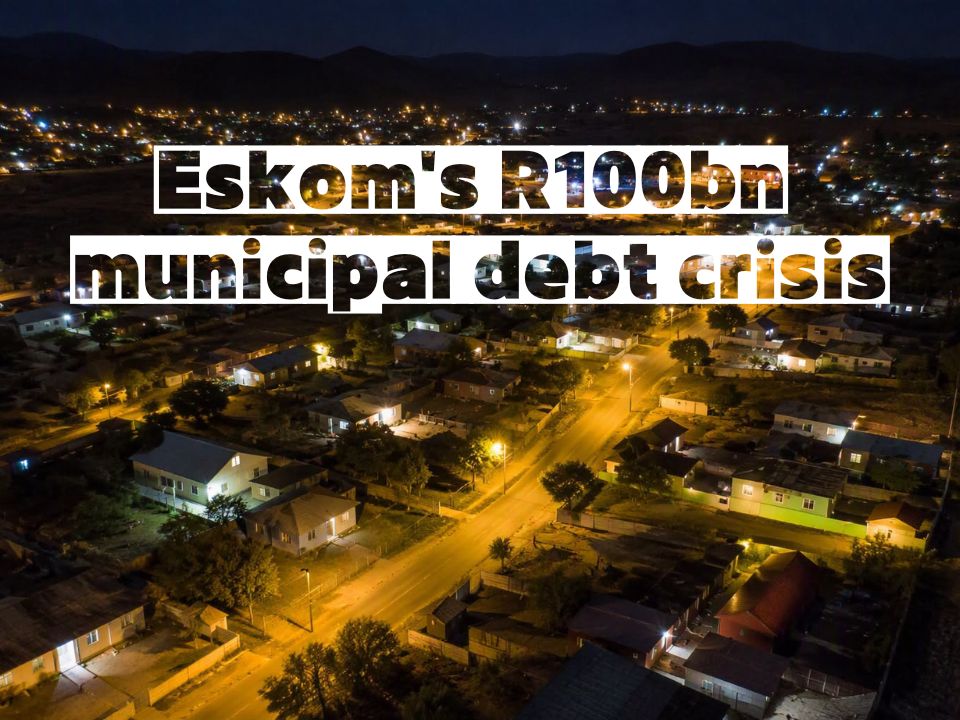
Last month the National Treasury made the rare decision to invoke section 216(2) of the constitution and temporarily withhold R13.5bn in local government equitable share transfers from 69 poorly performing municipalities across South Africa. The official rationale, defended as a corrective enforcement mechanism, is to force delinquent councils to settle their combined R27.4bn debt to Eskom, water boards and retirement funds. To a frustrated ratepayer the Treasury’s financial tourniquet might look like long-overdue discipline. However, looking at this crisis through a rigorous macroeconomic and public finance lens reveals a far more dangerous reality. South Africa is misdiagnosing a deep structural illness, treating a crisis of systemic, localised insolvency as if it were mere behavioural noncompliance by administrative officials. (Dorothy Kgosi) The extraordinary joint parliamentary committee meeting that took place on July 17, bringing together the portfolio committee on co-operative governance & traditional affairs and the standing committees on public accounts, finance and appropriations, turned this crisis into a high-stakes constitutional showdown. However, while the executive relies on blunt fiscal freezes, the parliamentary intervention proved that turning off the financial taps is a symptom of a deeper systemic failure, not a solution. The referee, players and the pitch During the intense briefing that Friday a compelling football analogy was introduced by the chair of the standing committee on appropriations, Mmusi Maimane, who argued: “When there are poor players on a football field we cannot suddenly conclude that the referee is the problem. We need more capable local government administrations. We must confront governance failures in local government.” While it is true that poor political and administrative leadership, cadre deployment and a lack of integrity drive municipal dysfunction, focusing exclusively on the “poor players” misreads the layout of the pitch. Yes, the players may be performing badly, but they are being forced to play on a field filled with landmines ― an obsolete 1998 local government fiscal framework that no longer matches the economic reality of the sector. When a framework is fundamentally broken even the world’s best administrators will fail. The Treasury cannot act as a rigid referee of fiscal compliance while playing as the entity that dictates a shrinking financial envelope for local mandates. Imposing central funding freezes without evaluating the actual cost of fulfilling municipal mandates creates an operational vacuum, prioritising creditor balance sheets over constitutional obligations and putting the public in immediate jeopardy. Constitutional obligationsThis referee-and-player paradox directly conflicts with the constitutional obligations of national and provincial governments. As standing committee on finance chair Mkhacani Maswanganyi rightly observed during the joint hearing, “The stopping of transfers may create pressure for compliance, but it is not, in itself, a municipal recovery strategy. It cannot replace the constitutional responsibility of national and provincial governments to support and strengthen the capacity of municipalities to manage their own affairs.” By ignoring section 154 of the constitution, which mandates national and provincial governments to support and strengthen municipal capacity, the state is treating a structural collapse as a basic disciplinary matter. Stopping unconditional grants is a blunt instrument that starves the immediate operational envelope required to deliver basic human services to ordinary citizens, particularly the indigent. The sovereign debt irony The joint committee meeting exposed a huge financial irony that undermines the Treasury’s punitive enforcement narrative. Standing committee on public accounts chair Songezo Zibi revealed that the 69 affected municipalities were collectively owed a staggering R217.8bn by households, businesses and organs of state. Crucially, R11.6bn (just more than 5%) of that debt is owed directly by government departments and public entities to the municipalities presently being starved of funds. The state was in effect penalising local governments for failing to pay utility bills, while the state’s own departments were failing to meet their payment obligations to those same municipalities. As Zibi noted, if provincial portfolio committees and provincial public accounts structures were performing their oversight responsibilities properly, parliament would not need to step in to clean up the executive’s mess. The structural core of the contradiction is that the National Treasury froze R13.5bn in critical operational funding because municipalities could not clear R27.4bn in bulk utility liabilities. Yet the broader state architecture was actively paralysing these councils by failing to pay R11.6bn in direct public department debts, while a broken macroeconomic framework left municipalities trapped chasing R217.8bn in largely uncollectible consumer debt. Scale of the structural siphon This debt crisis cannot be decoupled from the structural phenomenon of underfunded and unfunded mandates. As detailed in our municipal fiscal vitality & sustainability index, weak revenue collection and structural underfunding interact to eliminate municipal fiscal space. The parliamentary budget office paper released last month confirms that local governments are forced to deliver almost 46% of the frontline governance functions experienced directly by citizens, yet they are allocated a meagre 9.9% of nationally raised revenue. This macro-fiscal imbalance forces municipalities to spend about R31bn annually on functions contractually assigned to national or provincial departments, including libraries, primary healthcare support, housing administration and community safety. This R31bn siphon represents 29% of the entire local government equitable share allocation. Even our country’s best-resourced metropolitan hubs are buckling under this weight, as illustrated by the Treasury’s own data presented to parliament. Compounding this crisis are severe legislative barriers such as the Government Immovable Asset Management Act of 2007, which actively prevents councils from investing capital into repairing assets they deliver services from but do not legally own. This means municipalities are structurally financing infrastructure, staffing and high overhead costs out of local rates while their own revenue cover of recurrent operating expenditure has deteriorated to a mere 60%, falling far short of the 90% sustainability benchmark.A joint South African Local Government Association and department of co-operative governance & traditional affairs study explicitly confirms an enormous, permanent structural transfer gap of about R150bn across the sector. When a framework is so deeply misaligned technical bankruptcy is an absolute mathematical inevitability. The constitutional impasse Faced with these system-wide realities the joint committees took a firm stand against executive overreach, stating that they will act without reservation if the executive takes steps that put the public in jeopardy. Concluding that a uniform approach cannot be applied to all municipalities, the committees directed an urgent meeting be convened between the Financial & Fiscal Commission, National Treasury and the department to address the legal interpretation issues relating to the section 216(2) intervention. The executive was handed a strict seven-day ultimatum to submit a report addressing these legal concerns and outlining a proposed way forward that safeguards parliamentary oversight and service delivery. With the November 2026 local elections rapidly approaching, the national conversation must be extracted from political noise and grounded in empirical reality. We can no longer afford to wait for reactive, postmortem audit outcomes to tell us that a local economy has collapsed. The parliamentary hearings proved that we are running out of time. If our legislators fail to look past the bureaucratic refereeing and ignore the insolvency elephant in the room, they will guarantee the structural collapse of the local state post-2026. • Jantjies, a former director of the parliamentary budget office, is a senior macroeconomic and fiscal analyst, professor of practice at the University of Johannesburg, and chair of the African Network of Parliamentary Budget Offices.Business Day
DUMISANI JANTJIES | The municipal insolvency elephant
While poor local governance contributes to dysfunction, the outdated funding model, underfunding, and the state’s unpaid debts create insolvency and service delivery crises
1,206 words~5 min read