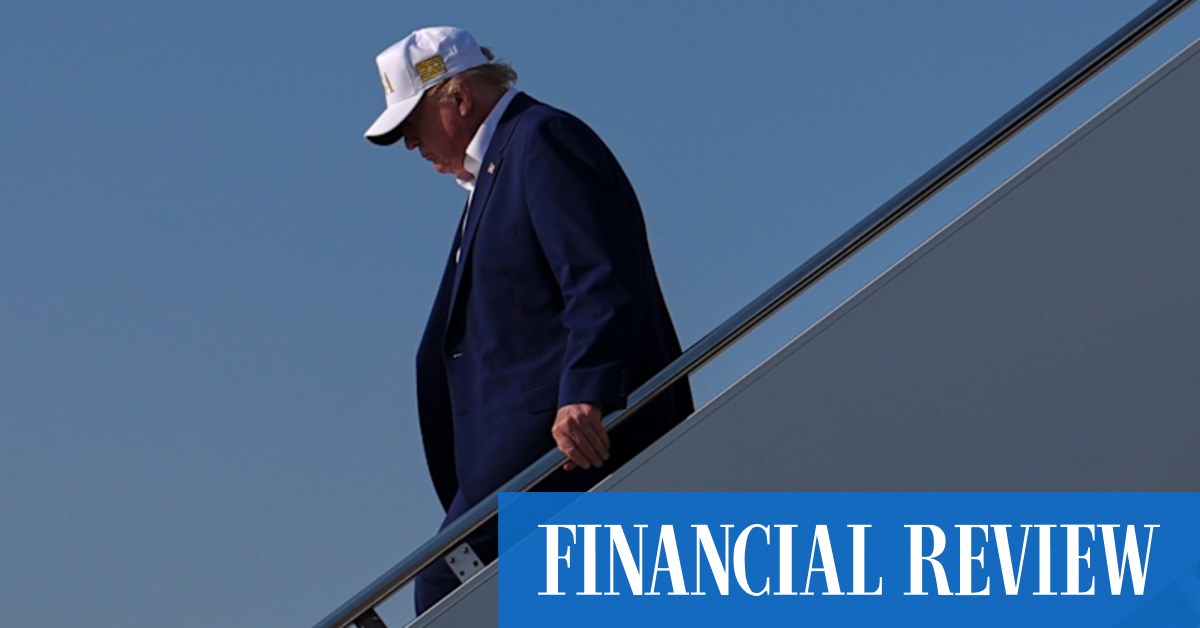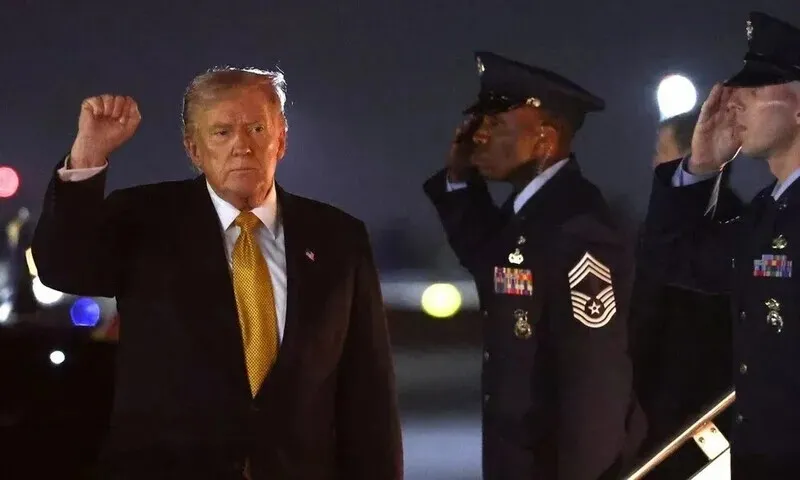
US President Donald Trump holds up his fist after deplaning from Air Force One in West Palm Beach, Florida, on Nov. 7, 2025. (Reuters/Yonhap)
By Kim Won-chul, Washington correspondentThe president of the United States is Donald Trump, someone who prides himself on ranking first in the world for political retribution.Trump has been overt about pushing investigations against his political enemies and critics. One figure, James Comey, the former FBI director, has actually been indicted, and many others have faced investigation. Yet from a South Korean perspective, this all seems somewhat mild.Imagine what a president here might have done if they had set out blatantly to destroy a political foe the way Trump has.First, investigators would descend on their home and office with blue boxes in hand, ready for a raid. The basic combo also comes with a public summons, followed by a request for a detention warrant. Once the warrant has been issued, the target could find themselves confined to a detention center until their trial.Thanks to the investigators’ “legitimate enforcement of the law” before an indictment has even been handed down, the target ends up battered in the court of public opinion. By this stage, the “assassination” of the political enemy’s character is already complete.Scenes like these are rare even in Trump’s America because the balance between investigative authority and due process in the US is better maintained than in Korea.Korea’s three axes of criminal investigation are extensive search and seizure, with over 90% of such warrants being granted; virtually mandatory summons for questioning under the threat of an arrest for non-compliance; and pre-indictment detention warrants, which courts grant at a rate of more than 70%. The legal arsenal at investigators' disposal gives them immense power over suspects.While the US also has the same tools in its arsenal, they are used only in exceptional cases and face strong judicial oversight. A subpoena takes the place of a major part of the Korean-style search and seizure. Instead of raiding homes and offices to confiscate everything, American investigators require the parties involved or witnesses to selectively submit relevant materials.The US principle is to secure materials held by third parties not suspected of a crime — namely witnesses — through subpoenas. In Korea, even witnesses have been subject to search and seizure.Someone who receives a subpoena may review the materials with an attorney and negotiate the scope of and deadline for the submission with prosecutors. If the demand is deemed excessive, the party can also file a motion with the court to cancel or modify the subpoena.Strong penalties can follow if the party refuses to comply with the subpoena without justifiable grounds or destroys or conceals materials, such as being charged with contempt of court or obstruction of justice. This, however, is difficult to compare to a search and seizure in Korea, in which investigative agencies physically seize evidence.Since it lacks the visual impact of a search and seizure, a subpoena cannot be easily abused by investigative agencies for the sake of public humiliation of a suspect. A suspect cannot be forcibly summoned to an interrogation room for questioning based simply on a request. To compel attendance and testimony requires the subpoena procedure of a grand jury of citizens that deliberates whether to indict.Even at that stage, a suspect retains the right to remain silent. Pre-indictment detention is possible but only under extremely limited circumstances, specifically if the suspect’s potential to escape or pose a danger to society is deemed unpreventable under any circumstance. It is extremely rare for former high-ranking officials or politicians, who are often targeted in political purges, to be held in custody before indictment.The long-standing debate in Korea over how much of prosecutors’ investigative authority should be transferred to police is entering its final stage. Hardly anyone disagrees that such power must be drastically reduced.The problem is little to no discussion of the “excessive” investigative power itself as epitomized by the big three. Whether held by prosecutors or police, excessive authority is bound to be abused; thus, the most fundamental check for this is strong protections of due process for suspects. Please direct questions or comments to [english@hani.co.kr]