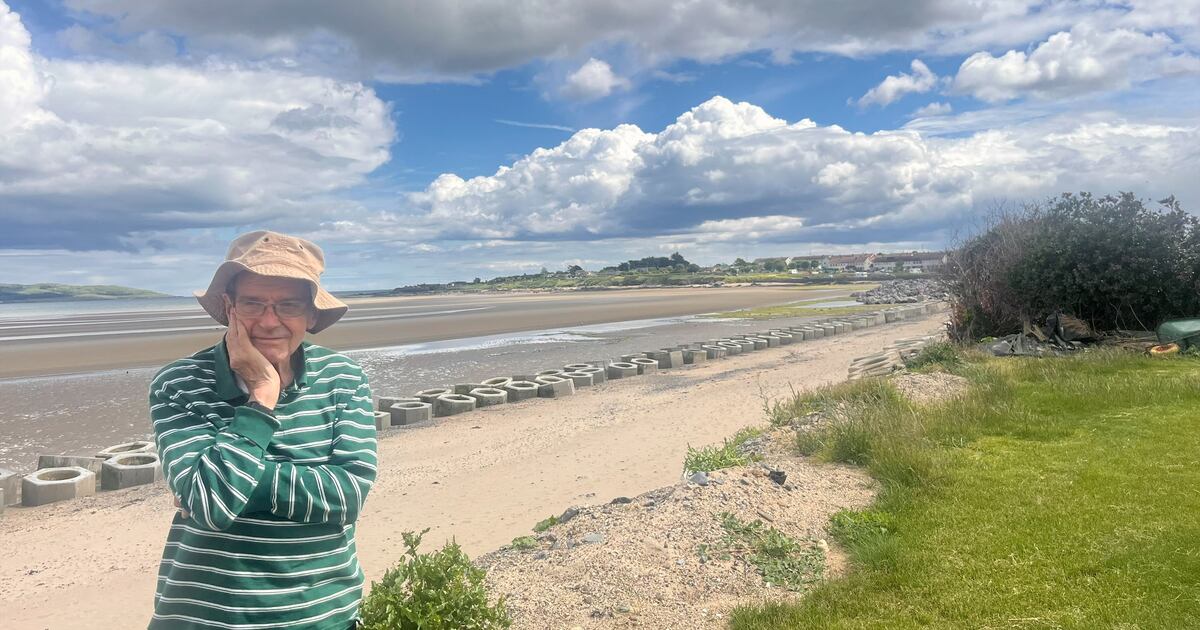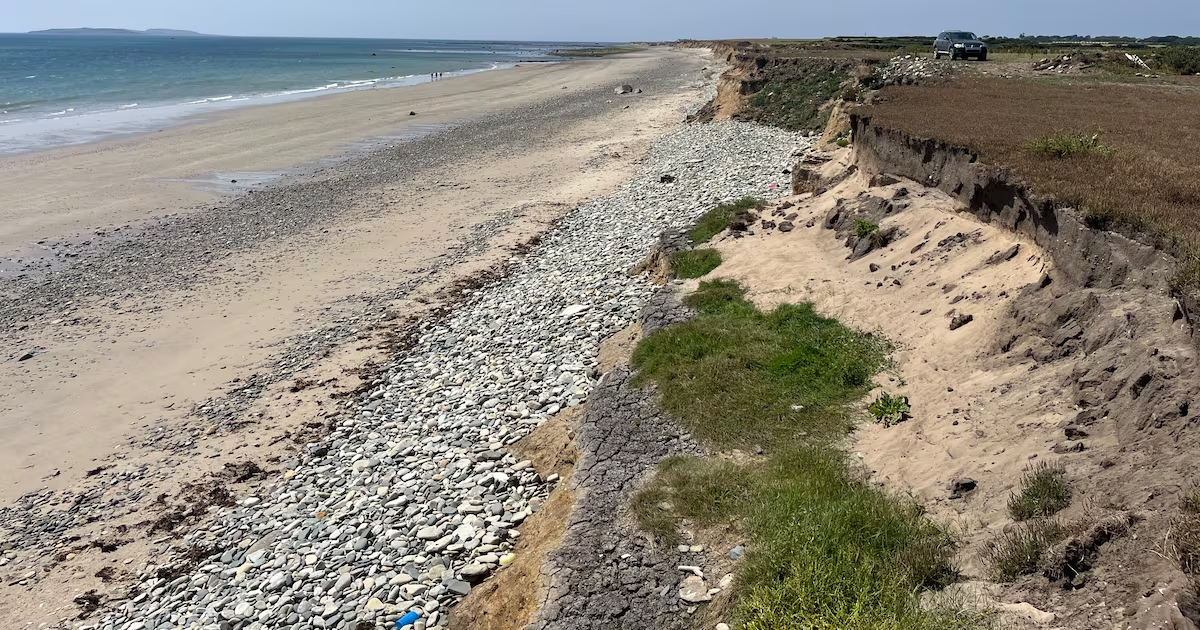
On a sunny summer morning, Kelly’s Hotel in Rosslare Strand is a hive of activity.Staff are turning things around after breakfast, guests are preparing to embrace the day, and a mildly panicked woman is searching for a diamond that has fallen off her necklace. Kelly’s is a place people return to year after year. The seaside setting is an undoubted attraction and the beach has never been closer to the hotel, which is handy for the guests but a reminder to the ownership that you cannot control everything. The Co Wexford coastline runs to around 260km and is a major tourism asset. However, about 100km of it is classified as being at risk from erosion and Rosslare Strand, despite various efforts to diminish the sea’s unrelenting impact on the soft and sandy landscape, is at the front line. The Kellys have been operating a business here for 130 years. Hotel managing director Bill Kelly represents the fourth generation to run the hotel, with members of the fifth also involved. “Definitely it is closer than it was,” he says of the Irish Sea’s proximity to the hotel. “If you look at the title maps, it would bring us out another 50 or 60 metres from where we are today.” Bill Kelly on a rear balcony overlooking the Irish Sea at Kelly's Hotel in Rosslare Strand. Photograph: Steven Carroll Kelly stops in a corridor to highlight a set of paintings showing how much wider (and farther away) the beach to the rear of the hotel was in the late 19th century. “It’s unbelievable the beach that was there,” he says looking at one, adding that car and horse races were staged on the wide strand back then. Today, you would do well to perform a three-point-turn in a car. Kelly believes “most of the real heavy erosion” happened in the 1950s and 1970s after the sea’s movements were shifted by the extensive work carried out to develop another local asset several kilometres south of the hotel: Rosslare Europort.Billy Kell on the heavily eroded bank separating Kelly's Hotel from the beach at Rosslare Strand. Photograph: Steven Carroll “It stopped the supply of sand to Rosslare [Strand],” he says, noting how a beach “that didn’t exist when we were kids” has developed to the far side of the port. Coastal erosion and Co Wexford are no strangers. Local authors John Banville and Colm Tóibín both reference the phenomenon in their works, with the former writing in his Booker Prize-winning novel The Sea, set in a fictionalised version of Rosslare Strand: “Late in the evening it was and I had swum the distance – what a hundred, two hundred yards – between two of the green-slimed concrete groynes that long ago had been thrown into the sea in a vain attempt to halt the erosion of the beach.”There remains plenty of evidence along Rosslare Strand of those attempts. Rows of timber groynes designed to hold sand in place pop up at intervals and sections of rock revetments – boulders piled together to break the waves – appear to have failed in their task about 1km from the hotel. A balcony droops over rock revetments placed on the beach at Rosslare Strand. Photograph: Steven Carroll There’s a sad looking wooden balcony drooping down behind a holiday home and Kelly points out a set of steps buckled by the elements that he used to walk down when going swimming last year. “Shocking, isn’t it?” he says.Some mitigation efforts have been successful. In 1994, rock groynes were added to the beach and thousands of tonnes of sand were pumped back towards it, which Kelly says provided protection for many years. “The higher the level of the beach, the further the waves break from the shore and the less it affects the shoreline itself in terms of erosion,” he says, adding that this should be done every five years and “not every 30 years” as is the case now. He believes that building rock revetments causes a lowering of the beach level and “creates greater erosion of the coastline”. “We should be trying to work with nature, not work against nature,” he says. About 20km southwest of Rosslare Strand, erosion is having an impact on another enterprise. Dairy and horses are the mainstays for John Byrne, whose family has farmed at Ballygrangans in Kilmore for more than a century. After a drive down a winding track from his yard, Byrne stops on a headland overlooking the Celtic Sea and the Saltee Islands. He used to be able to walk on to the beach, but there’s a steep drop down these days. “It was lovely. We used to bring the cows along the beach when it all went way out. We used to have it fenced and a gateway,” he says. “We can’t get down on to the beach now.” John Byrne on the edge of his farmland at Ballygrangans, Kilmore, Co Wexford. Photograph: Steven Carroll Byrne has had to redo the track around the boundary of his land four times in recent years due to the force of the sea eating farther into his fields. “Only last week a cow went over it there. Luckily enough she didn’t hurt herself, but I can’t get her up here at Ballygrangans now because the slip is gone.”Asked how much land he reckons he has lost, Byrne says: “Ah janey, it’s a lot.” Does it run to acres?“Oh absolutely, if you measure that stretch,” he says.He points towards a large rock on the beach, roughly 30m away. “You see that rock there? It was in the bank, in the land. The bare tip of that was exposed for a long time and now it’s there on its own,” he says.The rate of erosion accelerated “from 2014 onwards”, Byrne says, and since then “the amount of land breaking away every year is terrible”. A short distance up the beach at Bastardstown, rock revetments have been installed to protect homes coming ever closer to the edge. The heavily eroded coastline at Ballygrangans, Kilmore looking towards Bastardstown. Photograph: Steven Carroll Asked if anything has been done to defend his land, Byrne replies: “Nothing, nothing ... There’s nobody protecting my land for me, that’s one sure thing.”Wexford County Council deputy chief executive Eamonn Hore says the combination of rising sea levels and more severe storms battering the sandy coastline has led to a noticeable “acceleration in erosion over the last couple of years”.With more than a third of the county’s coast at risk, it leaves the local authority having to prioritise where and what it is willing to defend. “The priority would be people’s homes, roads, basically buildings, and then after that the priority drops,” he says. “It is going to be very difficult to look after just pure farmland because the cost of protecting it usually outweighs the value of the land.“Clearly, we protect villages, urban areas, that’s why there’s been so much protection done in Rosslare Strand. Millions have been spent over the years and it warrants it because of the value of the assets down there: properties and tourism.” Kelly accepts Rosslare has had its share of minor protection works carried out, but he has been in contact with the Office of Public Works (OPW) about the slow pace of the overall Rosslare Coastal Erosion and Flood Relief Scheme. A study was completed in 2019 and a five-stage plan set out. It remains at stage one and, subject to planning consent, the OPW told Kelly works should start in the final quarter of 2028 with “substantial completion” pencilled in for late 2030. “At the current rate of coastal erosion, we simply do not have the luxury of time,” Kelly stated in his letter to the OPW. “By the projected completion date of 2030, significant sections of the beach may already be lost.”A buckled set of steps that Bill Kelly used to walk down to access the beach at Rosslare Strand just a year ago. Photograph: Steven Carroll Hore says processes such as environmental assessments, screening and planning must be followed and this “applies to almost any major project we do, whether it’s a road or coastal protection”. “These major projects tend to take a lot of time,” he says, noting that the sums available for less complicated works have been more than doubled by the OPW to €2 million. [ How are European destinations popular with Irish tourists affected by extreme weather?Opens in new window ]Back at Ballygrangans, Byrne and his family will have to figure things out for themselves. Buying land elsewhere is not an option, he says, as it is selling for “crazy” prices. This surely poses challenges for the generation coming up behind him? “Of course it does, because the farm is getting smaller all the time and those fields are low. If it breaches there and [the sea] gets in there, then you have had it altogether,” he says.Byrne points out a house a few hundred metres inland that his daughter had built in the recent past. “That should be there for a couple of hundred years anyway, you’d imagine.”Tomorrow: Áine Ryan on mobile home summers on Achill Island, Co Mayo
Ireland’s coastline – erosion in Wexford: ‘There’s nobody protecting my land for me’
More than a third of the county’s sandy coastline is deemed at risk of erosion, leaving businesses and homes ever closer to the edge
1,532 words~7 min read