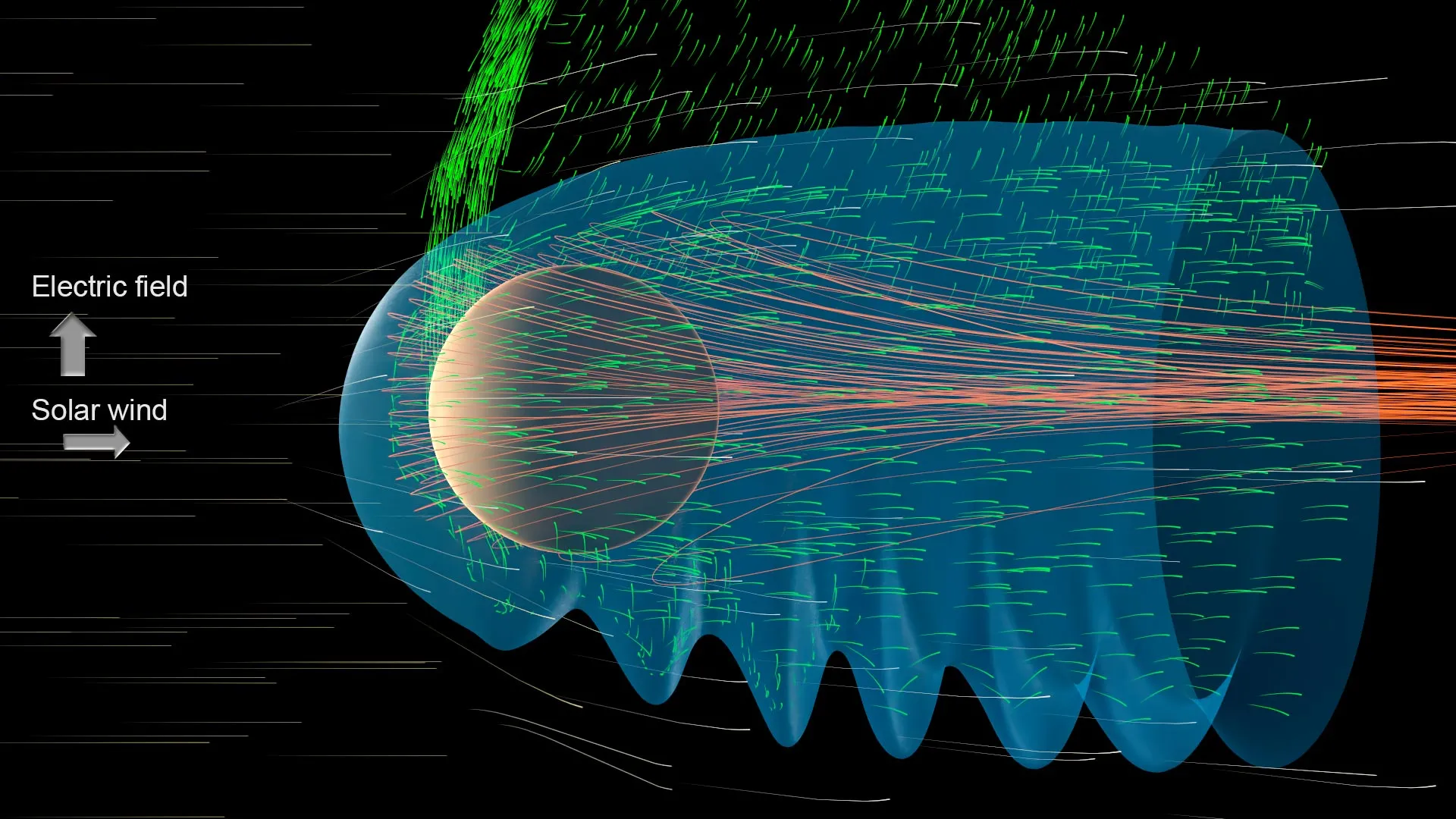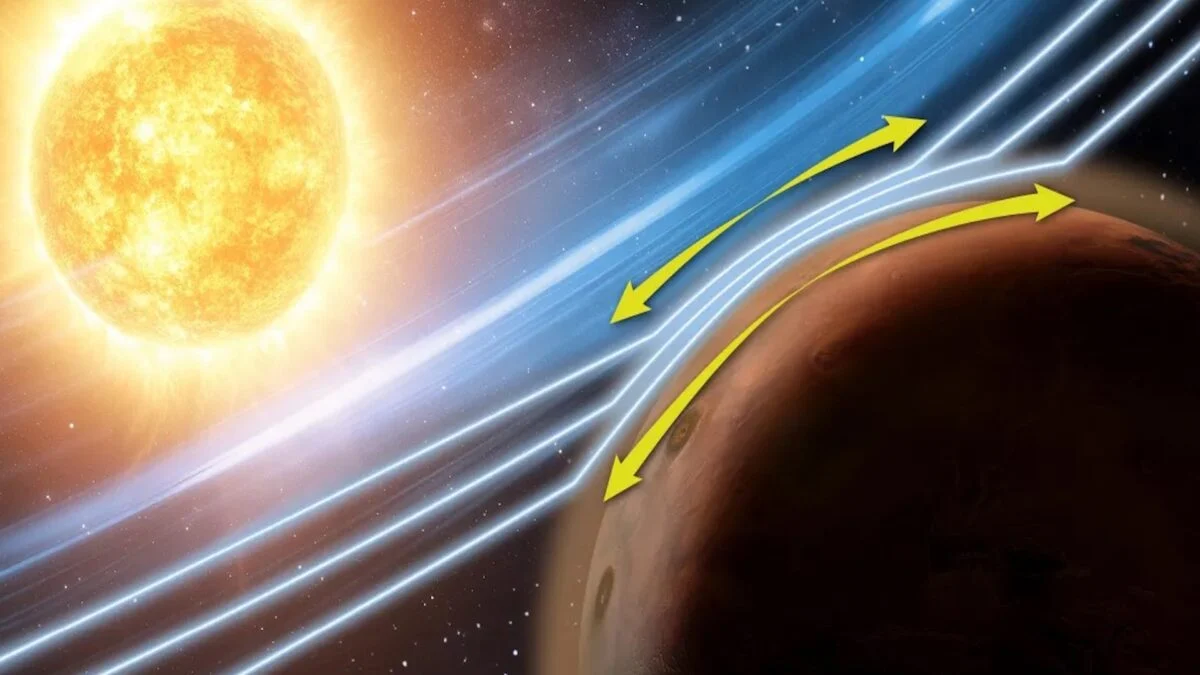
Although Mars is a frigid and hostile world today, the Red Planet may have once been capable of hosting some form of life. Unlike Earth, Mars lacks a strong magnetic field to protect it against incoming solar wind. As a result, the Sun’s stream of charged particles may have gradually stripped Mars of its atmosphere similar to how wind blows across the surface of water, according to a new study. In a new paper published in Science Advances, researchers describe how solar wind on Mars can stir the edges of the planet’s atmosphere, creating giant, rippling waves that carry its atmospheric particles into space. The new findings provide new clues as to how Mars lost its atmosphere, and how the same process could cause other planets to evolve over time. Riding the wave The Sun releases a constant outflow of charged particles in the form of solar wind, which directly interact with Mars’ atmosphere. Previous research has shown that large clouds of plasma in Mars’ upper atmosphere are the main culprit behind the bulk escape of atmospheric ions to space, but scientists have not been able to track down their origin.
“Mars is thought to have once been potentially habitable, with a thicker atmosphere and surface liquid water. Understanding how it became the cold, dry planet we see today is important for understanding how planetary environments evolve over time,” Chi Zhang, a research scientist at Boston University’s Center for Space Physics and lead author of the new study, said in a statement.