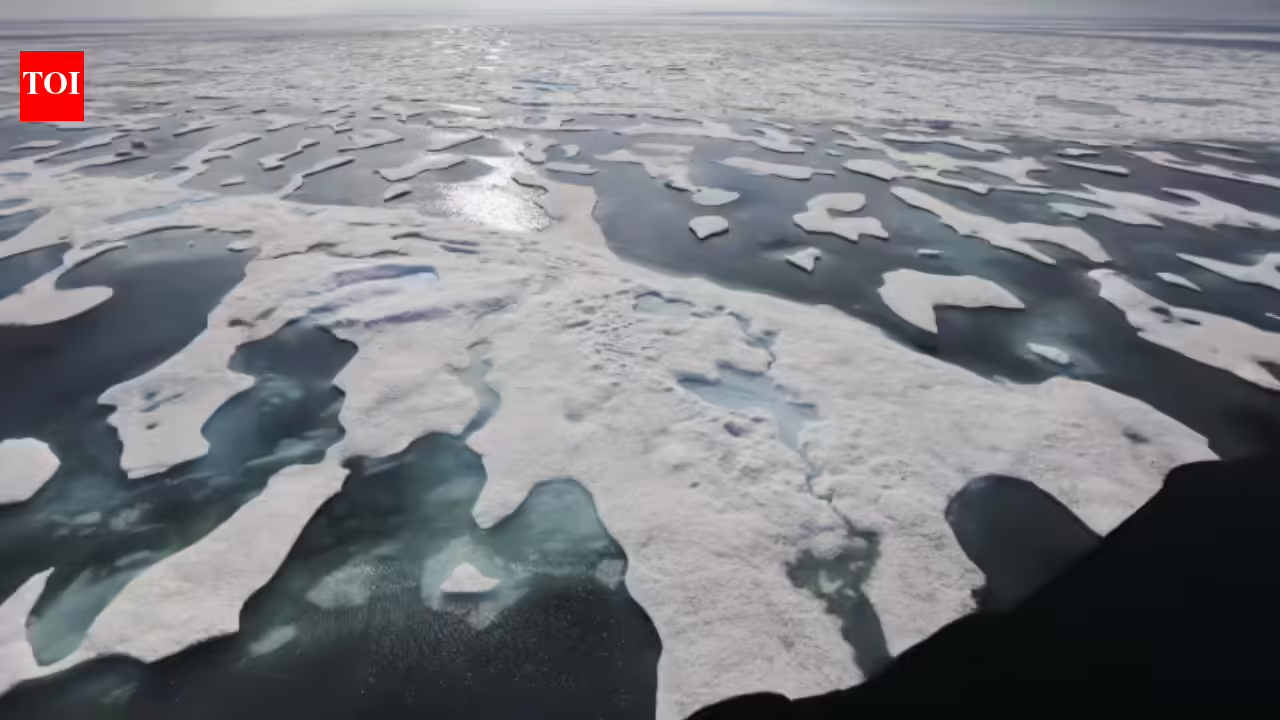
In 2018, a US engineer proposed spreading glass beads across Arctic ice to slow its melting. Scientists later warned the plan could warm it. Image Credits: Wikimedia Commons.The idea was deceptively simple: spread tiny glass beads across Arctic sea ice so their reflective surface could send more sunlight back into space. By making the ice brighter, proponents hoped to reduce the solar energy absorbed at the surface and slow the seasonal loss of sea ice.According to the study published in Earth's Future, in 2018, US electrical engineer Leslie Field and colleagues proposed just such an approach, known as surface albedo modification. Their idea involved spreading hollow glass microspheres, each only tens of micrometres across, over selected areas of young Arctic sea ice. The material was designed to float and reflect sunlight, much like a fresh layer of snow. However, the idea carried an important uncertainty. The effect of the beads would depend on how they interact with the changing Arctic surface and how much sunlight they absorb. Under some conditions, instead of increasing reflectivity, the material could absorb additional solar energy and contribute to warming.The idea was to make the Arctic brighterArctic sea ice naturally acts as a giant reflector. Its bright surface sends a significant portion of incoming sunlight back towards space. When ice melts, the darker ocean underneath is exposed and absorbs much more solar energy. That additional heat can promote further melting, creating what scientists call the ice-albedo feedback.Field's proposal attempted to intervene in this process by keeping the surface reflective for longer. The proposed material was made of hollow glass microspheres, essentially tiny, lightweight silica spheres that can float on water. The 2018 study described experiments using commercially available glass microspheres on ice and snow, including tests in Minnesota and Alaska. The researchers argued that applying the material to young, relatively dark ice could increase its reflectivity and reduce the amount of solar energy absorbed by the surface.It was not about covering the entire Arctic with a literal layer of glass. The plan was to deploy the microspheres selectively in key regions such as the Fram Strait and Beaufort Gyre. The goal was to give young ice sufficient time to survive the summer period and turn into old ice, which would be highly reflective by nature.The study published in Earth's Future also states that climate modelling suggested that increasing sea-ice reflectivity could substantially increase ice thickness and concentration in some parts of the Arctic. The researchers presented the technique as a possible temporary climate intervention, rather than a replacement for reducing greenhouse gas emissions. Yet the proposal depended on an important assumption: that the glass beads would make the surfaces they landed on brighter overall.Scientists found a problem with the sunlightAccording to research published in The Cryosphere, Arctic sea ice is not a uniform reflective surface. Its ability to reflect sunlight changes throughout the melt season as snow cover disappears and melt ponds develop on the ice. These ponds are darker than the surrounding snow and ice, reducing surface albedo and allowing more solar energy to be absorbed.The study also notes that the researchers used satellite observations from 2017 to 2023 to examine how melt ponds developed across the Arctic. They found substantial differences in pond coverage and development between regions and across the melt season. The study also shows that melt-pond formation is influenced by factors including air temperature and the physical characteristics of the sea-ice surface. The findings are important for understanding how sunlight interacts with Arctic sea ice. A surface that appears broadly white from above can contain a changing mixture of snow, bare ice and melt ponds, each with different reflective properties. As the melt season progresses, these changes can alter how much incoming solar energy is reflected and how much is absorbed by the ice and surrounding environment.The research does not examine glass microspheres or determine whether spreading them across Arctic sea ice would produce cooling or warming. Instead, it provides evidence for a broader point relevant to such proposals: the Arctic ice surface changes substantially during the melt season, so the effect of any attempt to alter its reflectivity would need to account for these changing surface conditions. Ice-albedo feedback. Image Credits: Wikimedia Commons.The debate over glass beads is still unresolvedThe question of whether reflective glass microspheres could meaningfully slow Arctic sea-ice loss is more complicated than simply making the surface brighter. Research using satellite observations has shown that melt ponds can substantially alter the reflectivity of sea ice during summer. Their coverage also changes across regions and through the melt season, meaning that the amount of sunlight absorbed by the ice is constantly changing.According to Atmospheric Measurement Techniques, observations from airborne imaging have reached a similar conclusion. As snow begins to melt, its mixture of ice, water and air changes the way the surface reflects sunlight. This makes the performance of any reflective coating difficult to predict in the real Arctic. A material placed on bright, snow-covered ice would interact with sunlight differently from the same material on bare ice or a melt pond. Wind and melting could also change where particles remain on the surface. The result could therefore vary with the location, season and condition of the ice rather than producing a uniform cooling effect.It also raises a broader question: can an intervention that changes one part of a complex climate system produce predictable results as conditions change? And even if such a technique were eventually shown to preserve some sea ice, it would not remove the greenhouse-gas emissions driving the underlying warming. It would address one effect of warming, not the cause.
In 2018, a US engineer proposed spreading glass beads across Arctic ice to slow its melting; scientists later warned the plan could warm it
The idea was deceptively simple: spread tiny glass beads across Arctic sea ice so their reflective surface could send more sunlight back into space. By making the ice brighter, proponents hoped to reduce the solar energy absorbed at the surface and slow the seasonal loss of sea ice.
936 words~4 min read