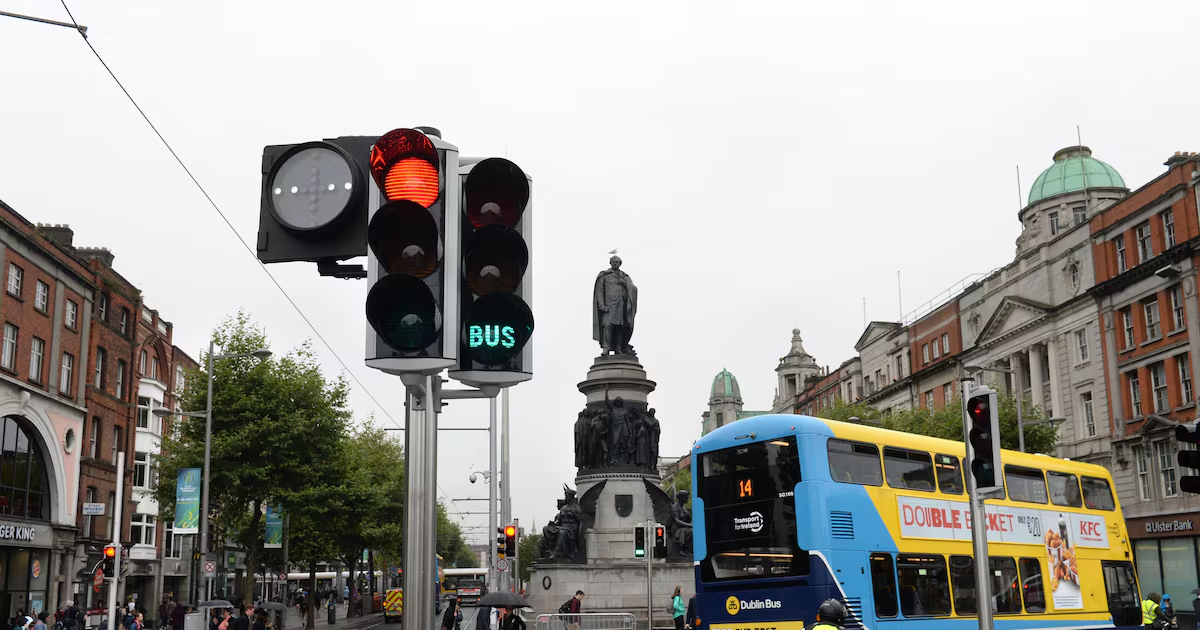
Nearly half a century ago, a prominent member of the south Dublin intellectual nexus was asked how he managed to conduct over many years a secret affair with his wife’s sister. He gave a two-word answer: “The Northside.” The explanation was as comprehensive as it was laconic. The northside is a different country – they do things differently there. And when it comes to the development (and non-development) of public transport, it still is. Dublin’s transport network is an everyday scandal. Ours is the only western European capital without a metro. We boast the third most congested city in Europe – Dublin drivers spend an annual average of 81 hours (10 working days) just sitting in traffic. Fares for public transport are among the most expensive of any big city in the world. Yerevan and Baku have metros. So do non-capital cities like Glasgow, Newcastle, Seville, Bilbao, Porto, Rotterdam, Brescia, Toulouse – and many more. But as the Dublin woman said while watching her son in a military parade: “They’re all out of step except my Johnny!” Everybody else has been doing it wrong – sure, why can’t they get the bus?To delve into the archive of announcements about public transport infrastructure in Dublin is to enter a tragicomic world of self-cancelling statements. Here, for example, are two headlines from the same day, April 30th, 1983. The Irish Times: “Tallaght-Heuston electrical rail link planned by CIE.” The Irish Independent: “Govt. may stall electric rail link.” That plan was for an electrified railway to run from the burgeoning suburbs of Tallaght, Killinarden and Clondalkin into the city centre. But the Indo’s anxiety was well placed. It quoted a spokesman for the Department of Transport as saying that it would be “premature to anticipate the Government’s decision on this proposal”. Premature ejaculations of delight have been the soundtrack of Dublin’s modern transport history.To understand what lies behind this abject failure of good governance, we might start with the image of a former taoiseach down on his knees near the side entrance to Trinity College, though not, as one might imagine, praying for forgiveness.According to The Irish Times in July 1997, “former taoiseach Garret FitzGerald was observed one dawn measuring the road at the corner of Nassau Street and Dawson Street”. FitzGerald later denied he ever did this, but the bizarre story was widely believed because he was, through his column in this paper, running a campaign against the planned Luas light rail system and was especially obsessed with the idea that trying to get trains around that corner would lead to disaster. He argued that “it would be indefensible to build a system which, within not much more than a decade, would effectively block public as well as private transport throughout the city at peak periods”.Of course, after delays caused in part by FitzGerald’s objections, the Luas was built. Passengers have managed more than 650 million trips on it so far and there have been no disasters on Nassau Street.[ ‘Incredibly dangerous’ but ‘the only way I can get to work’: what readers think of e-scootersOpens in new window ]But before the Luas, Dublin 4 also fought hard against the Dart. The Doheny & Nesbitt’s school of economics, representative of the UCD/ESRI/consultant firm nexus, was firmly against both Luas and Dart. In 1979, a working party including the most prominent transport economists Colm McCarthy and Seán Barrett “ruled out the proposed rapid transport system for Dublin on the grounds that such a system was not a good proposition for a city with such low population density”.It also decreed that the proposed electrification of the Howth-Bray rail line (which made the Dart system possible) should be abandoned and “that, instead, the existing diesel-operated system should be upgraded”. McCarthy and Barrett consistently argued that any rail-based project was a “Rolls-Royce option” that ought to dismissed in favour of more buses. No less a figure than Vincent Browne in his Magill magazine gave huge coverage to these views – Browne himself argued that “the £67 million electrification of the Howth-Bray railway line” was one of the follies that was setting Ireland on “the high road to disaster”.All of these objections were undoubtedly sincere. But those making them had two particular things in common. They were not known for their frequent use of public transport within the city. And they were not notably conversant with life beyond Drumcondra and Cabinteely. The northside and the westside – the places where the city was (and is) expanding – were other countries.For those people in Killinarden or Swords trying to get to work on a wet Tuesday morning, Dublin 4’s version of Marie Antoinette’s “let them eat cake” has always been “let them get the bus”. Who, after all, needs Rolls-Royce options for bus-type people? All of this is playing out again with the Metro – 26 years after it was first announced by the then government and 20 years after its first part (from Dublin Airport to the city centre) was supposed to be up and running. (The airport actually has a ghostly underground metro station built in the late 1960s when the planners imagined that it would surely not be long before it would be used.) The legion of the rearguard is again led from Dublin 4.“Too expensive” is the cry. But of course it’s too bloody expensive. This stuff always has been: “Rising Cost of Rapid Railway” screamed the Evening Herald headline in 1983, the shocking story underneath claiming that the entire Dublin Rapid Transit Plan might cost more than twice the projected cost of £220 million – amounting to about €2.2 billion in today’s money. We can but weep at the thought of how little that would have been and how the citizens of the city might have benefited in the meantime.Does anyone think the MetroLink is going to get cheaper if we don’t do it now? And can anyone explain why every other equivalent city in the developed world has failed to grasp the truth that all the plebs really need are more buses clogging up the roads so everyone can sit and savour the eternal wisdom of Dublin 4?
Fintan O'Toole: Dublin 4’s version of Marie Antoinette’s ‘let them eat cake’? Let them get the bus
The northside is a different country – especially when it comes to transport options
1,026 words~5 min read