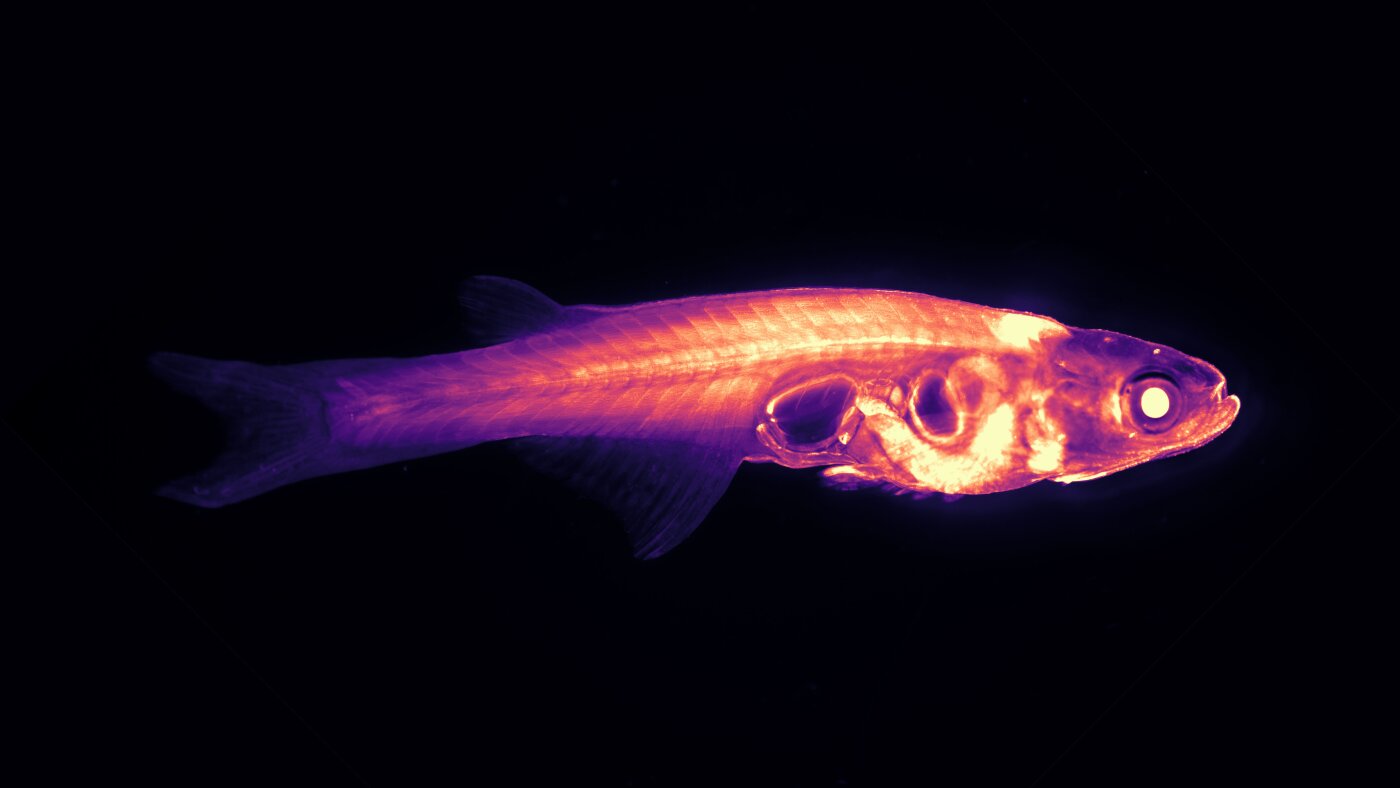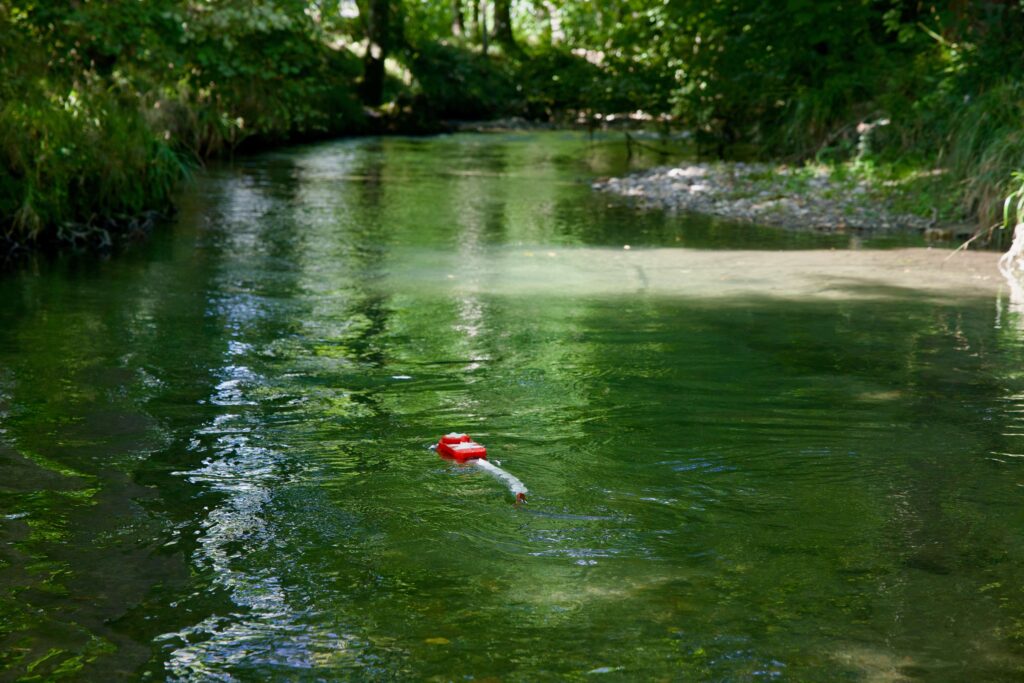
Image credit: Olivier Porchet, Biorobotics Laboratory, EPFL
When a fish holds its position against a current in a river, its brain must figure out how fast to swim and how to steer to offset the water flow. Most fish use vision to register the world sliding past, detect optic flow speed and direction, and their brains turn these signals into compensatory swimming. Neuroscientists call this stabilizing reflex the optomotor response (OMR), from neural activity imaging. The retina captures signals of optic-flow direction, central pretectal neurons interpret direction, and spinal nerves drive muscle contractions.
The catch is that one cannot easily change the living brain to test how these circuits work. Although advances in imaging now allow detailed recording, and even manipulation, of neurons alongside behavior, rewiring connections to ask what a particular link actually does remains almost impossible in the living, complex animal.
A joint team from EPFL (Switzerland), Duke University (USA), and the Instituto Superior Técnico (Portugal) took on this challenge by creating a realistic larval zebrafish simulation and a biomimetic robot, published in Science Robotics. The team found a way to replicate the body and known neural circuit architectures of live zebrafish, first as a physics-based simulation, then as a free-swimming robot that autonomously navigates upstream using vision and these bio-inspired neural circuits.