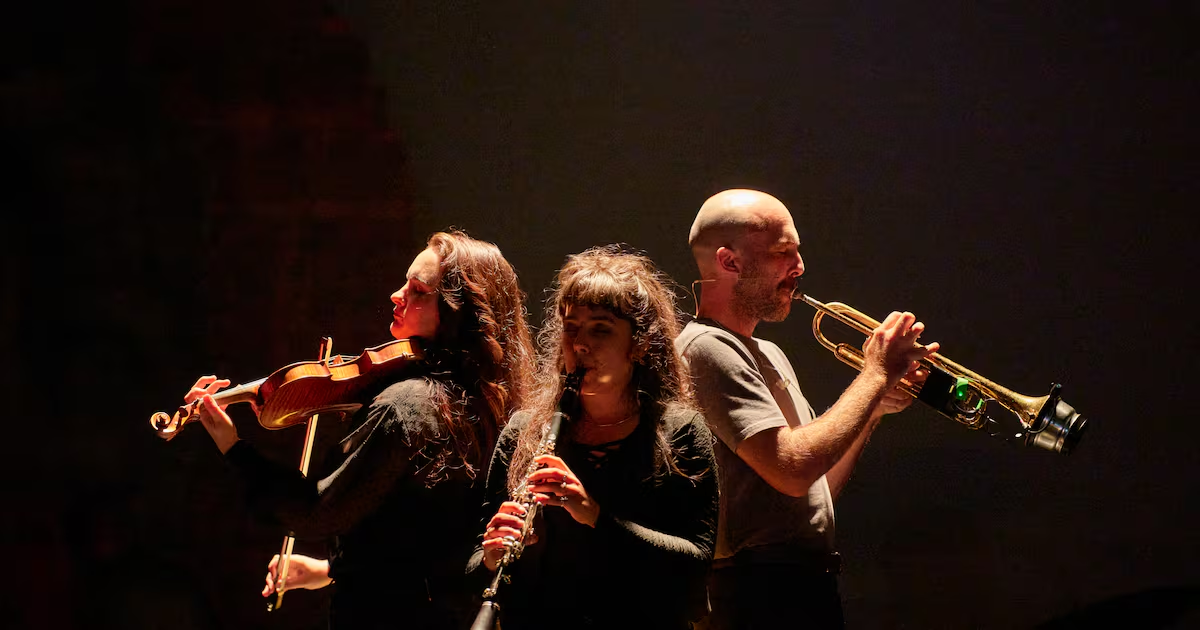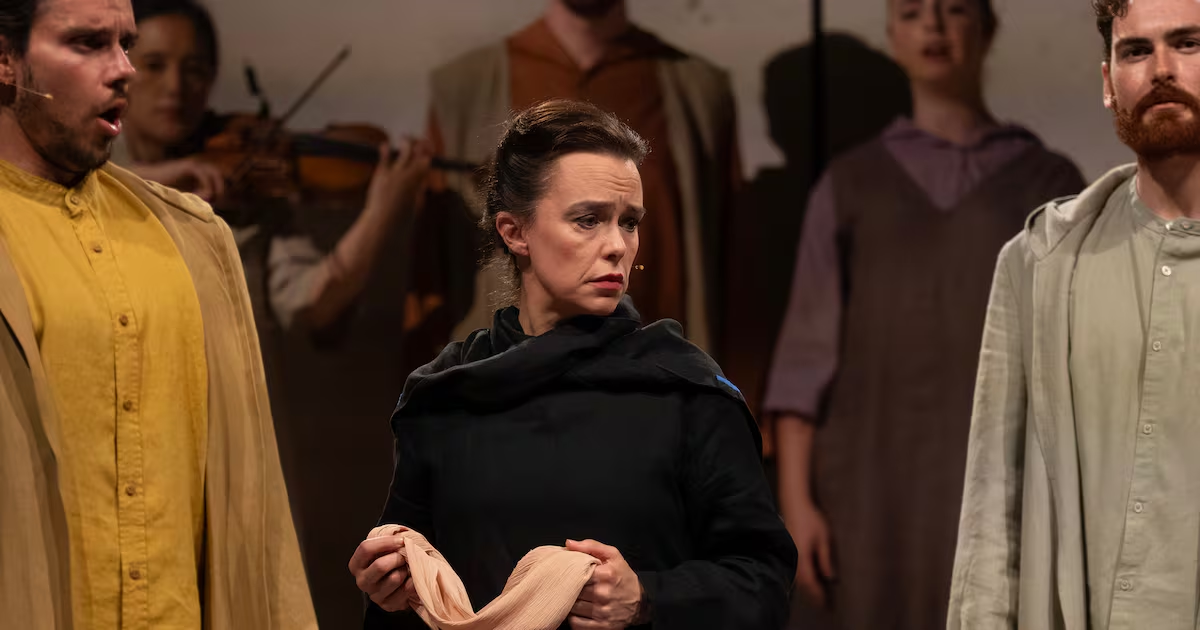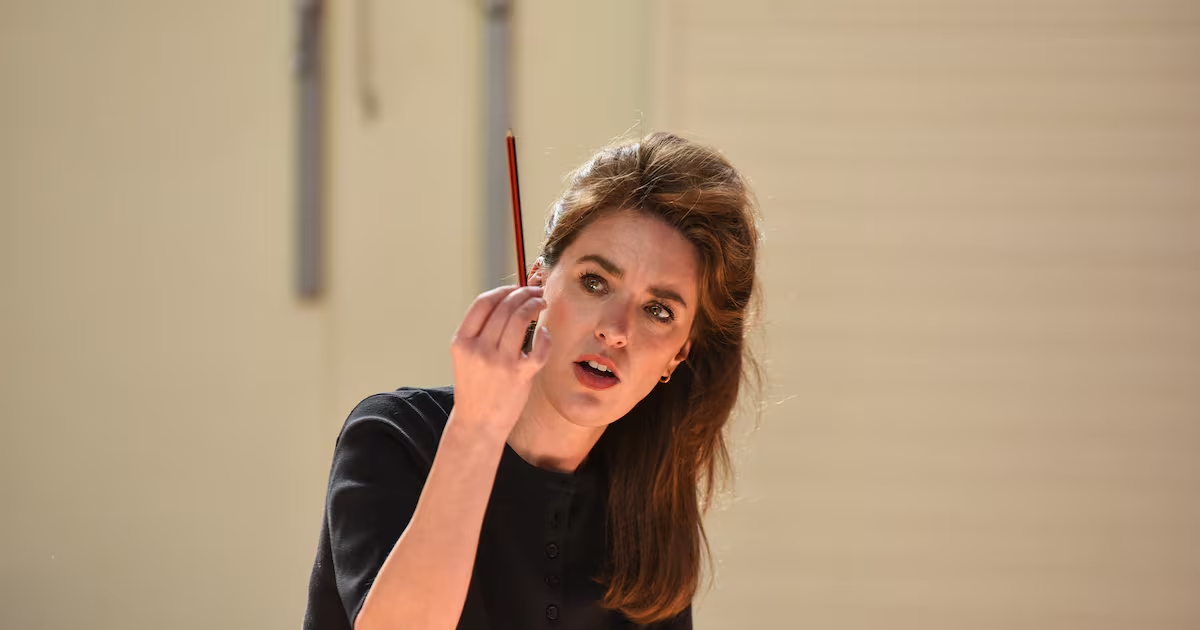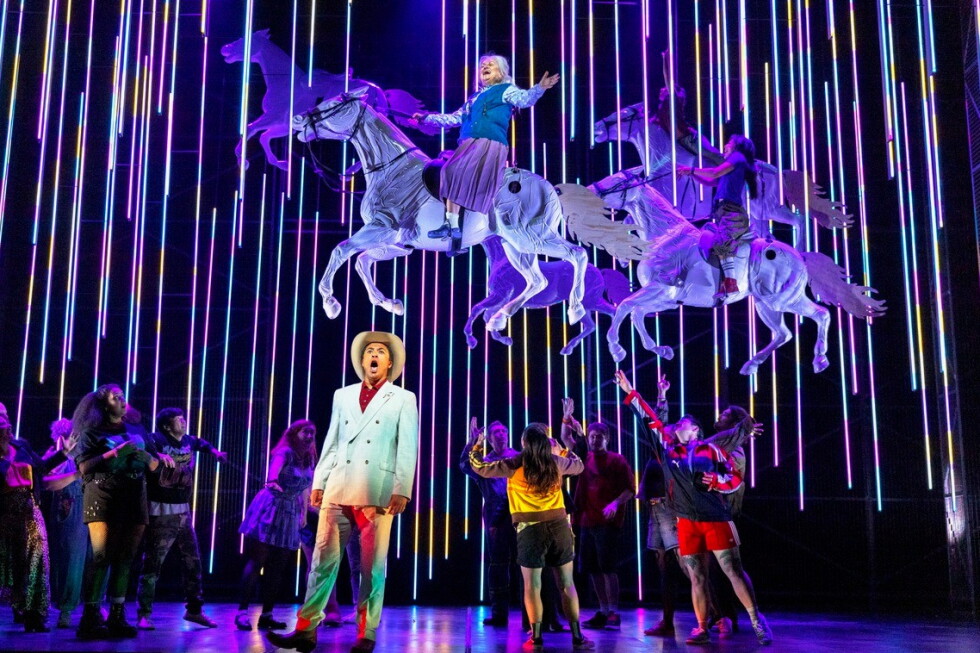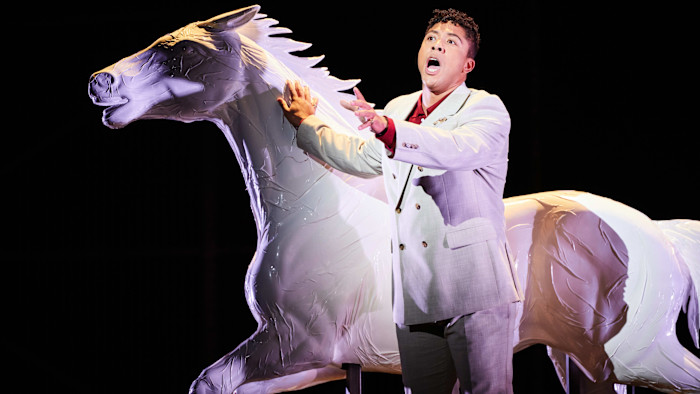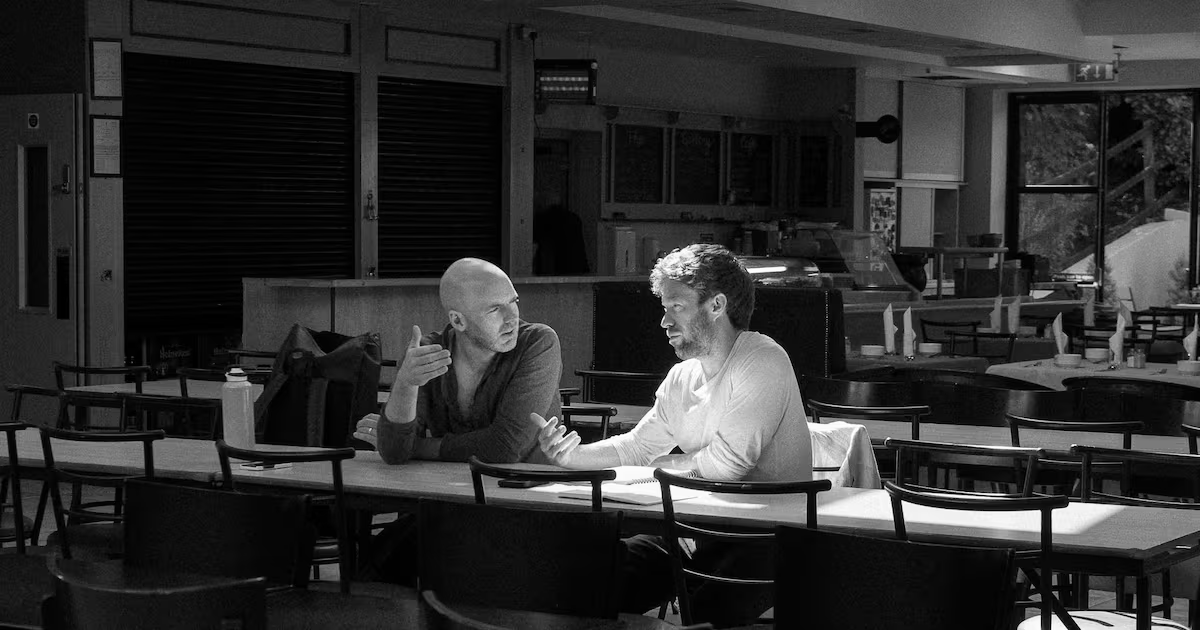
Michael Gallen knows how to choose intriguing and arresting subjects for his operas. The Monaghan composer’s first, Elsewhere, from 2021, was about the Monaghan Soviet, the first in Ireland. It was declared on January 29th, 1919, in Monaghan Lunatic Asylum (now St Davnet’s Hospital) under the leadership of the republican activist and writer Peadar O’Donnell. Its history gave Gallen a rich context not just of revolutionary activity but also of gender pay equality, mental-health care, and workers’ and patients’ rights. In 2026 Gallen is not the same person I spoke to about Elsewhere nearly five years ago. His three-year-old son makes sure of that. “It was a real learning curve for me in terms of going back to the process of making an opera. I sort of felt that I had it in my body from the previous one, you know, the amount of energy it would take. Add in a toddler to that mix, and you suddenly discover that you have much less in the tank than you would have anticipated.”He estimates that his second opera, The Curing Line, which premieres at Kilkenny Arts Festival shortly, took about six months longer than he had expected. The new work is about “the world of folk cures and that type of faith healing that isn’t about an exceptional character imbued with superhuman talents.” His interest is more in “the generation-to-generation idea of a person being able to cure one thing. It’s quite common around the Border region still. When I was growing up, people would have gone for cures for warts or ringworm, and it was all very normal.”But the most striking encounter he had with cures was when his father contracted shingles in the middle of chemotherapy for lymphoma. “We were told about this woman who had a shingles cure. He had to go to her three days in a row, and we had to bring a live rooster with us. She pricked the crown of the rooster and used its blood mixed with her own saliva and created a poultice, to put on the shingles. And by the third day the shingles had completely faded.” His father is still with us, “a hale and hearty 84-year-old”, and Gallen’s fascination with cures has been on fire ever since.“It felt to me,” Gallen says, “like we had encountered maybe the shattered pieces of a much older ritual, transmitted just generation to generation, but quite elaborate. And it has ended up with a disparate group of people who have inherited the cures.“I decided that it would be interesting to go around my home region, around Monaghan and Cavan and south Armagh, and interview people who had inherited the cures. They were mostly elderly. A sort of tapestry of people opened up in front of me, because I got passed on from person to person.”The Curing Line: the singers Amy Ní Fhearraigh and Sarah Shine during rehearsals. Photograph: Elektra Thomson There was, he says, “a reticence about talking about what the cure was. But also a reverence for what the thing is and for its lineage, and a fear about being the last in the line. They would say, ‘Well, my own children are not interested in taking it on,’ or, ‘Some of the cures involved never having seen your birth father, so you know ...’”The birth father issue was crucial. “In the age of industrial schools and mother-and-baby homes there was much more of a sense of, ‘There’s a person I’ve met who might be open to taking this on after me, when I don’t have the energy for it any more.’ “But most of the people said that they hadn’t located anybody for it. Some of the cures are passed from generation to generation in one family, generally from male to female to male. But some, like the capacity to have the cure for thrush, have this prerequisite of a person who has never seen their biological father.” So a lot of healers “are people who have had the experience of being in institutions outside the centre of society. The main character in the opera, Cora, is in a similar circumstance to that. She is fostered into a family where the father has a cure for breathing illnesses. “She’s brought into the family because there’s a daughter of the same age. The mother has passed away, and the father thinks it would be a good idea to foster a girl as company for his daughter. The two girls become extremely close, and when the father is about to pass away he passes the cure to the foster daughter.”[ Colin Dunne: ‘I don’t want to call it a show. I don’t even want to call it a work’Opens in new window ]The Curing Line focuses on the period before and after the father’s death. “It’s about someone inheriting a cure, feeling the weight of it, without any disposition towards care. We see her as a clenched fist, somebody who’s mainly misanthropic. It’s about the tension and the pressure that that puts on the relationship, and then on the character, and then on the cure itself.”For Gallen the opera is “an interesting way to examine the idea of extinction or cultural extinction through the prism of this indigenous folk practice. It evolved into the idea of writing an opera where a healer was the central character. And it has grown from there.”His research on healing has been deep. In tandem with the librettist Annemarie Ní Churreáin and the animation director and designer Ross Stewart, he seems to have done enough interviews with healers to make a documentary of some kind. Though that’s not something he shows any interest in. “The lovely thing about being an artist,” he says, “or being a composer or a writer, is that you get to reveal the thing in its mystery. It’s about being able to bring the ineffable into presence, and to leave it as the ineffable. That’s a massive strength that theatre and music have.” He describes his work process as “a gradual and intuitive one ... a slow process of diverse creative practices coming into constellation and eventually becoming a coherent artistic vision.” The Curing Line, which Gallen is directing with Shawn Fitzgerald Ahern, got to be called an opera “because the opera division of the Arts Council is the one which most corresponds with and is most likely to support this way of working”.As a composer, music-lover and listener, he says, “there are canonical works of opera that have completely bowled me over. However, as a theatremaker whose primary language is music, I most often find that productions of opera do not do the things that I most want my own work to do, in terms of the immediate and transformative potential of the live encounter.”The Curing Line: Caimin Gilmore on double bass and musical director Clara Baget during rehearsals. Photograph: Elektra Thomson In live performance the work he is most drawn to “tends to come from contemporary dance and theatre, and very rarely opera”, and he sees his own company, Straymaker, as being “more akin to companies that are led by a choreographer or director”.Musically, he says, “I draw on everything around me – diverse forms of contemporary music, traditional, classical or early music, rhythms of prayer, everyday sounds – and I am particularly connected with the Irish-language song and poetic tradition and its capacity to mine unfathomable depths through the interaction between word and music.”The father’s cure is in the Irish language, and he passes it “to this girl who doesn’t have Irish, and is trying to create her own version of it, or to translate it. Sometimes, when thinking of what we might have lost in our own culture through not speaking the language, the violence of being torn away from things that were a part of our culture for hundreds of years, you can feel like you’re looking back over an abyss.“The question is, is it ever possible to truly reconnect with a thing like a language once you’ve been separated from it?”He adds, “In Ireland, that’s maybe an important question that isn’t being asked enough. ‘What do we leave behind when we become modern and European and developed?’”The Curing Line is at the Watergate Theatre, as part of Kilkenny Arts Festival, on Thursday, August 6th, Saturday, August 8th, and Sunday, August 9th, with a preview on Wednesday, August 5th. The festival runs from Thursday, August 6th, to Sunday, August 16th
‘We had to bring a live rooster to the healer. She used its blood to make a poultice’
Kilkenny Arts Festival 2026: The Curing Line, Michael Gallen’s new opera, has grown out of his study of Irish folk cures
1,411 words~6 min read