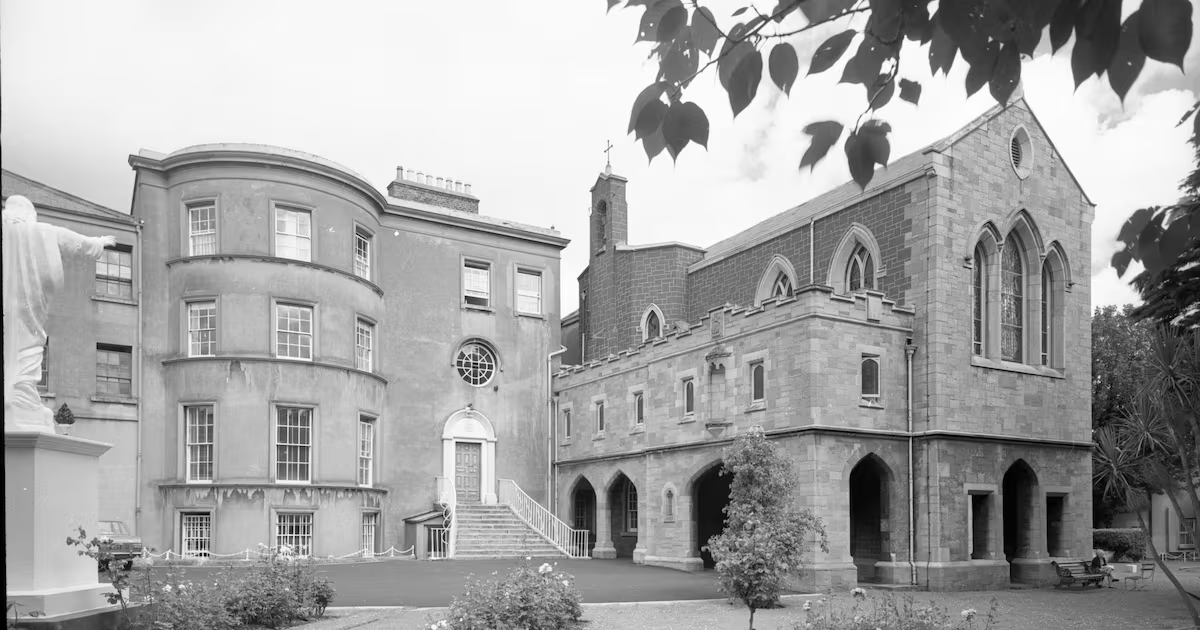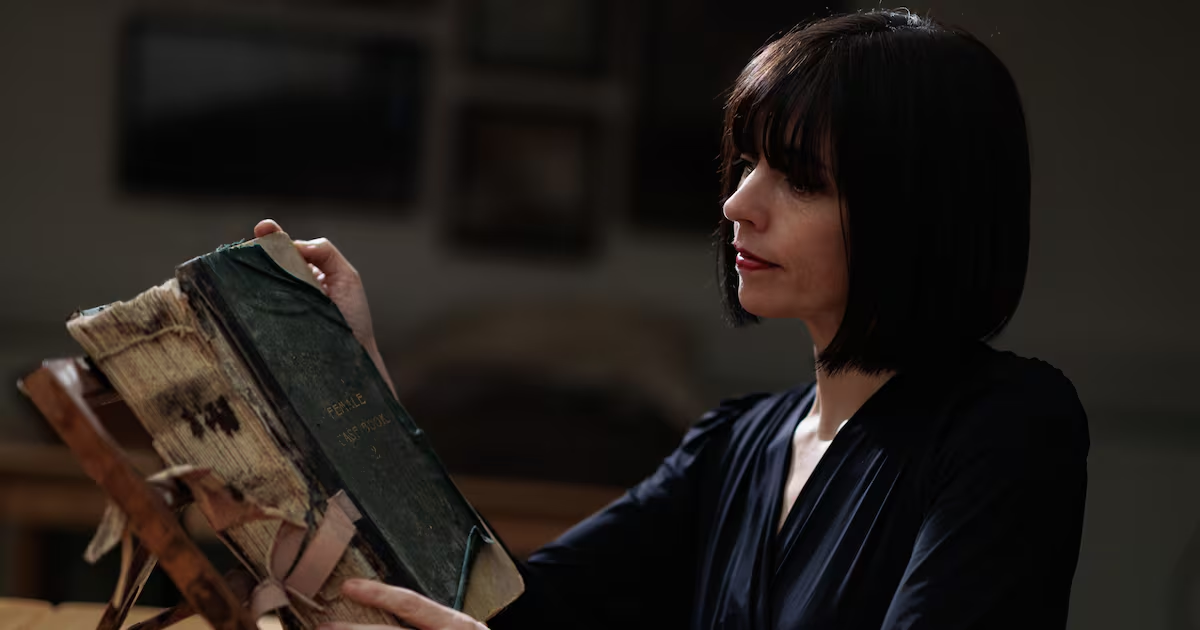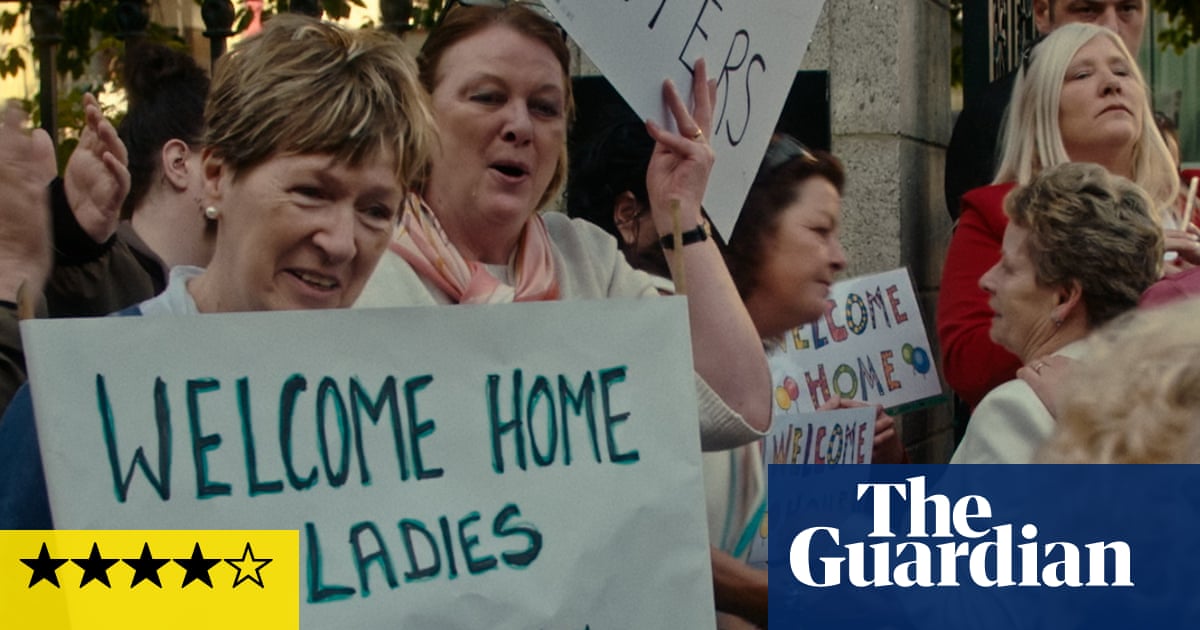
Deirdre Brenner’s Magdalene Songs project had a slow gestation. It all began in the early days of the Covid pandemic, when the Irish-American pianist read an article that triggered her memory about the Magdalene laundries. “I went down this rabbit hole, because I knew about them, and I really needed to know more and understand how these institutions could exist,” she says. “Then I suddenly thought, ‘Okay, is there a musical response to this story?’”For a long time she mulled over possible musical approaches to religious orders’ brutal and exploitative incarceration of more than 10,000 women and girls in locations around Ireland between 1922 and 1996.“The subject is so raw, and to approach this kind of material one needs a lot of sensitivity. There wasn’t a clear avenue initially. Then I found the organisation Justice for Magdalenes Research, which has done such tremendous work on behalf of all the survivors. I found their oral histories, which are really, really harrowing. It’s a lot. You can read one and then you need a break for a few days.”Brenner’s career has been focused on working with singers and in chamber music. “Song is this very special art form. I just wondered if we could find a way to turn them into songs. I thought, rather than dilute stories in a summary form by someone else, is there a way to take these women’s stories and put them into song in a way that makes sense?“So often these women weren’t actually listened to. The responses from the government or from the church didn’t take their words into account or didn’t take them seriously enough. The only way to be respectful would be to set their words [to music].”Next she had to find the people to write the songs, but she couldn’t identify any obvious composers. So, “in the weird blessing of Covid, I just spent a lot of time on the Contemporary Music Centre’s website. I went through all the female composers in Ireland that are listed there. I was on YouTube and SoundCloud and Spotify, everywhere I could find recordings, to get a sense of style.” Brenner’s original idea was to go for a song cycle by a single composer. But that idea morphed into a portmanteau project, on the lines of the violin sonata written for the great 19th-century violinist and composer Joseph Joachim by Johannes Brahms, Robert Schumann and Albert Dietrich, or the 1869 Messa per Rossini initiated by Verdi, with contributions from 13 Italian composers.The Magdalene Songs have been performed by the mezzo-sopranos Naomi Louisa O’Connell, at the Boyne Music Festival (which Brenner founded with her cousins Aisling and Julie-Anne Manning in 2013), and Lotte Betts-Dean, at the West Cork Chamber Music Festival and the Oxford International Song Festival. Brenner still sees the project as malleable. “After the initial performance, it felt like there was a lot more opportunity for the storytelling, and also for the performance setting. I’ve been curious about how much of these stories a listener can and would want to receive. Like, 10, 15 minutes? Sure. Can you do 45 minutes? Can you do an hour? What feels like the right amount to make an impact in a performance space?”She has considered other options. “We could have a larger collection of songs, and either I or other performers could, in their own programmes, take a few and perform them, also sharing part of this collective story.”She sings the praises of Francis Humphrys, director of the West Cork Chamber Music Festival. Early on, she says, she sought his advice about where she might get funding to commission songs. “And he said, ‘Well, I’ll commission songs.’ We didn’t know each other as well at that point. But that’s been really wonderful, because he commissioned a third of the initial songs, and now he’s commissioned Deirdre McKay to write another song for the upcoming performance at the festival.”Like everyone involved, McKay was impressed by the sensitivity of Brenner’s approach. “She really wanted to hold the women at the centre of what was created.” But “reading the archival testimonies was a tough experience, to the point that I had to keep taking breaks. I found it so tough. I felt entering a project like this you’re walking on eggshells. You are dealing with the lived experience of real people who have shared their experience in trust. There are more ways to go wrong than to get it right.”#Magdalene Songs: Deirdre McKay. Photograph: Rory Moore McKay’s first song, Litany to the Magdalene Dead, stands out as the only one not to be named after a woman who gave testimony. It is exactly what it says, a striking litany of 72 names and dates from tombstones with the location, all intoned on a single note, and with the names ordered to give an acrostic in the middle, Dolorem. Her new song, Margaret Burke, has its subject recording the experience of leaving the laundry in Galway, seeing “the beautiful yellow daffodils in Eyre Square” and saying, “I felt for the first time, being alive.”Elaine Brennan got to know Brenner when both of them were based in Vienna. The “bread and butter” of Brennan’s career is improvising accompaniments to screenings of silent films, and she jumped at the opportunity to write some songs. Magdalene Songs: Elaine Brennan. Photograph: Michael Mortlock “As an Irish person I had nuns all the way up, and I grew up in Ballyjamesduff, the Border badlands. Brendan Smyth” – the paedophile priest – “was literally five kilometres out the road. I didn’t labour too much over the actual music. What I laboured over was finding three little pieces of text that highlight the absolute pain and suffering that these women have to had to continue living with. They got no help.”The composer Rhona Clarke says, “I went to secondary school in Maryfield, Glasnevin, and right beside that was High Park. I didn’t know what High Park was. I thought it was an orphanage.” She shudders at the thought of having been so close to a Magdalene laundry and says she was shocked by the degree of suffering that the women and girls had endured, “often for almost their whole life”. She refers to the profound effect of one particular line, “I want to make what I have left to be happy.” Magdalene Songs: Rhona Clarke. Photograph: Marshall Light Studio As she began working, she says, “the amount of text became shorter and shorter. Musically, for me, it’s best to get across a single idea rather than putting too many things in.”Elaine Agnew nearly missed the boat, after an email went astray. “I didn’t hesitate in the slightest. I had no idea that there would be so much material. Some of the interviews are maybe 50, 60 pages of script. It’s very harrowing, very distressing. I found it very, very difficult to even work out in my head how would I approach it.”Magdalene Songs: Elaine Agnew. Photograph: Carrie Davenport She talks of the testimony of Mary, who loves Ireland but says, “I wouldn’t live in it, I’ll never live in it, it’s just the place of my birth,” and also, “These nuns, they’re not my sisters, the priests are not my fathers, and the reverend mothers are not my mother.” The Oxford concert started with Agnew’s Philomena. She says, “I think it was just at that moment that I realised, this is so impactful, what’s happening is actually incredibly remarkable. I’m sitting there with a full audience, and it was as if for the whole 50 minutes everybody held their breath.”Lotte Betts-Dean’s involvement with the project was sheer accident. She was contacted in 2024 when Covid struck Fleur Barron, who was to give a Magdalene Songs concert at the West Cork festival. “Luckily, I had a few days free. And though I was a bit under the weather myself I didn’t have Covid and I was able to at least get there and do it. In the course of those few days, it really hit me how valuable this project was and the legacy that it is capturing and paying tribute to.” Magdalene Songs: Lotte Betts-Dean. Photograph: Matthew Johnson She talks of it as “incredibly moving”, even in what she calls “this kind of fever-dream, stressed, jumping-in situation. I realised at that point that what we were doing on stage was greater than the sum of its parts and that this was a project that I would want to carry on with, if Deirdre would have me.”Brenner says, “All the composers have been really wonderful to work with. I feel like I’ve gained understanding of what these women went through. Now, in 2026, in my personal career, I’ve dealt with a lot of issues of gender in this field. But they’re nothing in comparison to what women of my mom’s generation went through.”One of her strongest wishes is “to find a way to perform these songs for some of the survivors who are interested. I’ve had some conversations about that, and we haven’t managed to make it happen yet. I hope very much to do that in the next year or two. Just to kind of connect and meet some of these women whose stories I’ve been relating to for years.”The Magdalene Songs concert is at Bantry House at 10.30pm on Saturday, July 4th, the final day of the West Cork Chamber Music Festival. The festival begins on Friday, June 26th
Magdalene Songs: ‘The oral histories are harrowing. You read one and then need a break for a few days’
West Cork Chamber Music Festival 2026 features Deirdre Brenner’s tribute to the victims of the Magdalene laundries
1,571 words~7 min read