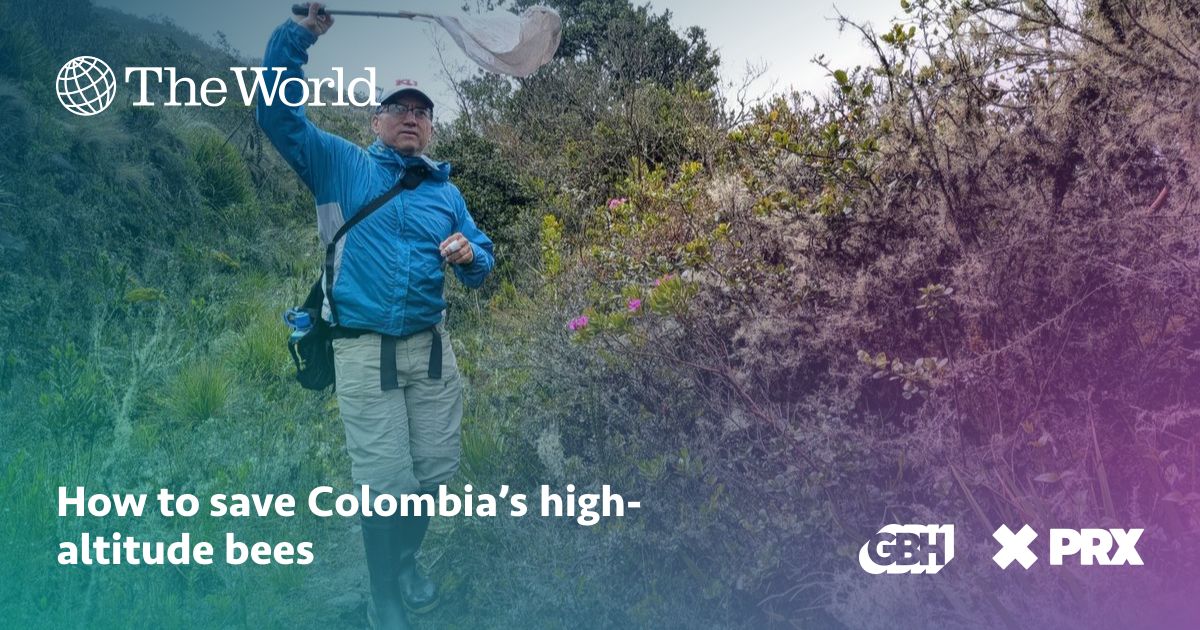
Public radio’s longest-running daily global news program.AboutContactDonateMeet the TeamPrivacyTerms of use©2026 The World from PRXPRX is a 501(c)(3) organization recognized by the IRS: #263347402.How to save Colombia’s high-altitude beesVictor Gonzalez grew up watching clear rivers flow through the forests of his rural Colombian hometown. But when this bee biologist at the University of Kansas returns home for visits these days, the mood is somber. Natalie Skowlund reports on Gonzalez’s efforts to prevent the extinction of pollinators. EnvironmentJuly 30, 2026Updated: July 30, 20266:39The University of Kansas bee researcher Victor Gonzalez waves a net above his head to catch a bee at a páramo outside of Cogua, Colombia, on Wednesday, July 15, 2026. Gonzalez and his team managed to catch a few bees on the excursion, but only one specimen of the Bombus funebris bumblebees they had hoped to find.It was a brutally cold and windy July morning at almost 12,000 feet up in the Andes as University of Kansas bee researcher Victor Gonzalez and a couple of students walked toward what looks like a shrubby moonscape.Alex Kurtt, a doctoral student studying bees at the University of Wyoming, leads the way along a trail through a páramo outside of Cogua, Colombia, on Wednesday, July 15, 2026. Amid sleet and high winds, this team of three forged ahead in pursuit of a unique high-altitude bumblebee called Bombus funebris. Natalie Skowlund/The WorldGonzalez’s team was in his home country of Colombia to learn more about bees all around the country. They were a few hours north of the country’s capital, Bogotá, visiting an endangered high-elevation wetland ecosystem called a páramo on the hunt for a unique bee species: Bombus funebris.Bombus funebris pollinates the frailejón, a plant native to the páramos. The frailejón absorbs moisture from high-elevation fog and gradually releases the water into the soil, rivers and aqueducts.A flowering frailejón plant in a páramo near Cogua, Colombia, on Wednesday, July 15, 2026. The frailejón is a key plant in páramo ecosystems that helps absorb moisture from the atmosphere and gradually convert it into liquid water.Natalie Skowlund/The WorldIt plays an essential role in maintaining water supplies for the entire country. In fact, an estimated 85% of water used for human consumption, irrigation and to generate electricity in Colombia originates in the páramos.“All these high-elevation ecosystems in Colombia are reservoirs for water,” Gonzalez said.The Bombus funebris species is extra hairy to cope with the colder temperatures in high-mountain paramos — but it’s also more than just a fuzzy, buzzing insect. This bumblebee plays an important role in ensuring the survival of biomes like the páramos.Student researchers Adi Beniluz and Alex Kurtt hunt for bees in a patch of frailejón plants at a páramo near Cogua, Colombia, on Wednesday, July 15, 2026. The Bombus funebris bee they are searching for pollinates the frailejón.Natalie Skowlund/The World“The bees are pollinating these plants. The plants are maintaining the whole ecosystem,” Gonzalez said. Colombia’s páramos are threatened because of climate change and agricultural expansion. For instance, as temperatures warm, potato farmers have to move higher up to grow their crops. As a result, the bees and the frailejón plants they pollinate face a diminishing habitat. It could be only a matter of time before they’re gone for good, putting at risk a principal water supply in a country already facing a major risk of drought. “There are records of these species in Bogotá and surrounding areas a long time ago, 40-50 years ago. Now, they are no longer there,” Gonzalez said. “What we’re seeing is the extinction of the local population, basically.”Researchers know a fair amount about the bees that buzz around North America and Europe, but not much about those that prefer more tropical climates, like Colombia. That’s true even though higher proportions of plants in tropical regions depend on pollination than those in more temperate climates. “The animals here and plants are behaving differently from what you are expecting,” Gonzalez said. “Every location, every species is different.”The University of Kansas bee researcher Victor Gonzalez helps Brown University student Adi Beniluz after she caught a bee near Cogua, Colombia, on Wednesday, July 15, 2026. Beniluz said this was her first time working closely with bees as a college student. Natalie Skowlund/The WorldThe better scientists understand these bees, the more likely they are to develop conservation plans and sustainable agricultural solutions for the future. Gonzalez has made it his mission to bring budding American scientists to the bees. With a grant from the National Science Foundation, a handful of students from universities across the US are studying Colombian bees alongside Gonzalez this summer. Over the course of a couple of months, students learn about bees through field research in different Colombian ecosystems, from tropical dry forests to high-altitude wetlands. In the process, they learn how to identify different bee species, the plants they pollinate and how to successfully catch specimens in the field. Adi Beniluz totes her net as she searches for bees in a patch of frailejón plants at a páramo near Cogua, Colombia, on Wednesday, July 15, 2026. Catching bees with a net requires a specific technique, with methods on how to wave the net overhead and funnel the bees into a vial once caught. Natalie Skowlund/The WorldAlex Kurtt, a doctoral student at the University of Wyoming working alongside Gonzalez, said bees generally aren’t all that tricky to catch.“By the nest, they need to defend from intruders and stuff. But then, out-and-about, they’re just focused on, ‘I only want food,’” Kurtt said. “A lot of the time you can just poke them and nothing happens because they just kind of are on a mission.” Adi Beniluz, a rising junior at Brown University, held up a net to demonstrate a proper bee-catching technique. Beniluz waved her net through the air and explains how to funnel a bee from the net into a vial. She insisted that it’s a relatively low-risk endeavor.“They won’t really sting you unless you squish them or something like that,” Beniluz said. Back on the hunt for bees in the páramo, hours had passed with no luck in the field. The high-altitude bumblebee Bombus funebris was nowhere to be found.Just as Gonzalez’s team prepared to wrap up and head out, the black-and-white, bumbling Bombus funebris finally appeared, foraging on a frailejón. Alex Kurtt scooped it up in his net.Alex Kurtt holds up his net after catching a Bombus funebris bumblebee at a páramo outside of Cogua, Colombia, on Wednesday, July 15, 2026. Kurtt said the Bombus funebris bee he caught was the fourth new species of bumblebee he found while in Colombia. Natalie Skowlund/The World“Oh man, I’m so excited,” Kurtt said. “This is my fourth new bumble species here.”For now, this team takes things one bee at a time.
How to save Colombia’s high-altitude bees - The World from PRX
Victor Gonzalez grew up watching clear rivers flow through the forests of his rural Colombian hometown. But when this bee biologist at the University of Kansas returns home for visits these days, the mood is somber. Natalie Skowlund reports on Gonzalez's efforts to prevent the extinction of pollinators.
1,121 words~5 min read