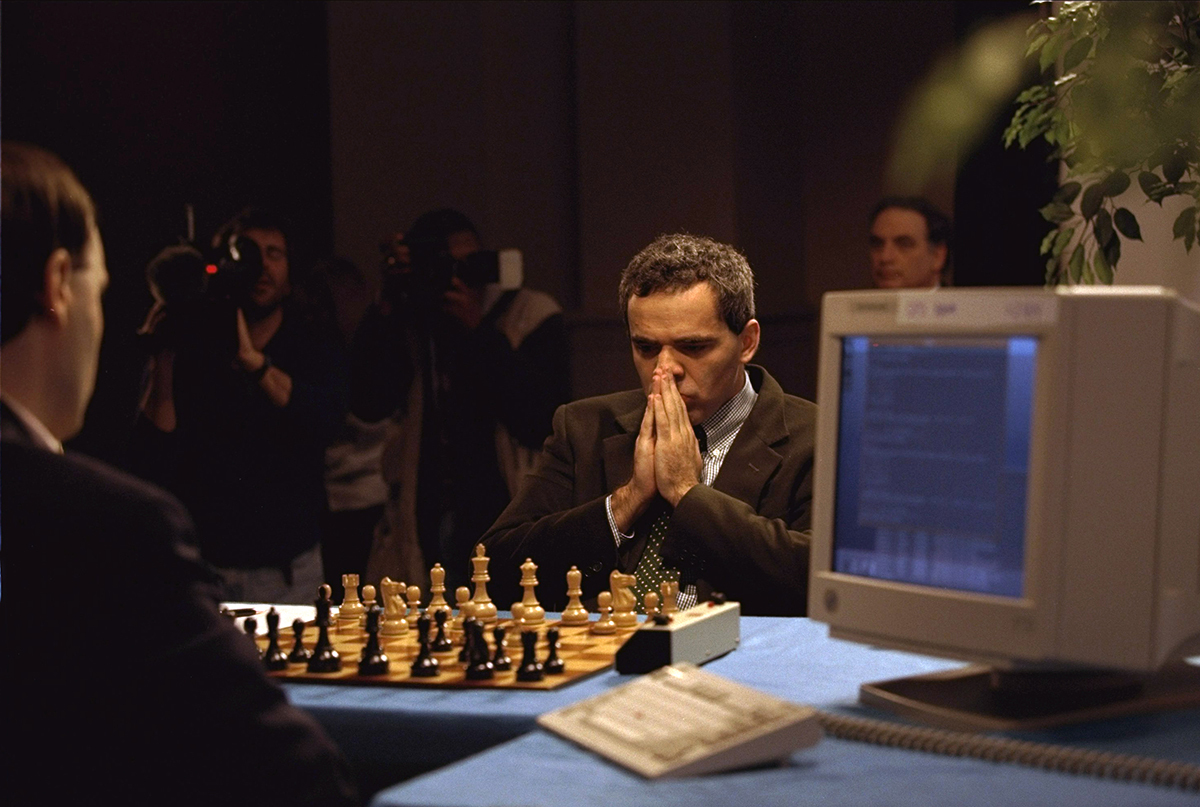
American chess genius Bobby Fischer defeated the reigning world champion Russia's Boris Spassky in 1972 in what has been called "the most exciting world chess championship ever". But the Eastern Bloc got its revenge on August 8, 1974, when Kaissa, a Soviet computer, checkmated its opponent, securing the very first World Computer Chess Championship title for the Soviet Union. Russian artificial intelligence had crushed its capitalist competitor. The victory proved to the world that the Soviets also had a say in the field of AI, which had until then mostly been developed at top US universities. Read moreFormer USSR chess grandmaster Boris Spassky dies at 88 AI, a ‘bourgeois science’? In the early 1950s, AI – which was not yet known by that name – was viewed behind the Iron Curtain with suspicion. The Soviets viewed what was to become AI primarily through the lens of cybernetics, a field of research that was very much in vogue for studying human-to-machine or machine-to-machine behaviour. Some saw cybernetics as a “false bourgeois science”, while others thought it held great promise for scientific advancement. Read morePublishers sue Google over alleged use of books to train AI models “Cybernetics almost became a sort of official philosophy of scientific research in the USSR,” said Olessia Kirtchik, a sociologist at the European Centre for Sociology and Political Science who has worked on the history of AI in the Soviet era. The hallways of research institutes and universities were then filled with mathematicians, philosophers and other researchers, tasked with ensuring the communist regime reaped the benefits of cybernetics. While it fell out of favour in the US by the late 1950s, giving way to computer science and what eventually became AI, the Soviets remained committed to cybernetics, particularly the concept of the “thinking machine”. The gold mine of Soviet AI One of the leading figures in Soviet AI to go down in history was Alexander Kronrod, a mathematician who was, among other things, in charge of the team that developed the Kaissa chess programme. For some, Kronrod was even the Soviet “father of artificial intelligence”. But before him, another mathematician had a considerable influence on the development of AI. His name was Dmitry Pospelov. Pospelov brought prestige to the discipline by “fostering and supporting the artificial intelligence research community for years”, said Kirtchik. This “lobbying” work culminated in the creation of the Russian Association for Artificial Intelligence in 1989. Pospelov’s pro-AI campaign within Moscow’s corridors of power also illustrates how the field was not immune to the ideological battle of the Cold War era. The Russian mathematician strongly criticised the Western approach to AI, which he deemed too “reductionist”. In his view, American researchers were reducing the human brain to a sort of supercomputer, performing rigorous but disembodied calculations. For him, intelligence had to be conceived as a social activity dependent on its environment, rather than as a purely logical process. In the Soviet Union, AI was expected to solve practical problems, and the USSR primarily “used algorithms to optimise the management of the socialist economy”, according to Kirtchik. The oil and gas industries, for example, used it to improve their operations.
AI before AI: The forgotten Soviet programme (1/2)
Beginning in the 1950s, the Soviet Union launched an ambitious programme aimed at developing artificial intelligence. While the history of AI today seems to be shaped by the giants of Silicon Valley,…
1,028 words~5 min read