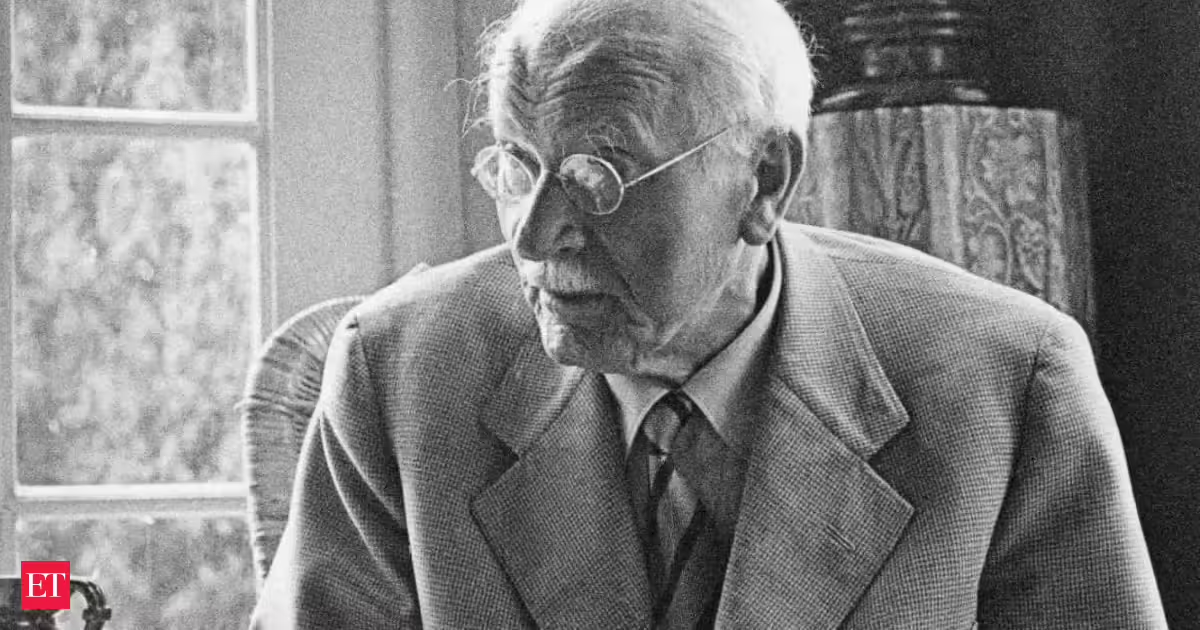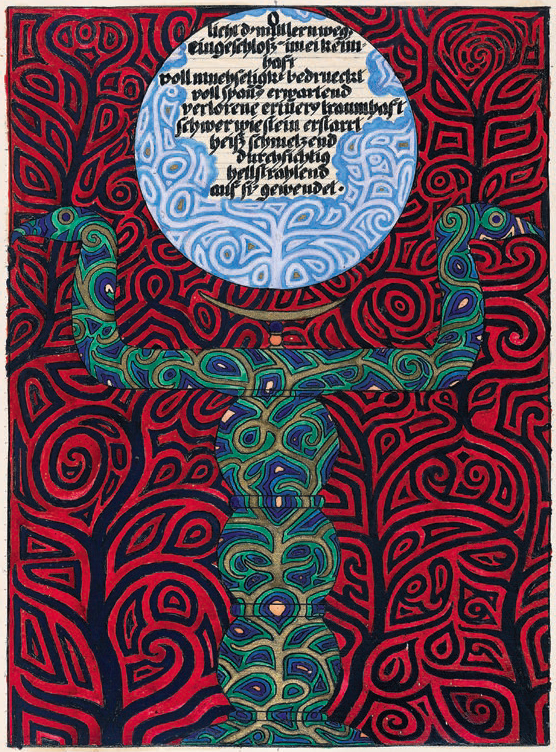
Carl Jung’s Liber Novus, better known as The Red Book, has come to light in a complete English translation, published by Norton in a 2009 facsimile edition and a smaller “reader’s edition” in 2012. The years since have seen several exhibitions of the book, which “could pass for a Bible rendered by a medieval monk,” writes art critic Peter Frank, “especially for the care with which Jung entered his writing as ornate Gothic script.”
Jung “refused to think of himself as an ‘artist’” but “it’s no accident the Liber Novus has been exhibited in museums, or functioned as the nucleus of ‘Encyclopedic Palace,’ the survey of visionary art in the 2013 Venice Biennale.” Jung’s elaborate paintings show him “every bit the artist the medieval monk or Persian courtier was; his art happened to be dedicated not to the glory of God or king, but that of the human race.”
One could more accurately say that Jung’s book was dedicated to the mystical unconscious, a much more nebulous and oceanic category. The “oceanic feeling”—a phrase coined in 1927 by French playwright Romain Rolland to describe mystical oneness—so annoyed Sigmund Freud that he dismissed it as infantile regression.