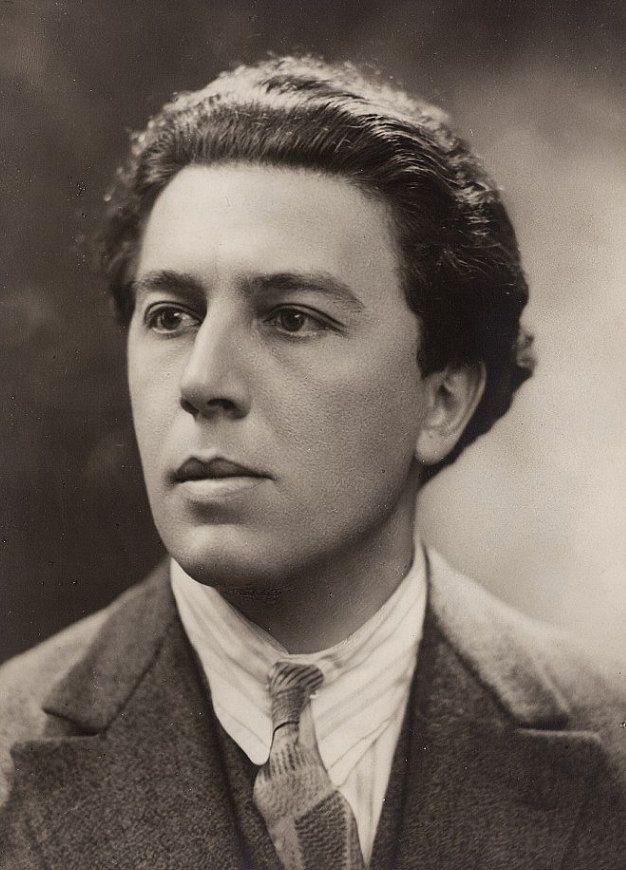
André Breton, necropolitics, and 100 years of surrealism.Nadjaby André Breton. Translated by Mark Polizzotti. NYRB Classics, 2025. 160 pages.Cavalier Perspective: Last Essays, 1952–1966by André Breton. Translated by Austin Carder. City Lights Books, 2025. 256 pages.Buy on Bookshop.orgMagic Art by André Breton. Translated by Michael Richardson and Krzysztof Fijalkowski. Fulgur Press, 2025. 320 pages.Buy on Bookshop.orgDid you know LARB is a reader-supported nonprofit?LARB publishes daily without a paywall as part of our mission to make rigorous, incisive, and engaging writing on every aspect of literature, culture, and the arts freely accessible to the public. Help us continue this work with your tax-deductible donation today!“PESSIMISM” IS NOT A WORD frequently associated with the legacy of surrealism. Over the years, I’ve seen a few changes in the way the movement is discussed. During the 1990s, sexier catchphrases dominated: we talked a lot about “desire” and “the irrational.” It is a sign of these very different times that pessimism came so readily to mind as I considered a series of new translations of books by André Breton. Of course, our understanding of any movement—literary, artistic, philosophical, political—will reflect the exigencies of the moment from which we look, but all the more so with surrealism, which continues to exert a strong fascination a century after its founding yet remains hard to pin down.It was a popularized understanding (strange, dreamlike) that made “surreal” the Merriam-Webster word of the year for 2016, a reflection of the improbable election of Donald Trump. A slew of publications and exhibitions focusing on surrealism in a historically specific sense marked the years leading up to the movement’s centennial in 2024. Several of these projects, most notably the 2021–22 Surrealism Beyond Borders exhibition at the Metropolitan Museum of Art and Tate Modern, finally achieved a representation of surrealism’s spirit that wasn’t at odds with the movement’s aims: surrealism’s “beyond”—beyond even itself—was an adamant insistence that the innumerable nefarious aspects of life under capitalism could be transformed—in Syria, as in Japan, Colombia, or even the United States—through new ways of living together. The arrival of the coronavirus pandemic posed a potentially catalytic comparison between the present and the conditions of the influenza pandemic of 1918–20 that gave rise to surrealism. The movement seemed to me more relevant than ever, for better and for worse.Augmenting the energies of the centennial, last year saw the publication in English of three works by Breton, who died 60 years ago in 1966: Mark Polizzotti’s new translation of the hybrid ode/lament Nadja (1928); Fulgur Press’s much-anticipated edition of Magic Art (1957), rendered by Michael Richardson and Krzysztof Fijalkowski; and Austin Carder’s translation of the posthumously published volume Cavalier Perspective: Last Essays, 1952–1966 (1970), from City Lights Books—the latter two works appearing for the first time in English. Translations typically entail a surfeit of love, as these volumes no doubt did, but arriving in this war-torn moment, this moment of resurgent fascism, they feel steeped in pessimism—a pessimism with deep roots in surrealist politics.Ex-surrealist Pierre Naville spoke of “pessimism” as a revolutionary and surrealist “watchword” in his 1927 essay “Mieux et moins bien” (“Better and Worse”). Naville had broken with the Paris Surrealist Group a year earlier over the movement’s conflicted relationship with the French Communist Party, and he and Breton exchanged a battery of texts wrestling with the role of the intellectual or artist in anti-capitalist revolution. For Naville, total and immediate alignment with the party was the only viable path, but he maintained the view that surrealism, and Breton in particular, had discovered the key to cultivating revolutionary consciousness, an “organization of pessimism” that could spark the seeds of permanent dissent. Surrealist pessimism was a keen awareness of society’s lies and hypocrisies, and a profound aversion to ideologies such as religion and nationalism. For Naville, Breton, and many other first-generation French surrealists, this totalizing pessimism was rooted in their service in World War I, so as they came to articulate a condemnation of nationalism and militarism, it was mingled with an inescapable sense of culpability. Yet the ramifications of such a “vibrant pessimism” went far beyond the passivity and malaise of personal or “social despair,” as Naville termed it. Walter Benjamin picked up on this in his dynamite 1929 essay “Surrealism: The Last Snapshot of the European Intelligentsia,” where, following Naville and Breton, he imagines surrealists envisioning humans as walking alarm clocks, ready at any moment to awaken to a permanent, explosive demand for sociopolitical change.Today, as neofascisms multiply and nation-states are driven by necropolitics, what Achille Mbembe calls the “creation of death-worlds”—in Gaza and elsewhere—the surrealist reveille has a new urgency. Playing out before our eyes in cities like Minneapolis is a demonstration of the observation made by poet, politician, and surrealist Aimé Césaire, in his 1950 essay Discourse on Colonialism, that Nazism and fascism’s savagery represented the weaponization against Europe itself “of colonialist procedures which until then had been reserved exclusively for” overseas colonized subjects. The targets point both ways when it’s convenient for the state, as Naomi Klein reminds us in a recent essay on surrealism and “confronting the far-right in a new age of genocide.”Accordingly, surrealism is increasingly understood today as a set of tactics of resistance that activate collective symptoms of disgust and despair. The 2024–25 surrealism and anti-fascism exhibition at the Lenbachhaus in Munich convincingly took up the refrain that there is more at stake in the ominous contemporaneity of surrealism than some epochal resonance or zeitgeist style. Surrealism gained its significance as a social and political force, beyond the realm of art and literature, after it denounced Stalin’s authoritarianism in the mid-1930s; after its many transnational groups resisted, fought, or condemned fascism in its many guises; and after it became a sustained flame that has ignited youth resistance groups from the 1950s to the present. This belatedness of surrealism, its continually deferred contemporaneity, is the essence of its effectiveness as a Benjaminian wake-up call. That surrealism matters outside the art museum has little to do with surrealism and everything to do with how some continue to live and thrive, while so many others suffer and die.¤Breton grew up in a middle-class family in Normandy, surprising his father, a policeman, and his mother, a former seamstress, with an early fixation on writing symbolist poetry. He entered medical school and was soon conscripted as an orderly, where he worked with shell-shocked patients while being exposed to trends in psychiatry. During the war, he befriended artists in Paris and elsewhere who shaped his intellectual orientation, but the armistice and the immediate postwar period saw the deaths of his two best friends, the writers Guillaume Apollinaire and Jacques Vaché, both of whom died under circumstances directly related to their service. Breton was deeply affected by these losses and by his experiences with the traumatized and disfigured soldiers he treated, out of which emerged a lifelong anti-militarism.For Breton, personal grief combined with an emerging sociopolitical consciousness in the wake of the October Revolution and the economic and political turmoil in France after the armistice. Galvanized by his participation in the Dada movement and his exploration of anarchism and socialism, he refused a career on principle, surviving by gig labor. Launched in Paris in 1924, surrealism offered a trenchant critique of capitalism, imperialism, and the nation-state. Within a few months, France had joined Spain in the Rif War against the Berbers in northern Morocco, and the surrealists’ protests against the colonial campaign brought them into close engagement with the French Communist Party. A couple years later, Breton became a party member, though his alignment with the PCF was short-lived. By the mid-1930s, Breton and many of his surrealist comrades had publicly condemned Stalin’s regime, and as World War II unfolded, Breton became involved in Trotsky’s Fourth International. Again conscripted into the French Army at the outbreak of World War II, Breton served as a medic during his brief mobilization. After the Fall of France, he fled, settling in exile in New York, a challenging period during which his wife, the surrealist artist Jacqueline Lamba, left him for American sculptor David Hare, taking their child with her. The 1940s and 1950s saw Breton’s return to France, his renewed investigation of utopian socialism and anarchism, and his continued surrealist praxis—a systematic critique of modern life in all its guises.Nadja, the 1928 semi-autobiographical novella for which Breton is best known, and his final collection Cavalier Perspective, written between 1952 and his death in 1966, invite deeper immersion into episodes of this life story and its inextricably intertwined personal and political commitments. When seen as biographical bookends, they convey a saga of struggle for both social revolution and a revolutionary lifestyle. As art historian Raymond Spiteri has shown, Nadja is more than just the story of Breton’s encounter and brief affair in 1926 with a young woman of extremely precarious means and mental health, Léona Delcourt, who was eventually incarcerated in a psychiatric institution. This relationship and the subsequent one that concludes the book coincide with the period of Breton’s struggle to merge his surrealism with the operations of the French Communist Party, which would result in his withdrawal from any party politics just a few years later in favor of the anarcho-syndicalist orientation he maintained for the rest of his life.In Polizzotti’s new translation of Nadja, which untangles and rectifies skewed or imprecise passages in Richard Howard’s 1960 version and appends informative annotations, we gain a clearer sense of the inherent connection between the book’s infamous “love story” and Breton’s concurrent steps toward revolutionary commitment. Polizzotti’s introduction also provides a wealth of biographical information about Delcourt that has emerged from European scholarship over the last 20 years, along with intricate details of Breton’s biography. The result is a more nuanced set of insights, particularly for Anglophone readers, into the text’s motivations and its relationship to Breton’s and Delcourt’s lives. His love affair with a woman spiraling into a crisis brought on by economic precarity and patriarchy in the text is mirrored in his party affiliation. Both are marked by a problematic, idealistic hope for revolutionary praxis: free love with a visionary partner and liberation through revolution. As Polizzotti tells us in the introduction, Breton reflected on this situation years later, describing his politicized approach to love and his affective approach to politics as characterized by a fatal flaw: an investment in the transcendence of romantic love as a salvation from social ills. Speaking of himself in the third person, he wrote, “That man […] can imagine no disappointment in love, but he imagines and has never stopped imagining life—in its continuity—as the locus of every disappointment.”The often overlooked yet immensely important essays gathered 42 years later in Cavalier Perspective likewise linger on the bitterness of personal and political dead ends but ruminate more extensively on Stalinization and Breton’s falling-out with the French Communist Party. In the 1953 essay “At Long Last,” Breton admits that the main heartbreak in his life was neither the violence of capitalism nor the gradual demise of his romantic idealism but his refusal of the Soviet revolutionary apparatus. Responding to the praise and critique of surrealism as a revolutionary force by the writer, resistance fighter, and leftist activist Dionys Mascolo in his book Le communisme (1953), Breton writes, “History, at its current stage, condemns us to this ambivalent position of absolute refusal and regret.” The “absolute refusal” was, in large part, the Paris Surrealist Group’s condemnation of Stalin’s regime, with its “methods of assassination and orchestrated dissolution of human consciousness.” The “regret” is that which the Paris group collectively experienced in the simultaneous necessity and impossibility of being card-carrying communist intellectuals and activists. Surrealism’s goad, Breton admitted, driving it ever forward, was sharpened through its dogged investment in communism fused with this intractable refusal of that party’s ultimate authoritarianism. The splintering of that revolution, in its party form, was embedded in the continued struggle for another horizon, a nonauthoritarian and noncapitalist way of life. Surrealist refusal was not without its costs.Just a few months prior, in another short essay included in Cavalier Perspective, “Stalin in History,” Breton had condemned the “duplicity and terror erected as a mode of governance” under the Soviet dictator, whose “heinous attack against Language” had “pervert[ed] words carrying ideals.” But as Garrett Caples reminds us in his engrossing introduction to the edition, Breton and the Paris Surrealist Group had already made their attack on this regime widely known roughly 20 years earlier when Breton left the French Communist Party. He had refused to bow to an ultimatum that he retract a colleague’s letter, published in the final issue of the journal Le Surréalisme au service de la revolution in May 1933, that was critical of the USSR. In his essential biography of Breton, first published in 1995, Polizzotti confirms via Paris surrealist André Thirion that Breton considered his break with the party “a personal failure,” though he held to his convictions, refusing to compromise on the scope or means of revolutionary change, even if it meant decrying the apparent revolution at hand.¤Surrealism in no way equals the sum of Breton’s disappointments, whether in the realm of love or politics. Still, there is something significant to be distilled from his personal vacillation between idealism and refusal, which offers insight into the surrealist horizon and its rejection of what Breton called “miserabilism”: the idea that there is no overcoming—and no point in resisting—the miseries of life under capitalism (what Mark Fisher called “capitalist realism”). How do denial, disappointment, and despair become organized pessimism, and how does organized pessimism lead to any kind of effective refusal of the necropolitics of colonialism and capitalism? What is the transformative thread?One finds it in a seemingly distant preoccupation of Breton’s: a curiosity about the dynamic potential of the aleatory, automatism, and nonreligious spiritual and occult practice, evident across these three volumes. An interest in the occult was always present for Breton, yet this tendency became most apparent after the Second World War. Nadja dramatizes Breton’s creeping feeling that Delcourt perhaps possessed some degree of clairvoyance, even as she experienced the onset of schizophrenia. In Cavalier Perspective, we get a broader sense of this network of inquiries into nonrational forms of sensation and happenstance. Along with the political writing, the volume gathers several essays devoted to chance, psychic, and occult phenomena, with titles such as “You have the floor, young seer of things …,” “On Astrology,” “Everyday Magic,” and “On Magic Art.”Even essays in Cavalier Perspective that are ostensibly about art or politics contain kernels of what might be called spiritual thinking. For instance, “Link,” which was a preface to the catalog for a surrealist exhibition in 1952, professes that surrealism’s goal is not just to transform the world but also to increasingly liberate the “instinctive impulse,” breaking the imprisoning dominion of the physical world in order “to reach the total psychophysical field (of which the arena of consciousness is only a small part).” One of the final “links” between the surrealist marvelous and the surrealist revolution to erupt in Breton’s life was his awareness of what the late artist Ben Morea—founder of the anarchist collective Up Against the Wall Motherfucker, active in New York in the 1960s, himself substantially influenced by surrealism—recently called “the unified field.” It’s the idea that art is not enough to change life as we know it, and neither is politics, nor radical art and politics hewn together. An animist understanding of the universe as fully alive can unite these aspects of the struggle into a single motivation to resist the death drive’s domination. If humans could perceive what Breton called this “Language of Stones” through art-as-divination and other forms of consciousness-changing activity, we might avoid the world’s extinction.These concerns are at the heart of Magic Art, which Breton composed between 1953 and 1955. He was commissioned by Le Club français du livre to write a volume on visual art and magical practices for a series devoted to art historical iconographies or periods. The resulting study haphazardly examines art around the world and across time—from the prehistoric to the tribal to the modern—as a magical tool or “vehicle” for human negotiation with life. In his roughly chronological yet vastly transcultural survey, Breton resists limiting what “art” or “magic” means for him while simultaneously conflating their definitions. Visual art is a method for magic through which humans manipulate reality, while magic, in turn, is described as an art form for shaping experience. Copiously illustrated and densely erudite, the volume is a compendium of heteroclite surrealist collecting impulses, intellectual proclivities, and elective affinities. It culminates in an exegesis of surrealism as the latest iteration of a magic art that strives to dissolve the veil separating psychological and material existence and “change life,” in the words of the surrealist precursor Arthur Rimbaud.In the characteristically spectacular edition from Fulgur Press, the translators’ introduction provides a comprehensive overview of the gestation and development of Breton’s idiosyncratic project, which subverted art historical timelines and hermeneutics. The translators detail Breton’s challenges with the material: the “enquiry” on magic art that he sent out to 250 key figures in 1955 (over 80 responses appear in the Fulgur volume) and his collaboration with the poet and philosopher Gérard Legrand to bring the book to completion. Magic Art remains the most important document for understanding the role of magic and divination in Breton’s thought after his return to France following the war. Yet the text was never fully realized as he had envisioned. Anne Egger’s epilogue elegantly conveys the sense of loss and anxiety that beset Breton as he commenced the project in 1953, surrounded by the deaths of a series of close friends and family members. His health suffered, and he was racked with disturbing premonitions. Breton came to feel that Magic Art was a cursed endeavor, even if he never relinquished the notion of art as a form of powerful agency tied to an animist ethos. If surrealism represented for him a type of “magic regained,” as the last chapter title attests, Breton left it for Legrand and future surrealists to fully express.¤Surrealism arose from a mortally perilous condition that we can’t seem to shake, as Breton articulated in the 1963 essay that gives his final collection its name. “Cavalier perspective” describes a warrior on horseback, peering over the walls of the enemy’s fortifications from a high vantage point, evoking a method of depth perception that allows apprehension of the actual shape of things rather than just their surfaces. According to Breton, surrealism’s point of view looks beyond barriers faced in the midst of struggle, which surrealism understands as a “continuum” that unfolds “from the degree of effervescence kept up in relation to the problems of the present.” This past-present-future continuum unites “categorical refusals of the imposed ‘order’” with “a call from distant horizons” by which, from this embattled position, we can just make out the distant outlines of another way of life.Reading these new translations gives a sense of the pitfalls of the surrealist refusal of what is, and its demand for something better both in the lived moment and over the long haul of a lifetime marked by warfare and its condemnation. This beleaguered aspect of surrealist refusal and demand becomes more pronounced in the glaucous light of today’s déjà vu of neofascisms. If, in 2021, surrealism’s ability to organize “beyond borders” was emphasized, the exhibitions and publications of this year and last, including the troika of Breton translations, reveal a surrealism continually at war with the state, struggling to see anything beyond the ever-encroaching shadow of necropower.The 107th issue of the Czech surrealist magazine Analogon in 2025 was titled Pessimism & Disappointment. This journal was launched in 1969 by Vratislav Effenberger but shut down by the authoritarian Czechoslovak government that same year, and its second issue did not appear until 1990. Persevering decades later, Analogon speaks directly to the surrealist art of organizing pessimism via strategic perspective. It’s doubtful that either historical or contemporary surrealism is on its way to becoming a new samizdat under the rise of authoritarian regimes, but it is possible that its pessimistic perspective, prefiguring alternate horizons amid crisis, might at least set off a few alarm clocks.¤Featured image: Henri Manuel, Portrait of André Breton, 1927, is in the public domain. Image has been cropped. LARB ContributorAbigail Susik is associate professor of art history at Willamette University and the author of Surrealist Sabotage and the War on Work (Manchester University Press, 2021). She is the editor of Resurgence! Jonathan Leake, Radical Surrealism, and the Resurgence Youth Movement, 1964–1967 (Eberhardt Press, 2023) and co-editor of the volumes Surrealism and Film After 1945: Absolutely Modern Mysteries (Manchester University Press, 2021) and Radical Dreams: Surrealism, Counterculture, Resistance (Penn State University Press, 2022).ShareLARB Staff RecommendationsAll of This, My Dear Sir, Is Surrealism: On Mark Polizzotti’s “Why Surrealism Matters”Anna Levett reviews Mark Polizzotti’s “Why Surrealism Matters.”Anna LevettMay 14, 2024Political Surrealism, Surreal PoliticsChina Miéville takes on Surrealism, exploring how to be as radical as reality in art and in politics.Carl FreedmanDec 26, 2016
Organizing Pessimism | Los Angeles Review of Books
André Breton, necropolitics, and 100 years of surrealism.
3,503 words~16 min read