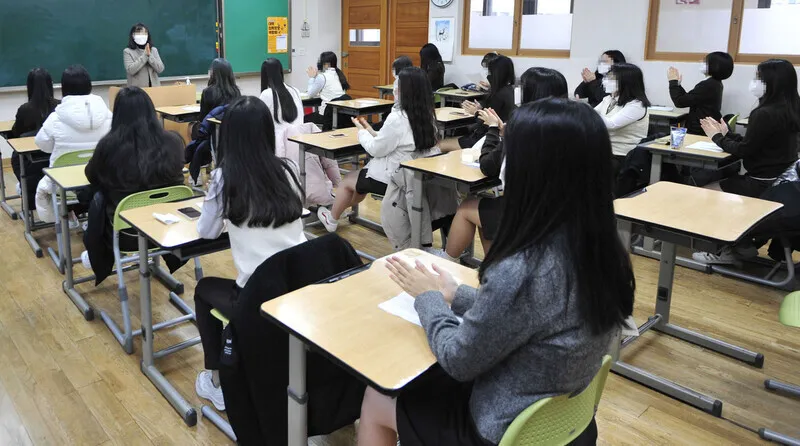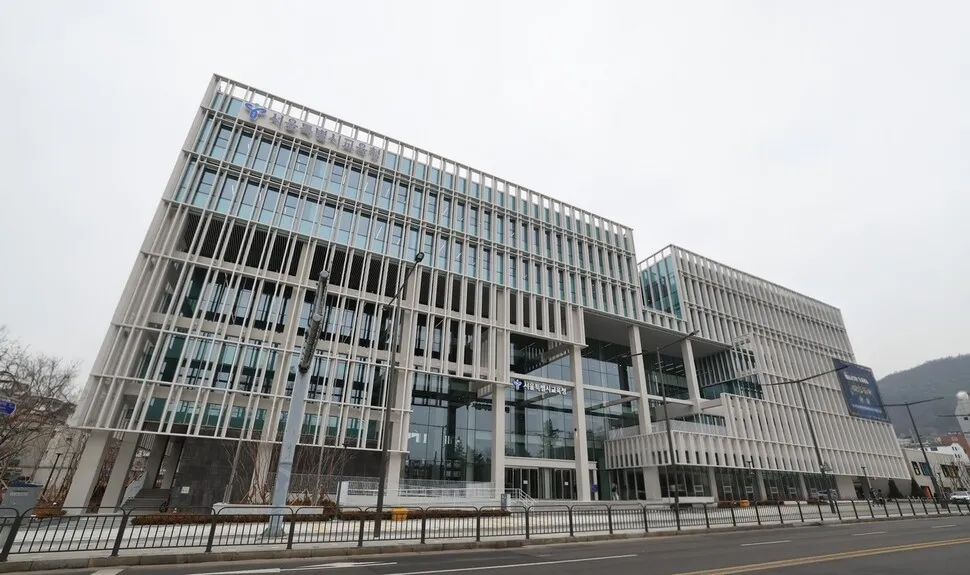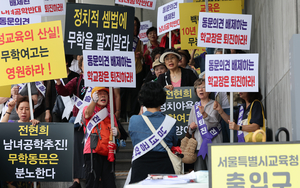
Education authorities say coeducation needed to cope with shrinking enrollment, while alumni warn it threatens school identity and tradition Muhak Girl's High School alumni gather in front of the Seoul Metropolitan Office of Education in Yongsan, central Seoul, to protest the school's decision to apply for coeducation transition on July 20. (Yonhap) The Seoul Metropolitan Office of Education on Thursday approved eight of 11 schools that applied to transition to coeducation, including Muhak Girls’ High School, allowing them to make the switch within the next two years.The decision is expected to draw backlash, particularly at Muhak, where alumni and students have mounted protests against the proposed transition. They have argued that their views were not sufficiently reflected and that the transition would undermine the school’s identity as an all-girls institution.Muhak Girls’ High School in Seongdong-gu, Seoul, applied in June to begin admitting male students from the 2027 school year.Founded in 1940, the school has seen enrollment fall from 521 students in 2023 to 406 this year, a decline of 22.1 percent. The number of first-year classes has also fallen from eight to six.Of the nine schools that applied to transition in 2027, seven — Jeongwon Girls’ Middle School, Sacred Heart Girls’ Middle School, Hanyang Middle School, Hanyang Technical High School, Sinjeong Girls’ Middle School, Seoul Sinjeong High School and Muhak Girls’ High School — received approval.Sacred Heart Girls’ High School was also approved to transition in 2028, bringing the total to eight.Why authorities say coeducation is becoming necessaryThe Seoul education office said the conversions are intended to address a rapidly shrinking school-age population, improve students’ commuting conditions, correct gender imbalances among schools in certain areas and give students more choices over where to attend.At Muhak, those demographic pressures are already visible.Its 406 students are fewer than the 463 enrolled at nearby coeducational Seongsu High School. Among this year’s first-year classes, the smallest had just 19 students, compared with a Seoul average of about 26 students per class.Muhak has said losing one class would require reducing its teaching staff by two positions. If enrollment continues to decline at the current pace, the school expects to lose another class next year.The smaller student body also complicates implementation of the high school credit system, under which schools are expected to offer students a wider selection of subjects.The school has told alumni that admitting male students from nearby neighborhoods could help preserve at least some of its current classes.Concerns have also grown over the five-tier grading system. Because the highest grade is awarded to the top 10 percent of students, smaller cohorts mean fewer students can receive a top grade, adding to fears that shrinking schools may become less attractive to prospective students.For schools approved for conversion, the education office plans to provide funding to expand or renovate facilities including restrooms and changing rooms.Each school will also receive 300 million won ($208,000) in total over three years to operate adjustment programs and hire additional student guidance staff. The education office will also assist with administrative procedures such as school name changes and ordinance revisions.Why coeducation continues to fuel conflictMuhak is far from the first single-sex school in Korea to face backlash over a proposed transition to coeducation.Last year, women’s universities including Dongduk Women’s University and Sungshin Women’s University saw student protests after discussions over admitting male students came to light.Across such disputes, opponents tend to raise three recurring concerns: safety of students, a lack of meaningful consultation with the student body and the loss of institutional identity and tradition.At Gwangju Women’s University, some students have voiced unease over the presence of male international students already enrolled at the school.One student told local media outlet OhmyNews that some women were already experiencing “considerable anxiety and discomfort,” citing reports of smoking in prohibited areas and catcalling of female students.At Dongduk Women’s University, meanwhile, the controversy centered heavily on how the decision-making process was structured.Lee Su-bin, head of the university’s emergency student committee, argued that students had repeatedly expressed their opposition to abandoning the women’s university model but had little influence over the formal discussion process.“Thousands of students expressed several times that the university should remain a women’s university, but I cannot understand why those voices were barely reflected in the decision-making process,” Lee said.Muhak alumni have raised a similar complaint.The alumni association said the plan was pursued “without sufficient explanation or collection of opinions from alumni and current students,” arguing that a decision affecting the school’s fundamental identity should not be made without broader consent.“Muhak Girls’ High School’s history and identity must be preserved as a prestigious girls’ school that has produced female talent for 86 years and contributed to the development of women’s education in Korea,” one former student said.“The identity and tradition of the school as a women’s institution are essential values that make Muhak what it is.”Students and parents have also raised concerns about how the school environment could change.“Once the school becomes coeducational, students may find it harder to concentrate on their studies compared with an environment made up only of girls,” one parent told local daily Kyunghyang Shinmun.
Muhak Girl's High coed conversion pits survival against tradition
The Seoul Metropolitan Office of Education on Thursday approved eight of 11 schools that applied to transition to coeducation, including Muhak Girls’ High Schoo
848 words~4 min read