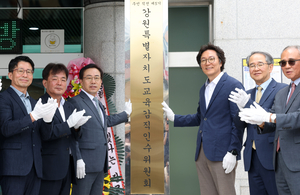
Case illustrates growing concerns over policy continuity as incoming education chiefs revisit predecessors' plans Newly elected Gangwon Provincial Education Superintendent Kang Sam-young (third from left) attends a signboard unveiling ceremony for his transition committee in Chuncheon, Gangwon Province, on June 10. (Yonhap) A plan to establish an international school in Gangwon Province could face delays after the province’s newly elected education superintendent signaled a shift away from building new international schools and toward strengthening public education.“International schools may shake the broader framework of public education and could therefore require a public deliberation process to listen to different views,” Kang Sam-young, Gangwon’s superintendent-elect, said on June 18.Kang’s transition committee said the incoming superintendent would focus on strengthening public education to narrow academic gaps and respond to the risk of regional decline.Gangwon Province and the Gangwon Provincial Office of Education had been pushing to establish a Jeju-style international school through the fourth revision to the Gangwon State Special Act proposed at the National Assembly in April. Unlike ordinary foreign schools, the proposed school would allow Korean nationals to enroll without restrictions.Local officials had promoted the plan as a way to draw high-income families to the region by offering globally competitive education, while also helping revitalize the local economy and ease the risk of regional depopulation.The plan now faces uncertainty after Gangwon elected Kang, a liberal candidate, to replace Shin Kyoung-ho, the province’s conservative former superintendent.During Shin’s term, the province and the Ministry of Education reportedly clashed over earlier revisions to the Gangwon State Special Act, with one key point of contention being a clause that would make it easier to establish international schools open to Korean students.The ministry opposed the creation of additional international schools, citing concerns that they could become exclusive institutions for the elite. In March, ahead of the fourth revision, the ministry demanded that Gangwon remove the clause on establishing international schools.The Gangwon case reflects a broader concern over policy continuity after the June 3 local elections, which replaced superintendents in 10 of the country’s 16 provincial and metropolitan education offices.Observers say education policies could undergo major changes in areas such as academic achievement, teachers’ rights, and responses to regional decline, as incoming superintendents move to reverse or revise key policies pursued by their predecessors.In Jeju, newly elected liberal Superintendent Ko Eui-sook said she would scrap her conservative predecessor’s policy of providing one laptop to every middle school student.Ko said the academic effects of the policy remain unverified, despite more than 1.7 million won ($1,100) being spent per student to provide the devices. Instead, she said she would introduce school entrance subsidies of 500,000 won for elementary school students and 700,000 won for middle school students.In Sejong and South Gyeongsang Province, conservative and centrist candidates won the superintendent posts for the first time in 12 years.South Gyeongsang Superintendent-elect Kwon Soon-ki has pledged to prioritize recovering basic academic skills and normalizing public education. Digital education policies, including future education platforms promoted by the previous administration, are expected to come under review.In Sejong, Superintendent-elect Kang Mi-ae has pledged diagnostic assessments for third- to sixth-grade elementary school students, an artificial intelligence-based learning support center for customized academic management and an expansion of autonomous public high schools.Her election also signals broad changes in both policy and personnel, marking a departure from the system built under former Sejong Superintendent Choi Kyo-jin, who is now education minister.In North Jeolla Province, Superintendent-elect Cheon Ho-sung has signaled a push for school consolidation, which had been minimized under his predecessor, and revisions to the comprehensive elementary school assessment system for fourth- to sixth-grade students.Some educators warn that abrupt policy shifts based on the political orientation of superintendents could cause confusion in schools.“Schools need autonomy, and education policies should be carried out consistently,” a teacher told local newspaper Hankook Ilbo.“If cash support programs or assessment methods change with each superintendent, it could undermine school autonomy and create confusion in local education systems.”
Gangwon international school plan faces setback after superintendent change
A plan to establish an international school in Gangwon Province could face delays after the province’s newly elected education superintendent signaled a shift a
654 words~3 min read