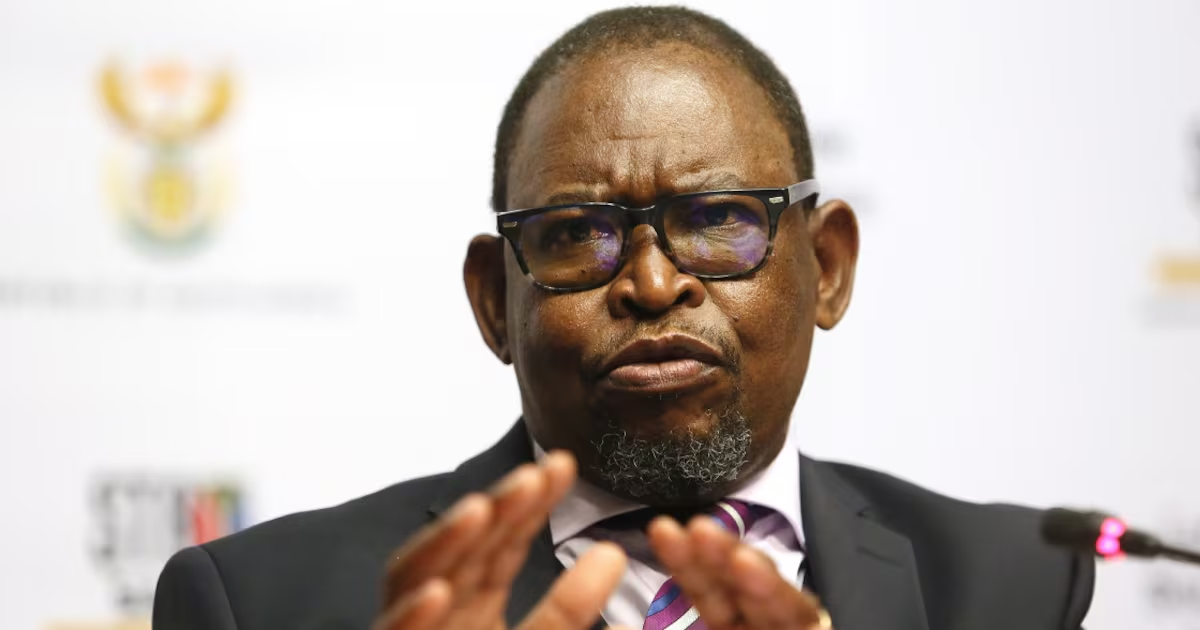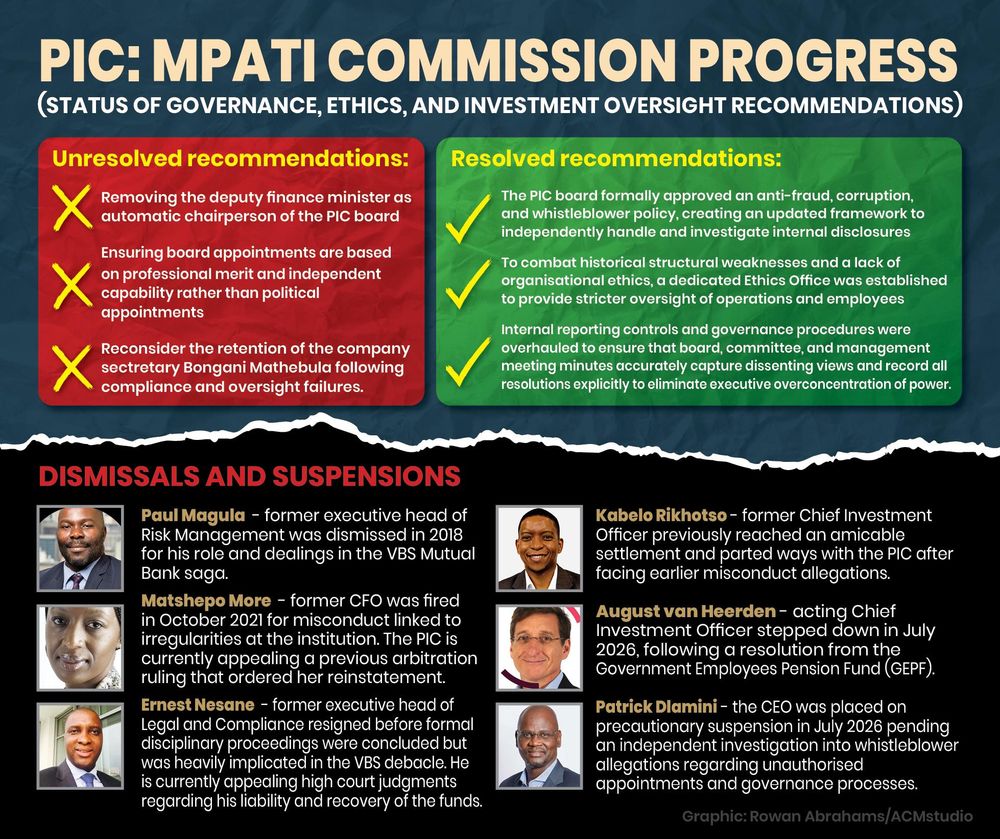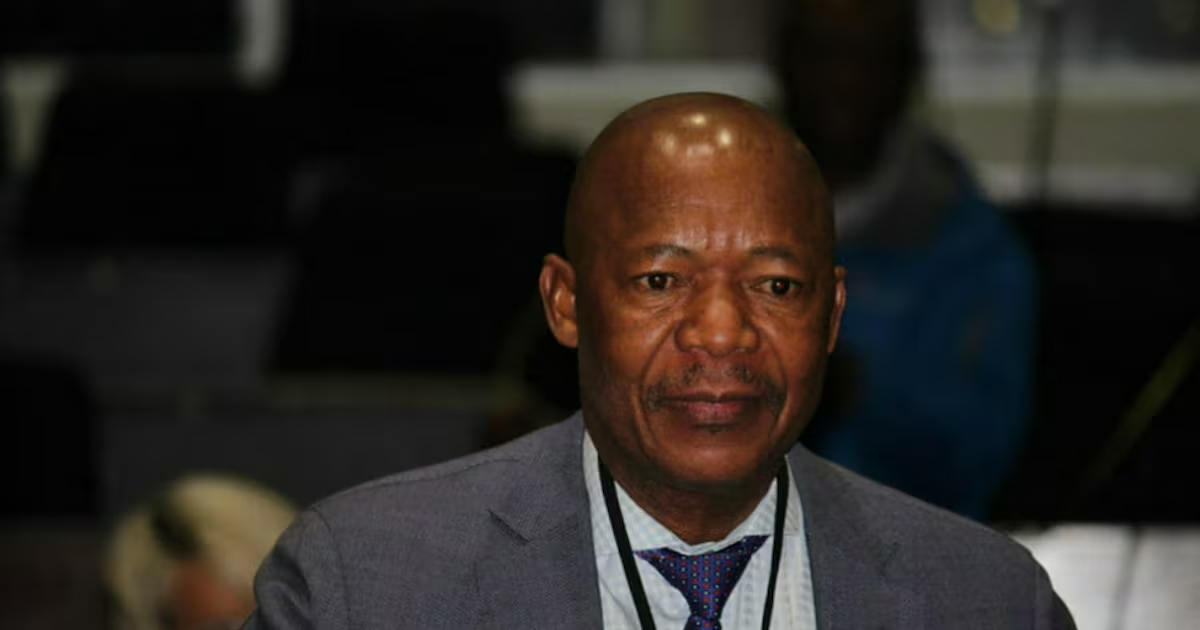
To fix the Public Investment Corporation (PIC) finance minister Enoch Godongwana must come up with an antidote to the very nature of the corporation. The institution brings together two elements that make it susceptible to recurring crisis: a large pot of money under management, and money-hungry people. The building blocks of Godongwana’s antidote must include finding people of absolute integrity to make up the PIC board of directors, which may be an impossible task in the short term given the strictures of the PIC Amendment Act (2019) when it comes to the composition of the board. The antidote must also find a workable solution for the inherent tension between the PIC’s CEO and CIO. To reduce political and corrupt influences Godongwana must delink the chairpersonship of the PIC board from politics, something that would require changes to legislation. And he must revisit the overall composition of the PIC board. To do justice to being a director of the PIC requires tons of integrity, which the King IV report on good governance describes as “the quality of being honest and having strong moral principles”. As corporate history in South Africa and elsewhere in the world shows, integrity is not an exclusive preserve of private sector people. Integrity matters because the nature of the PIC, an institution that steers billions of rand for investment, makes it attract all manner of money-hungry people. As the recent history of shenanigans at the PIC has shown, it is one of the few remaining state institutions where one can score handsomely at the expense of retirees and beneficiaries of the Government Employees Pension Fund. Whispers in the PIC corridors have pointed to a long history of board members “engaging” the CIO to promote certain deals on behalf of their friends, relatives or people from whom they stand to benefit. As the recent history of the PIC illustrates too, being a director of the money manager can open one to being lobbied by the money-hungry crowd. The evidence tabled before the Mpati commission, and recent events within and outside the PIC, attest to this. That brings me to my second point about the CIO. The PIC CEO is responsible for, among other things, overall vision and strategy, leading the executive team and driving engagement with stakeholders. The CIO has direct responsibility for the investment function, but the incumbent also reports to the CEO, as do all other senior PIC executives. Given the nature of the PIC’s business, you cannot run the PIC without a CIO. This automatically makes the CIO a crucial pillar of the corporation, making such a person in money-hungry eyes more important than the CEO. Whispers in the PIC corridors have pointed to a long history of board members “engaging” the CIO to promote certain deals on behalf of their friends, relatives or people from whom they stand to benefit. This has in the past made the CIO a favoured son of unscrupulous board members, so much so that in case of a major disagreement between the CEO and CIO some board members “naturally” side with the CIO. A telling historical fact is that Dan Matjila, who had been the PIC’s investment chief for many years, chose not to fill the role of CIO as soon as he was appointed CEO in December 2014, a point noted by the Mpati commission. Matjila as CEO in effect fulfilled the CIO’s role, something that was contrary to the PIC’s memorandum of incorporation. One could read this to mean that Matjila understood only too well the risk of the CEO being undermined by the CIO. • Sikhakhane, a former spokesman for the finance minister, National Treasury and South African Reserve Bank, is editor of The Conversation Africa. He writes in his personal capacity.
JABULANI SIKHAKHANE | PIC structure fuels integrity crisis
Board interference and CIO favouritism undermine effective oversight
626 words~3 min read