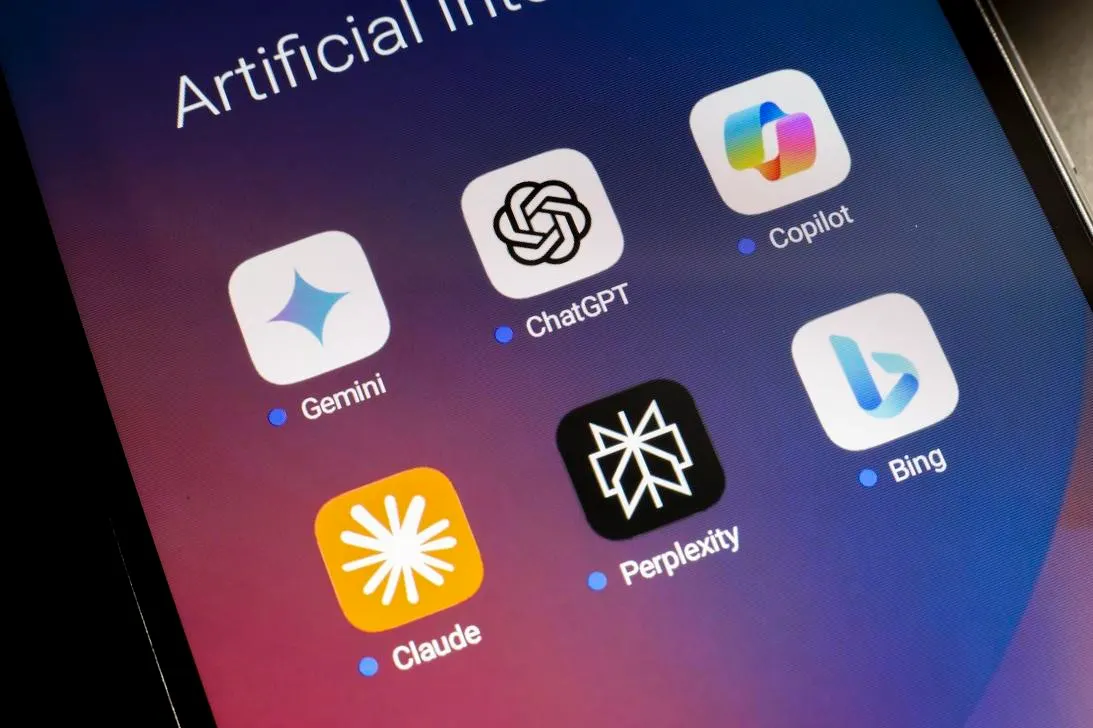
The logos of Google Gemini, ChatGPT, Microsoft Copilot, Claude by Anthropic, Perplexity, and Bing apps are displayed on the screen of a smartphone in Reno, United States, on November 21, 2024. (Photo by Jaque Silva/NurPhoto via Getty Images)NurPhoto via Getty ImagesWhen Anthropic published its labor market impacts report earlier this year, one finding stopped a lot of people mid-scroll: market research analysts and marketing specialists rank fifth on a list of 800 occupations most exposed to AI displacement. A separate analysis by Adweek, drawing on the same research, put a sharper number on it: 65% of marketing tasks may not survive the current wave of automation.For an industry that has long positioned itself as the human face of business (the discipline responsible for culture, creativity, and consumer connection) the ranking deserves a harder look than most trade coverage has offered. It bears asking why marketing became so straightforward to automate in the first place.Five structural reasons explain how the industry got here.1. A decade of systematization created the conditions for automation.Over the past 10 years, marketing investment flowed heavily into performance channels: programmatic advertising, SEO-driven content, email automation and data-driven targeting. The craft of the discipline — the cultural intuition embedded in a great campaign, the consumer insight that takes months to surface — was deprioritized in favor of metrics that could be dashboarded and optimized quarterly.The result was an industry where the average unit of output became more repeatable and less differentiated. According to CoSchedule's State of AI in Marketing Report, 85% of content marketers now use AI for content creation. That adoption was possible because the work, in most cases, had already been reduced to a formula.2. Synthetic audiences are replacing traditional quant research with measurable accuracy.Market research was long considered one of marketing’s more defensible functions, where genuine human understanding was built. While it is clear that marketers should never (ever) give up that close ethnographic understanding of the humans they wish to convert, that assumption is being tested. Qualtrics' 2025 Market Research Trends Report found that 73% of market researchers have already used synthetic responses at least once.The accuracy case is strengthening. Research from UC San Diego and KU Leuven, presented at NeurIPS 2025, demonstrated that AI-generated synthetic profiles can achieve 95% correlation with real survey data.The practical consequence is already visible in the automotive sector, where at least one major manufacturer has shared with me it replaced its creative testing process entirely with AI-powered synthetic audiences after internal validation showed match rates above 98% against traditional research. If the signal is that clean, the economic argument for traditional research becomes difficult to sustain.It doesn’t mean there is no place for human research; there absolutely is, and I pray that marketers won’t look to AI to answer some of the deeper human questions that bear asking to real people. But marketing is definitely built on a huge quant foundation that will be increasingly automated in years to come. In some cases, it already has.3. The distribution layer is becoming AI-to-AI.A significant portion of what marketing professionals do involves optimizing content for algorithms (search engines, social feeds, programmatic ad exchanges) that are themselves increasingly AI-driven. According to industry data, AI-driven programmatic advertising reached $134.8 billion in 2024, an 18% increase year over year.When the audience for a piece of content is effectively another AI system, whether a ranking algorithm, a bidding engine, or a recommendation model, the human judgment involved in crafting that content for "resonance" becomes less decisive. The optimization becomes a technical problem between machines, and the human intermediary in that loop is harder to justify at scale.4. The economics of AI augmentation are compounding faster than expected.The pace at which AI augmentation outpaces human headcount is now visible in the arithmetic of marketing operations. AI-powered PPC campaigns are delivering 50% higher click-through rates and 30% better conversion rates compared to traditionally managed campaigns.The optimistic framing (that AI will reshape more jobs than it replaces outright) is probably correct over a long horizon. At the task level, however, the pace of change is already forcing a harder reckoning. When one person with AI tools can produce the output that previously required three, the arithmetic for headcount decisions is straightforward regardless of what the reshaping looks like in ten years.What makes this transition particularly striking is where the labor of building those AI systems is falling. Organizations are not simply buying off-the-shelf tools; they are asking experienced practitioners to train the agents that will reduce reliance on the roles below them. One former head of strategy at a major global agency described to me spending her final months in the role building an AI agent trained to replicate her strategic review process — evaluating briefs, identifying logical gaps, strengthening arguments — so that junior strategists could access that function on demand.The expertise being encoded into these systems is not generic. It is the accumulated judgment of experienced marketers, extracted and systematized by the people who developed it, often without a clear accounting of what that transfer means for the profession’s future. 5. The entry-level pipeline is deteriorating before it can build resistant skillsThe increasingly discussed consequence of AI’s acceleration into marketing is what it does to the talent development cycle. Per Anthropic's research, hiring of younger workers in AI-exposed occupations has already slowed by approximately 14% relative to 2022 benchmarks, a data point that reflects how quickly the organizational math is changing.Junior roles, where marketers historically learned to think, to ask the right questions, to understand what makes an insight interesting, are shrinking precisely because they involve the most automatable tasks.The crisis is forming in real time: organizations are investing in AI agents to replicate mid-level strategic judgment while simultaneously reducing the junior headcount through which that judgment was traditionally cultivated. The result is an industry absorbing automation at the bottom of the skill ladder without a clear plan for how the next generation of senior practitioners gets built.The skills that appear most durable — ethnographic instinct, persuasive storytelling grounded in psychological understanding, the ability to develop and defend a genuine point of view — are precisely the skills that require years of lower-level work to develop. If that developmental path compresses or disappears, the pipeline problem becomes self-reinforcing.Marketing Needs To (Re)Build It’s Moat: Understanding PeopleMarketing as a discipline is not disappearing. The version of it built around volume, systematization, and performance optimization (i.e. the version that came to dominate the industry over the past decade) is structurally exposed in ways that cannot be resolved by individual professionals learning to use better tools.The work that will retain value is the work that was always hardest to do: genuine consumer understanding, cultural judgment, and strategic thinking that starts from a real human observation rather than a data output. AI cannot, like Tom Goodwin encourages marketers to do, "sit on a bus and listen to what teenagers are saying."The industry has understood this in principle for years, but somewhere along the way it got more obsessed with technology than people, and right now the technology is about to overtake the people.
5 Reasons Marketing Is One Of AI’s Most Vulnerable Professions
Marketing specialists face high AI displacement risk because AI is getting better at what fuels the industry. Marketers need to refocus on their moat: understanding people.
TL;DRAI
Anthropic ranks marketing 5th in AI-exposed professions—65% of tasks automatable through systematization, synthetic research, algorithmic distribution. IT leaders face headcount compression, junior talent erosion, expertise codified in agents by displaced practitioners.
1,183 words~5 min read