Archimedes was in the bathtub. Newton was under an apple tree. We’ve all heard stories of the strange places that inspiration can strike. For me it was at the circus studio, hanging upside down. “Pike to stall your rotation,” coach Trevor cued. A former high school physics and math teacher turned full-time acrobatics instructor, he peppered our weekly lessons with physics talk. As a teenage girl in the 1980s, I’d found high school physics deeply alienating. In the circus studio three decades later, I couldn’t wait to learn about how microadjustments to my center of mass were key to balancing on the unstable aerial silks and how the angular momentum of my limbs controlled the speed of spins. Stretching my mind and body together was so much fun I wondered if I could try something similar with my MIT students. The Institute’s motto is mind and hand … why not full-body learning? Following the research trail into cognitive science, exercise science, philosophy, linguistics, sociology, anthropology, and education, I discovered reasons beyond fun to get students out of their seats. Evidence collected over several decades has established that people use their bodies—not just their brains—to think. And numerous studies have found that movement enhances academic outcomes for nearly all students, with special benefits among populations that do not succeed in typical classrooms—underrepresented minorities, low-performing students, and those with learning disabilities, including dyslexia and ADHD. Now I really have to make this happen, I thought. But how?
Learning in motion
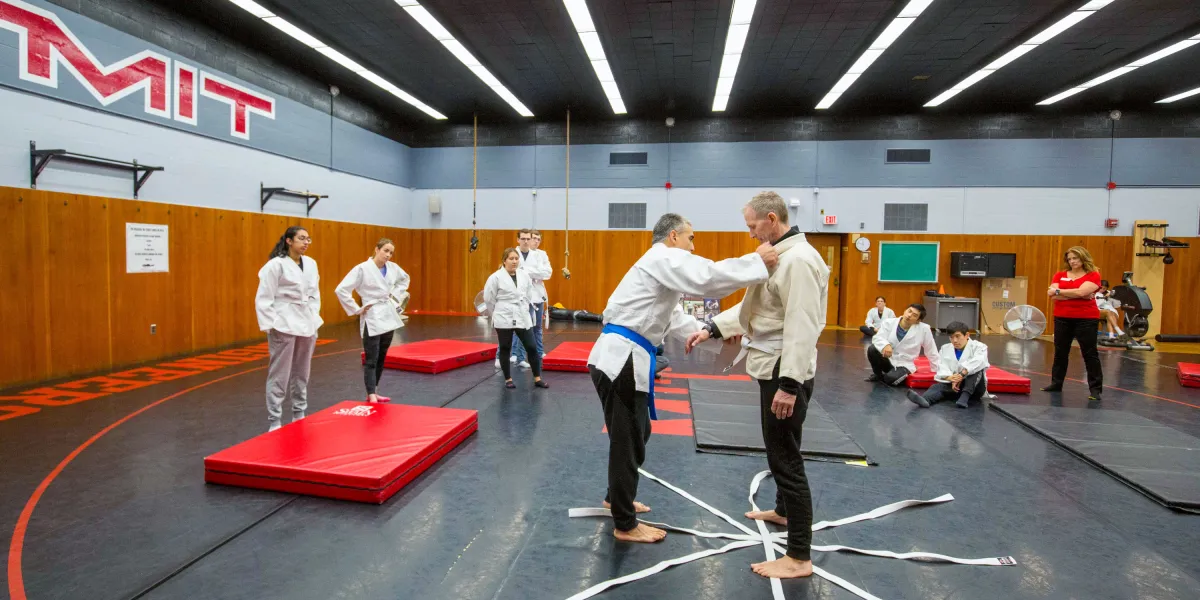
People use their bodies—not just their brains—to think. So the MIT Project on Embodied Education brings movement to the classroom and academics to the gym, the river, the studio, and even the playground.
1,276 words~6 min read