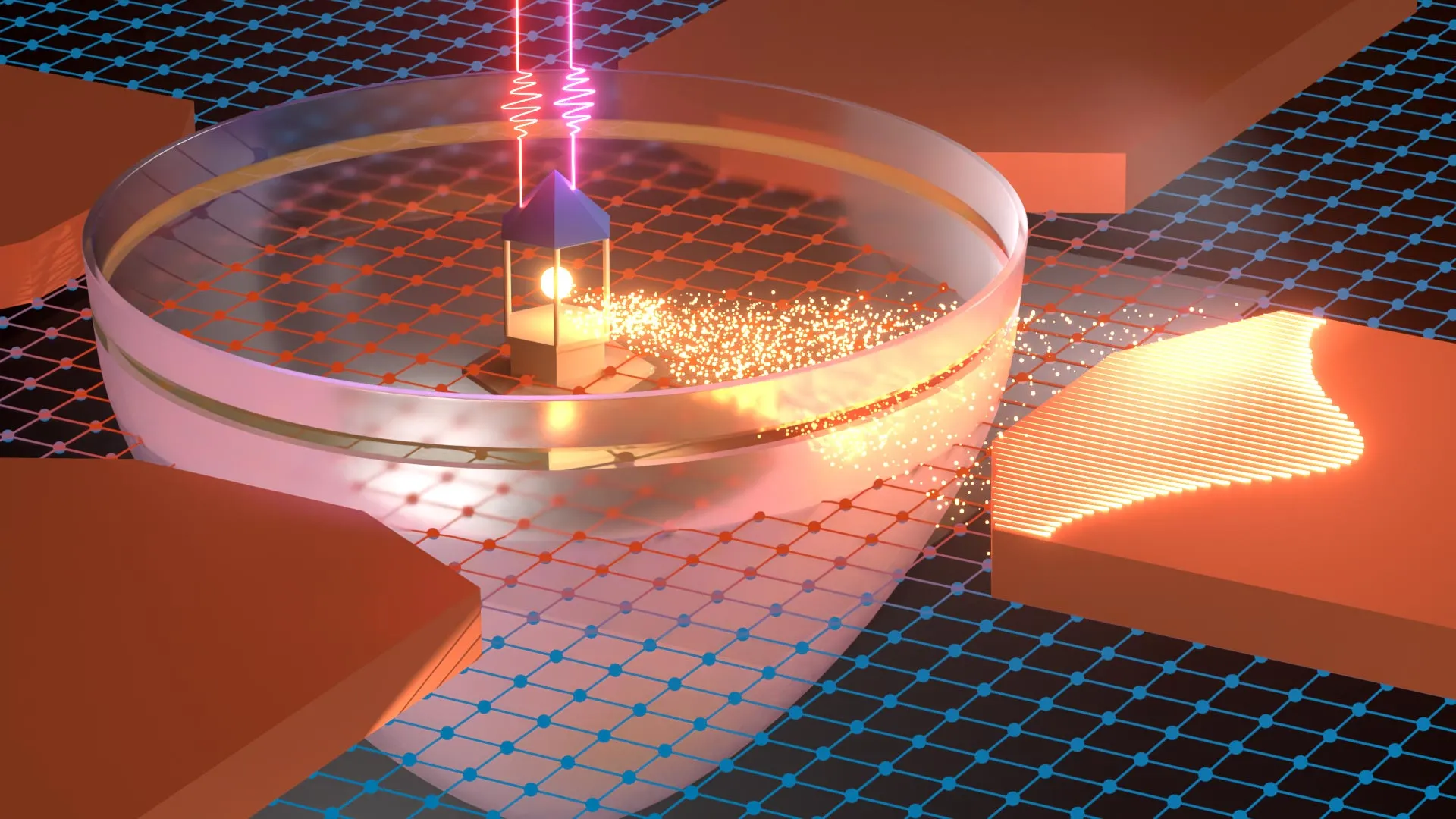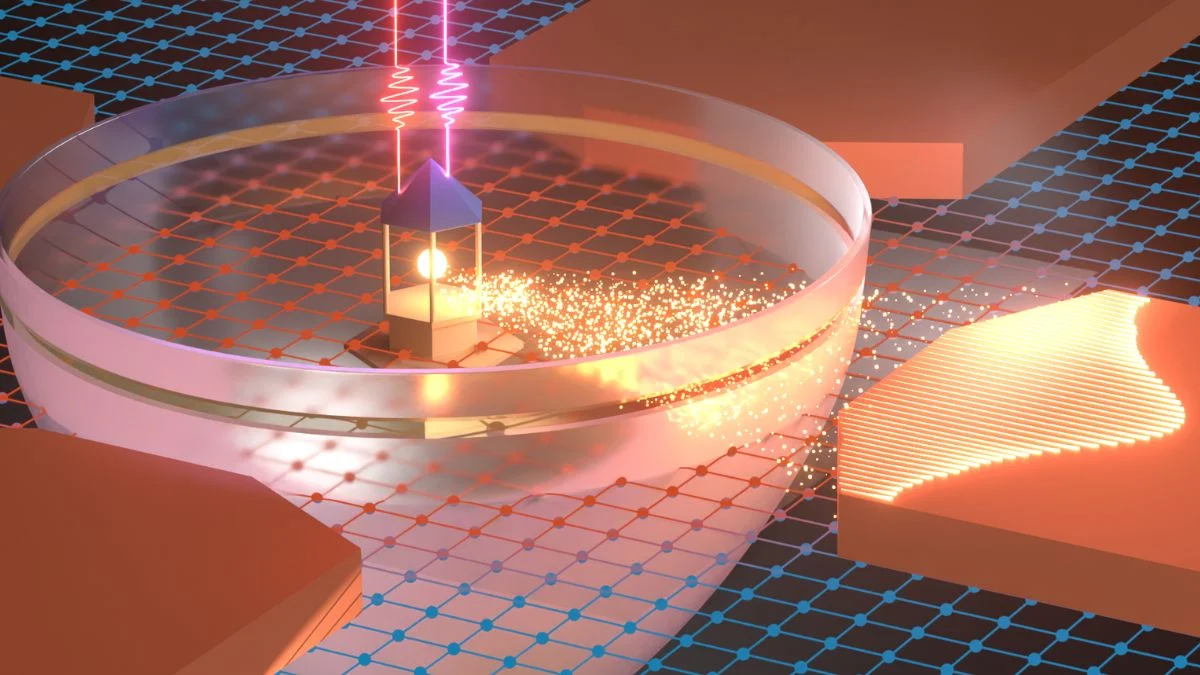
An illustration of the 'electron lighthouse' created at the University of Michigan. (Yiming Gong)
The flow of electrons powers our modern lives.From household conveniences like the indispensable air fryer to the variously sized screens we rely on for work and meme-browsing leisure, modern tech functions through the directed flow of electrons.Yet electrons play by the weird rules of the quantum universe, displaying strange behaviors unseen in the macroscopic world, like the superposition that allows them to exist in many states until they're observed, à la Schrödinger's theoretically undead cat.Sometimes, however, their odd activities do display real-world analogs that help us non-quantum-physicists wrap a fraction of our minds around unseeable processes.In a breakthrough study, physicists at the University of Michigan (U-M) have illuminated new physics by developing an electron lighthouse device that emits a beam of electrons that can be controlled using different 'colors' of light without requiring any electrical power source.The new electrical device created at the University of Michigan, in which two laser pulses meet to yield a beam of electrons that can be directed by switching the wavelengths of the beams. (Yiming Gong)"This isn't the way things normally work. When you think about electrons moving through a material, they're moving because you've applied an electrical field and they actually bounce around and drift across the materials," explains Steven Cundiff, an experimental physicist at U-M, as well as the study's senior author."Here, using light, you can actually sort of squirt the electrons in a specific direction without applying an electric field."With support from the US National Science Foundation, the researchers built a device that uses two laser beams of different 'colors' (in the invisible infrared region of the electromagnetic spectrum) to control the flow of electrons through a semiconductor."Probably the most surprising thing is that the currents produced by this process are even detectable using the device we made," Cundiff told ScienceAlert."The generated current is a 'ballistic' current, meaning the electrons travel along a trajectory determined by their initial 'launch' velocity. Usually, electrical currents are not ballistic, but rather are diffusive because the electrons are constantly scattering off impurities and defects in the material."An illustration of a conceptual apparatus in this study, though the actual experimental setup differs because it uses a prism sequence rather than beam splitters to separate the 'colors.' The electrodes pictured at bottom right helped detect the direction of electron flow. (Gong et al., Phys. Rev. Lett., 2026) The researchers built their device at U-M's Lurie Nanofabrication Facility (LNF), testing different methods to establish an experimental setup that didn't introduce external electric fields that could skew their results."That was the biggest puzzle to solve for me, because there isn't a standard way to do that," says Yiming Gong, a machine learning scientist now at Grainger and the study's first author."So I worked with the LNF staff to play around with different recipes and temperatures to come up with a manufacturing process."Previous theoretical and experimental work has shown that light alone can supply the energy needed to get electrons flowing."Actually, this project is kind of interesting, because I started working on [its predecessor] many years ago as a way to make a phase-sensitive detector for use in stabilizing frequency combs," Cundiff told ScienceAlert.Such frequency combs are central tools for allowing precision control of electromagnetic waves, creating more accurate clocks, computers, and communications systems.