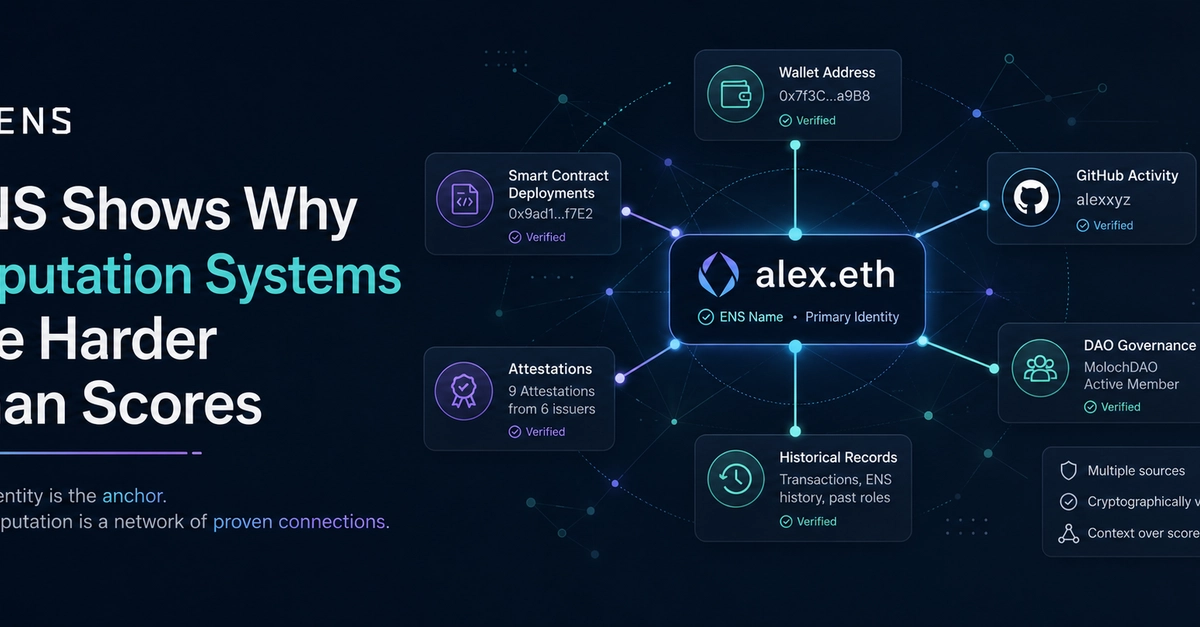
Most reputation systems start with a simple idea: take someone’s public activity, turn it into a number, and make that number useful. It sounds clean until you try to build it. A wallet is not a person. A name is not always a stable identity. A GitHub account, a deployment address, a DAO vote, and an ENS name may all point to the same developer, or they may point to five different people. The hard part is not creating a score. The hard part is proving what the score actually refers to.
ENS is interesting here because it gives developers something Web3 badly needs: a human-readable anchor. Instead of asking people to trust a random address, we can start with a name, a resolver, a history of records, and the addresses attached to that name over time. That does not solve reputation by itself, but it gives the system a more honest starting point. A reputation layer should not pretend that every address is equal. Some addresses are disposable. Some are long-lived. Some are operational wallets. Some are social identities. ENS helps separate those cases, but only if the system treats it as evidence, not as proof.
The first real technical problem is provenance. If a developer claims a contract deployment, a pull request, a DAO proposal, or an audit contribution, the system needs to understand where that evidence came from and how it was verified. Was the contract deployed by an address currently linked to the ENS name? Was it linked at the time of deployment? Did the developer sign a message? Was there an attestation from another party? Did the claim come from an indexer, a GitHub integration, or manual input? Without provenance, a reputation system becomes a collection of screenshots with a nicer UI.