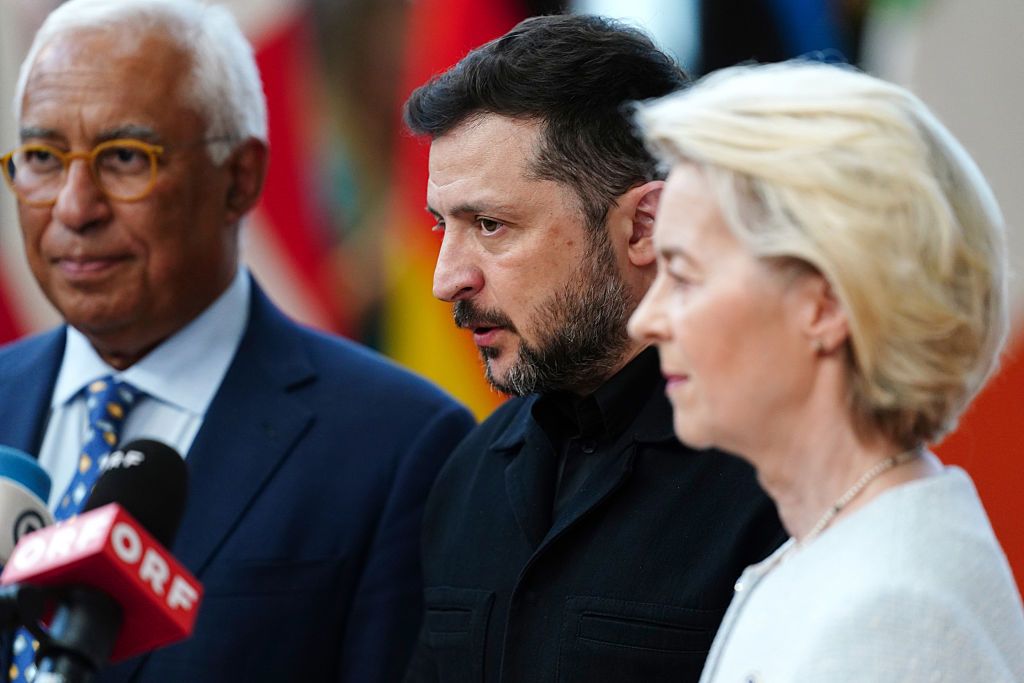
European Council President Antonio Costa, President Volodymyr Zelensky, European Commission President Ursula von der Leyen arrive at European Council Meeting on June 18, 2026 in Brussels, Belgium. (Pier Marco Tacca/Getty Images)BRUSSELS, Belgium — Despite a long and difficult birth, EU countries passed the bloc's 21st package of sanctions against Russia on July 23, and the measures that made it through show that the EU is not lacking in creativity when it comes to restricting Russia's war efforts.The EU published 218 new sanctioned entities in its July 23 announcement, the most in a single sanctions package since 2022.Several high-profile names did not make the final listing. Bulgaria blocked the addition of Patriarch Kirill, head of the Russian Orthodox Church. Estonia's suggestion to add Ireland's Aughinsh alumina plant did not make it through because it is still being investigated. And France said the time isn't right to include Russian propagandist Xenia Fedorova, Le Monde reported.But even so, the breadth of the final list reveals the ever-widening scope of the EU's ever-evolving sanctions regime. Banks, drone manufacturers, ship-servicing crews, athletes, oil refineries, and cryptocurrency platforms are just some of the categories being addressed.And the EU has gone global in its hunt for the loopholes Russia is exploiting to evade sanctions, with countries as far-flung as Mongolia, the Marshall Islands, India, Nigeria, and Panama all featuring among the listings.Going for (the) goldAn EU official also highlighted to journalists in Brussels "an important part of the package driven by non-economic factors."With Russia returning to ever-more cultural spaces and sports, the latest package "focused on prominent amplifiers of Russian propaganda, including through sports-washing," the EU official said.Prominent on that list is Russia’s sports minister Mikhail Degtyarev, who the EU's listing notes describes himself as "Putin's soldier."The sanctions also include several individuals associated with Russian media and propaganda, including Putin aide Vladimir Medinsky. The listing notes that Medinsky, who headed Russia's delegation for peace negotiations in 2025, "is a central figure" of the government's propaganda efforts.Vladimir Medinsky speaks at Ciragan Palace on July 23, 2025 in Istanbul, Turkey. Previous talks between Ukraine and Russia took place in Turkey in June and May of this year, but yielded few results. (Chris McGrath/Getty Images)Reasons for that listing include his work to rehabilitate Russian soldiers through sport, and to develop Russian sport infrastructure in occupied Ukrainian territory.The listings were welcomed by Glenn Micallef, the EU's culture and sports commissioner, who called them "a clear signal," and promised the bloc will keep taking action, "wherever necessary."But it is on finance where the EU's latest measures truly stand out.Ninety-four Russian banks are fully blocked from trade with Europe as a result of the latest package, roughly 50% of the country's banking sector, according to an EU official.But when measured by revenue, assets, and transactions, the percentage of the sector affected is far higher.Especially noteworthy is the EU’s decision to add Moscow’s stock exchange to the sanctions list in its own right.The listing highlights the exchange’s central role in trading “investments into Russian military corporations and government bonds,” and note that it is “under a high degree of control” of the Russian government.Separately, there are measures targeting Russia's gold exports, which generated $12 billion for Russia in 2025, as well as the $2 billion diamond trade.The EU's sanctions also focus on cryptocurrency more meaningfully than ever before, and the bloc has followed the U.K.'s lead by targeting Russia's notorious A7 crypto network, which helps the country evade sanctions.A7 was established in 2024 and is majority-owned by the Israeli-Moldovan oligarch Ilan Shor, one of the masterminds behind the 2014 Moldovan bank fraud scandal, in which $1 billion was stolen from three Moldovan banks. Promsvyazbank, a Russian state-owned bank that supports Russia's military-industrial complex, and which is also sanctioned by the United Kingdom, is a minority owner.The crackdown on crypto encompasses 14 third-country platforms from every continent, all identified as helping Russia circumvent sanctions.Critically, if a country hosts several crypto platforms that undermine the sanctions effort, EU countries have agreed they can impose wholesale bans at the country level, rather than identifying and targeting each individual company.An EU official told journalists that the hope behind such a move, beyond simplifying the work involved, is to encourage countries to do more to ensure sanctions compliance so they do not get blacklisted.EU brings back piracy to tackle shadow fleetAlong with the idea of wholesale country bans, some of the most creative thinking from the EU's sanctions team centers on stopping Russia's shadow fleet.Harking back to the 16th century, when English monarchs told their explorers that Spanish treasure ships were fair game for plunder, the EU has introduced a provision allowing member states to confiscate the assets on any shadow fleet vessels that they board, with the proceeds filling state coffers.In June, a Swedish court ruled that the grain aboard one shadow vessel could be returned to Ukraine, taken as it was from territory illegally occupied by Russia.The ship Jin Hui, which was boarded by the Swedish coast guard, is pictured in the haze outside Trelleborg, southern Sweden, on May 3, 2026. (Johan Nilson / various sources / AFP via Getty Images)European countries have increasingly begun boarding suspect ships in recent months, and the bloc agreed EU naval missions could also intercept ships they have reason to believe are part of the Russian shadow fleet.On top of that new provision, the EU has added a further 41 shadow fleet vessels to its sanctions database, enacted a ban on third-country ships offering services to the shadow fleet, implemented financial transactions bans on Russian ports, and even sanctioned a crewing agency providing support to the fleet for the first time.However, legal loopholes remain for Russia's fossil fuel industry, notably for the trade in LNG.The Commission had originally proposed banning EU operators from selling LNG tankers to Russia, which prompted objections from Greece.Athens has a large shipping industry, and it was already feeling the pain of the 19th sanctions package, which banned EU companies from importing Russian LNG and from transferring it to third countries.Greek shipping company Dynagas has been serving Russia's Arctic route with specially made ships that cannot realistically be deployed elsewhere. They are also funded by long-term loans from Chinese investors, meaning that closing down their business model would most likely have meant China inheriting the LNG trade route rather than shutting it down.To get Greece to accept the 21st package, which had already been postponed three times due to Athens' concerns, EU countries agreed to a new exemption allowing companies to keep transporting LNG to third countries, effectively weakening part of the 19th sanctions package.They also agreed to introduce a system forcing EU operators to notify of the sale of any LNG tankers. Three months later, EU countries will revisit the need for a full prohibition, but for now, there will be no change to Greek shipping's business model.In return, the European Commission was able to claim a victory in the decision to freeze the Russian oil price cap at $44 a barrel for a year, a freeze that Greece had previously been worried about, but which will now be frozen for twice as long as the Commission originally proposed.Long-range drone sanctionsRounding out the sanctions package, the EU announced 56 listings targeting the Russian military-industrial complex directly.An EU official told journalists that for the first time the bloc's sanctions team decided to "focus on one category of equipment, long-range drones, map the entire manufacturing and supply network, and target it in a single blow."That blow accounts for 37 of the military-industrial listings.And among the remainder, the EU already has in its sights entities working to help Russia produce an alternative to Starlink.In February, Defense Minister Mykhailo Fedorov persuaded Starlink's owner, Elon Musk, to deprive Russia of access, which some say helped tip the scales on the battlefield in favor of Ukraine.The EU has sanctioned a company called JSC-IRZ, or the Izhevsk Radio Plant, which has been providing navigational and communication components to Russian drones and is working on Moscow's satellite navigation system GLONASS.As usual, the EU's newest sanctions against Russia are also mirrored so that they apply equally to Belarus, but Belarusian entities can and do also get sanctioned in their own right. In the latest package, the EU has placed restrictions on Belarus' Mozyr oil refinery because it is "supporting and benefitting from the Lukashenko regime."Russia's President Vladimir Putin (C-R) and Belarus dictator Alexander Lukashenko (C-L) arrive to attend the Victory Day military parade in Moscow on May 9, 2026. (Igor Ivanko / AFP via Getty Images)Other ideas previously touted for the 21st sanctions package, including restrictions on Russia's fishing industry and on denying former Russian soldiers visas to the EU, were kicked into the long grass but could yet return.An EU official told the Kyiv Independent that the Commission needs to devise a workable proposal for determining which Russians should and should not be denied visas, which they would like to have ready "ideally in October."The work on the 22nd package has already begun. Lithuania's Foreign Minister Kestutis Budrys suggested that Russia's Rosatom nuclear energy company should be targeted, and Foreign Minister Andrii Sybiha floated adding Gazprombank to the list of sanctioned entities.Both of those suggestions are likely to trigger pushback. Germany has given the green light for Rosatom to be involved in a new nuclear facility in the country's northwest.And an EU official told the Kyiv Independent that Gazprombank is needed to carry out some of the "still legitimate trade going on."
From crypto bans to shadow fleet seizures, EU gets creative with Russia sanctions
BRUSSELS, Belgium — Despite a long and difficult birth, EU countries passed the bloc's 21st package of sanctions against Russia on July 23, and the measures that made it through show that the EU is not lacking in creativity when it comes to restricting Russia's war efforts. The EU published 218 new sanctioned entities in its July 23 announcement, the most in a single sanctions package since 2022. Several high-profile names did not make the final listing. Bulgaria blocked the addition of Patria
1,578 words~7 min read