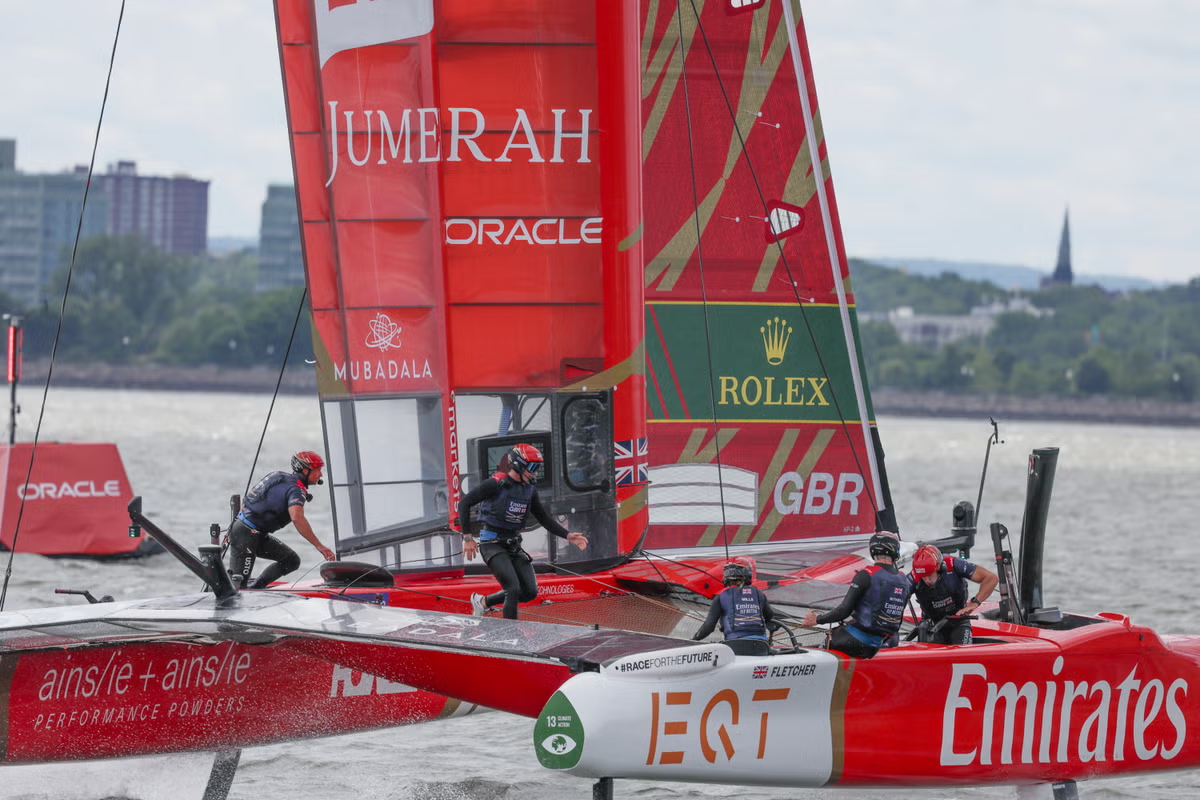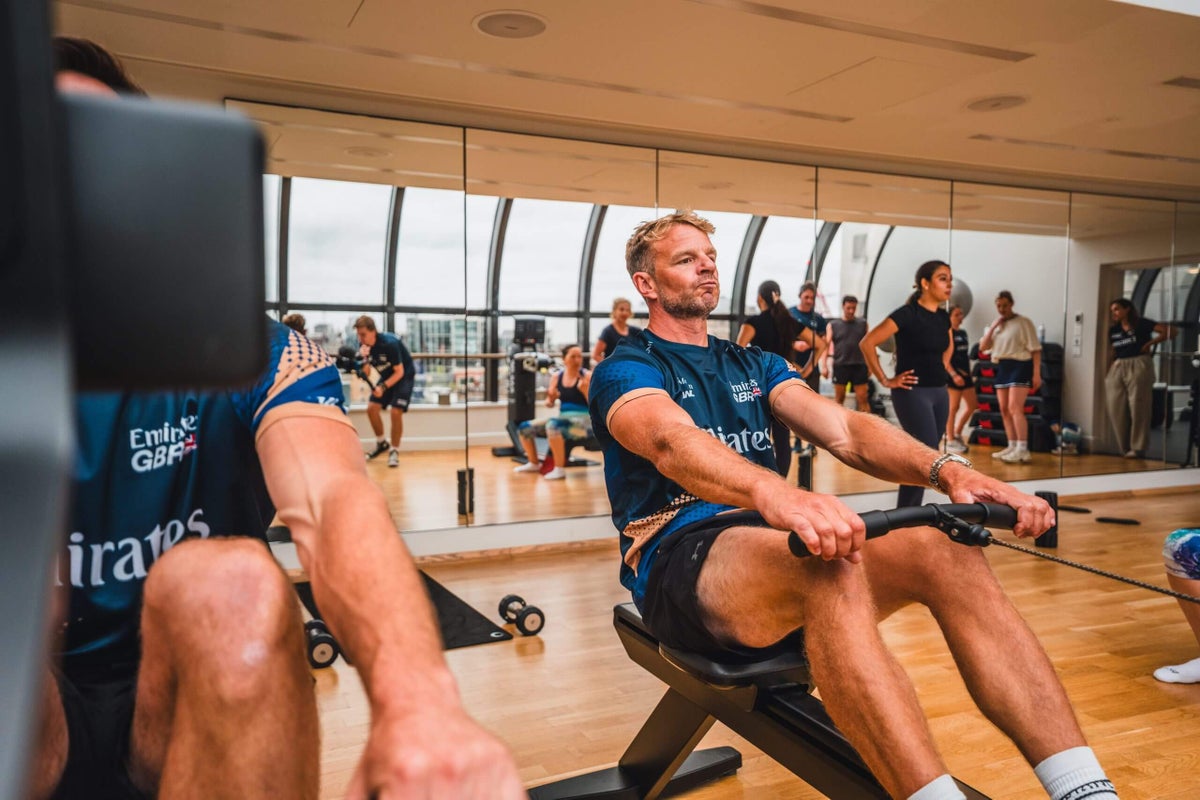
Editor’s note: This story is part of The Athletic’s coverage of SailGP, an international sailing competition that has been likened to Formula 1 on water. Follow SailGP here.Nick Hutton is building towards perhaps the most important weekend of his SailGP season.Racing on board the British F50 catamaran as one of two powerhouse grinders, Hutton must be getting fired up to put on a strong performance in front of the home crowd in Portsmouth, right?“Um, for me, I don’t think it really makes any odds, it’s just the same as usual,” he tells The Athletic. “We talk a lot about trying to keep things the same in sport. So, even when we’re in England, we treat it as just another race in another place. We try to ignore that your family are there and we just crack on with the job.”Hutton is looking for consistency. He and his fellow grinder, Neil Hunter, are the power units on the six-person British team. The grinding pedestal mounted in the front of each of the port- and starboard-side cockpits is where Hunter and Hutton do their hard work. When they turn the handles on this hi-tech instrument of torture, they’re providing the power for wing trimmer Stu Bithell to pull in the wing and power up the sail plan to make the boat go faster.He says he can sustain short bursts of power, just over 1,000 watts, for key maneuvers around the race course. Weighing 191.8 pounds (87kg) and standing at 5ft 9ins (181cm) tall, Hutton consumes around 4,000-5,000 calories per day and trains twice a day for most days of the week. “Just one session on Sunday,” he says.While it’s not quite as good as the real thing, upper body muscle and fitness can waste away very quickly. “It’s hard to compare directly, but on the grinding ergometer, I can easily sit at 240 watts for an hour in zone 2/3 — just sitting there chatting or watching TV.“That level of output with your arms and shoulders is unique in sport because your upper body is made up of smaller muscle groups that are built for short bursts. If you make them work continuously for 10 minutes or an hour, you get a massive lactic acid buildup very quickly.”Nick Hutton and Neil Hunter during a practice session ahead of the Perth Sail Grand Prix earlier this year. (Ricardo Pinto for SailGP)While four back-to-back races might sound like a lot on a typical weekend day of SailGP competition, Hutton says it’s not that hard compared with the training regime. “We train much harder than we race, so racing feels relatively easy compared to our on-water training sessions.“We know what’s coming and how many laps we have to do, and our races are only 20 minutes long, whereas we train for an hour to an hour and a half. So 20 minutes isn’t a real issue.”When I joined Hutton and other members of the British race crew in the gym of the Jumeirah Carlton Tower hotel in Knightsbridge in London’s west end, he put me to work on the grinding machine.I do a minute of forward grinding (pushing the handles away from me) and then a minute of reverse grinding (pulling the handles towards me). Hutton, of course, had made it look easy. I am struggling to register 200 watts on the digital scale.“You’re just about at the level I’m at for our 60-to-90-minute sessions when we’re in cruise mode watching YouTube videos,” he tells me, matter-of-factly. No sugar-coating of the raw facts. He says it how it is.Which is also how the team speak to each other when racing. The driver Dylan Fletcher never demands anything like a “big push here, lads” from Hutton and Hunter.“It’s an interesting thing across professional sports that we don’t really talk about how we play the game or how we’re going to do a maneuver,” he says. “If a maneuver happens, we just do it because we’re all very good at it.“We don’t tell someone to drop the board, pull the wing in, or ease the jib; all those functions just happen. It’s just, ‘Tacking in three,’ and that’s it. We try to keep a really quiet boat during the maneuver so everyone can concentrate on their roles, and then we’ll start talking again after the maneuver is over.“We’re trying to minimize conversation about how we’re sailing the boat as much as possible and base everything on performance and what’s around us. It’s about making us as quick as possible around the track without involving basic boat handling in that.“For me, if you can do the boat handling perfectly every time, that’s three meters gained right there. Tactical decisions are what they are — you might get them right or wrong — but boat handling should be perfect every time. There’s no excuse for it not to be.”Andy Rice, on the grinding ergometer, struggles to match Nick Hutton’s power. (Emirates GBR)Hutton overlooks the fact that teams get very little time to train on board the F50s. They do as much as they can on land — using simulators, gym training and group discussions to maximize the precious time on the water. Everything has to be spot on, or mistakes like Britain’s boat-breaking crash in Halifax a few weeks ago will happen from time to time. “There’s a lot happening all at once,” Hutton says.There’s also the small matter of flying across the water at up to 60 mph (100 km/h), being firehosed by the spray and trying to resist up to 3G through high-speed maneuvers.“It’s a challenge,” says Hutton. “If you imagine a grinding ergometer in a static, controlled environment where you’re not getting fire-hosed and it’s not moving around, and then you add all those ocean elements on top, it becomes much harder to provide that instant power for the wing sheet. Quite often, when things start going wrong, that’s when we need to put more power into the wing sheet because they need to move it more when it’s out of control, not less.”Hutton, like all his teammates, is a perfectionist. “I’ve always been quite picky about the small details, and I don’t think I ever have a ‘perfect’ race.“There are always things you think you could do better, and that’s what drives you. A lot of the guys are the same; they can always find things they could have done one percent or two percent better over a day, or even during a single tacks. You might be a tiny bit off on one tack, but then you try to make it better the next time around.Nick Hutton and Neil Hunter work the grinding handles during a practice session ahead of the Bermuda Sail Grand Prix on May 8, 2026. (Bob Martin for SailGP)“It comes down to tiny fractions — like being less than half a second off on popping the camber [when the wingsail pops from side to side through a maneuver]. A quarter-of-a-second difference affects how fast the boat turns, when the camber pops, the pitch, and the balance on entry. All these things loop together.“The key to all professional sport is to keep pushing to be better every time. It’s super rare to have a vision like Ayrton Senna talked about — where you’re in total tunnel vision and don’t even feel like you’re in the car anymore, especially in sailing because there are so many changing variables. It’s not like we’re racing on a fixed track.”Aged 43, Hutton concedes in pure power terms, his best days might be behind him. But the huge experience he carries from growing up racing dinghies in Exmouth, in the south-west of England, is all relevant experience.Even though most sailing boats barely touch into 10 knots, and F50s are capable of over 50 knots, Hutton argues that every experience feeds back into being better at SailGP. It’s the kind of broad experience that the next generation will struggle to match.“It might sound arrogant, but I think I’m in a fairly unique position. I learned to sail on a 52-foot race boat with a dip-pole and traditional spinnakers (a large, three-cornered sail). I went through that whole evolution — sailing with spinnaker poles, moving into the Prada America’s Cup days when foiling catamarans first started, right up to where we are now.“Not many people have done all of that, and it gives you a really strong foundational understanding. I even did the Round the Island Race [around the Isle of Wight in the south of England] last week on a classic wooden boat, and it all has relevance.”
How to train like a SailGP athlete: 5,000 calories a day and 13 training sessions a week
Britain's SailGP athletes have very little time on their boat so most of their training takes on land in the gym
1,431 words~7 min read