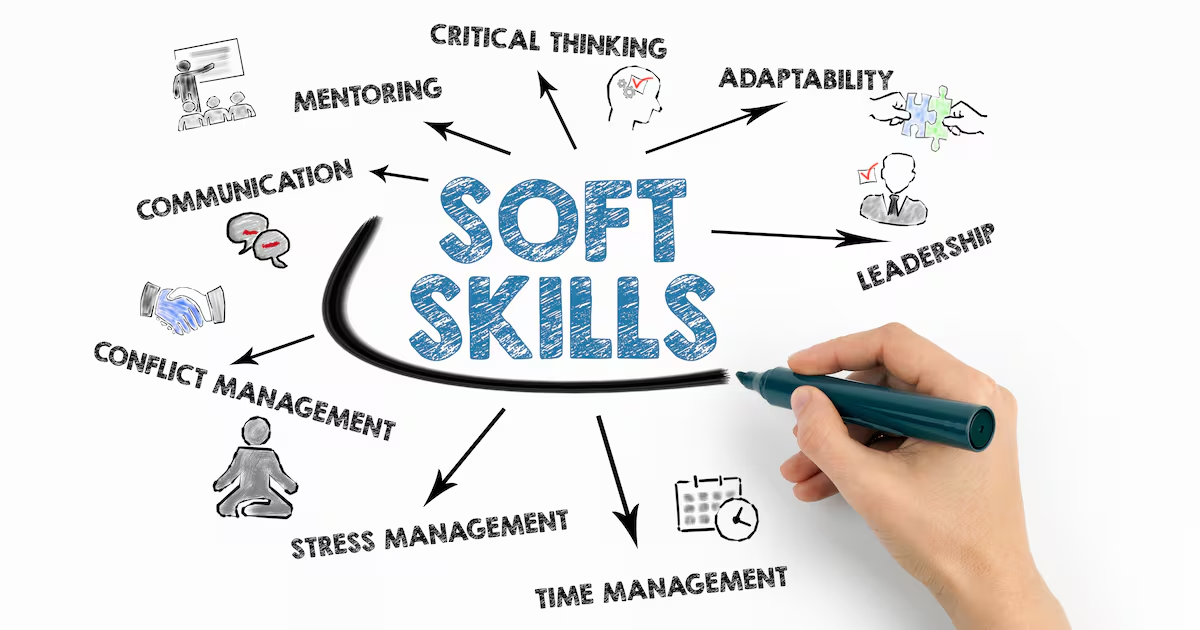
Amid the rise of skills-first companies, South African businesses are making sharper, evidence-based talent decisions tied to organisational performance. However, in this environment, “skills versus degrees” is often wrongly framed as a tug-of-war.“A skills-first business should not be understood as an organisation that disregards credentials, but as one that asks whether credentials are supported by evidence of capability, adaptability and real-world performance,” explains Prof Cobus Oosthuizen, PhD, Dean of Postgraduate Studies at Boston City Campus.Prof Cobus Oosthuizen, Dean of Postgraduate Studies at Boston City Campus, says experience strengthens the value of postgraduate education. (Boston City Campus) This distinction is increasingly important in a labour market marked by misalignment. The department of higher education & training’s (DHET) 2024 National List of Occupations in High Demand shows that 51.7% of South African workers are employed in roles for which they do not have the correct education level, while 30.3% work in fields unrelated to their highest qualification. This reinforces the point that the real challenge is not degrees versus skills, but the alignment of qualifications, capabilities, experience and labour-market relevance.Oosthuizen notes that formal study remains the most powerful investment an individual can make in their long-term career. Higher education provides the intellectual scaffolding to interpret complexity, understand organisational systems and make responsible decisions.“Deep strategic capability cannot be taught in isolation. It needs professional maturity, real experience of South African corporate realities, and the ability to lead teams, solve problems and decide under pressure. Without this grounding, advanced theory has no anchor,” says Oosthuizen.Durable foundation of executive learningAccredited higher education is most effective when grounded in practical exposure. South African professionals with operational experience bring real cases and organisational dynamics into the classroom, making theory a tool for interpretation rather than abstraction.“Professional experience enriches executive learning by giving students lived context to test academic ideas. A manager who has faced competing priorities, people dynamics, resource constraints and pressure engages more deeply with postgraduate study,” says Oosthuizen.“When students arrive with operational experience, the classroom becomes a strategic laboratory. They analyse, debate and challenge each other using real corporate scenarios, which elevates the entire learning experience.”When students arrive with operational experience, the classroom becomes a strategic laboratory— Prof Cobus Oosthuizen, Dean of Postgraduate Studies at Boston City CampusThis is why Boston’s suite of higher education qualifications and postgraduate programmes is intentionally designed to build on existing capability rather than replace it.The DHET/Labour Market Intelligence report on skills gaps in South Africa supports this approach, noting persistent gaps in critical thinking, active learning, complex problem-solving and judgement — precisely the competencies strengthened when academic study builds on prior workplace experience.Oosthuizen argues that prior professional skills amplify academic study by helping students test frameworks against lived organisational complexity, while diverse South African industry backgrounds enrich peer learning and deepen collective insight.“The value of advanced business education lies not simply in acquiring more information, but in developing a more mature way of thinking. “Prior workplace experience helps transform academic study into reflective practice, where professionals learn to connect concepts, evidence, context and consequence,” he notes.Theory grounded in strategic judgementA modern skills-first organisation does not abandon management theory; it depends on it. Operational agility needs sound principles, while academic frameworks build the context, judgement and ethical responsibility managers need in uncertainty.Oosthuizen also states that good management theory gives leaders disciplined ways of thinking. “It helps them move beyond instinct, habit or short-term reaction. But theory becomes powerful only when connected to context, judgement and responsible action. That is the capability modern managers need,” he says.A framework such as systems thinking becomes transformative when a manager uses it to diagnose market uncertainty, map organisational interdependencies, and make decisions that balance risk with opportunity.“At senior management level, the most important capability is not simply knowing what to do. It is knowing how to judge what is appropriate when the situation is complex, the information is incomplete, and the consequences of a decision affect people, performance and organisational sustainability,” says Oosthuizen.This emphasis on judgement is increasingly relevant in a labour market where education improves prospects but does not guarantee employability. Stats SA’s Q1 2026 Quarterly Labour Force Survey shows unemployment at 32.7%, but only 12.2% among graduates — compared with 35.7% for those with matric and 37.6% for those with less than matric. Education clearly matters, but capability and readiness remain decisive.Boston’s curriculum is built and delivered by a professional business faculty who understand that theory becomes powerful only when applied by individuals who already grasp corporate realities.Where capability meets postgraduate achievementSouth African organisations’ workplace needs are directly connected to postgraduate achievement. Strategy demands context, and context demands experience. This is why Boston’s premier Master of Business Administration (MBA) programme requires at least three years of supervisory or managerial experience.The MBA is not an entry-level qualification; it is a strategic accelerator for professionals who already understand the mechanics of organisational life.The programme brings theory and practice together, equipping managers with analytical depth, strategic frameworks and executive leadership insight while building on proven workplace capability. This is skills-first in practice: not skills instead of education, but skills that make education more powerful.“For postgraduate business education, the ideal learner is not a blank slate. The ideal learner brings experience, questions, challenges and professional maturity into the learning space. That is what allows advanced study to become transformative,” says Oosthuizen.This is especially relevant in a country where youth unemployment remains structurally high. Stats SA reports 4.7-million young people aged 15-34 were unemployed in Q1 2026, with youth unemployment at 45.8%. Employers are therefore placing greater emphasis on capability, workplace readiness and practical experience — qualities strengthened through postgraduate study built on real-world exposure.More information is available on the MBA programme page.This article was sponsored by Boston City Campus.
Why capability, context and education matter in the skills-first era
SPONSORED | Boston City Campus explores how workplace experience strengthens postgraduate learning, preparing professionals to lead with sound judgement and strategic insight
953 words~4 min read