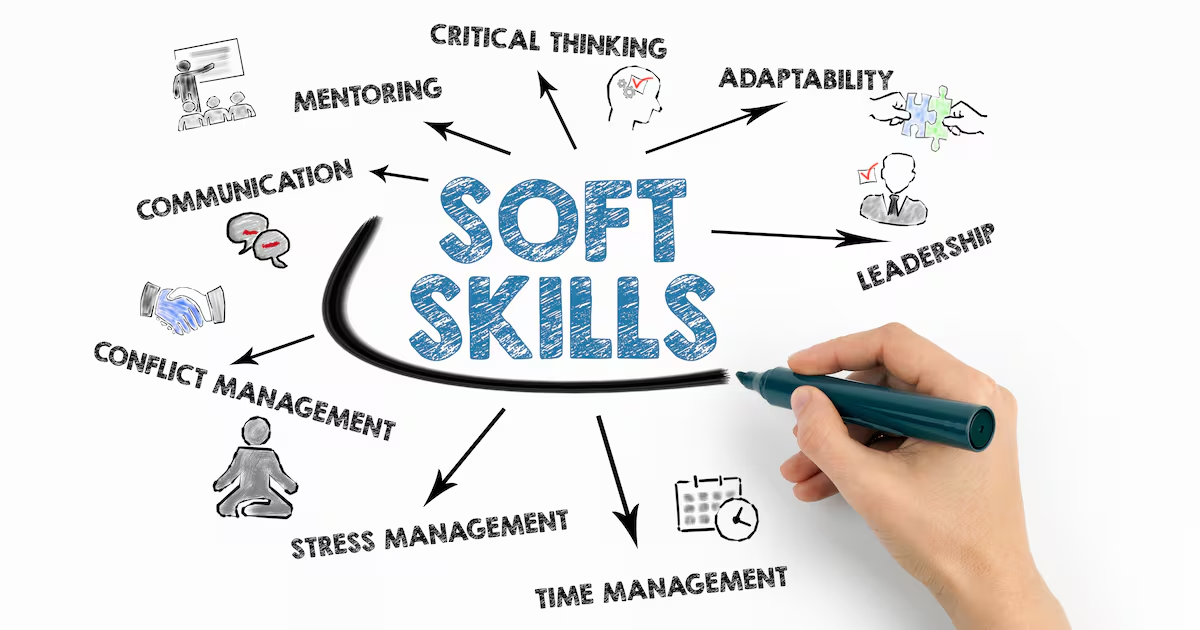
Skills like critical thinking, creativity and problem solving allow a graduate to stand out from their peersEmployers are looking for hard skills required through education and training in tandem with soft skills. Illustration: Getty Images Tue Jun 09 2026 - 16:01 • 5 MIN READRecent graduates have an opportunity to stand out among their peers and colleagues by looking beyond their degree to their college activities, which most likely taught them just as much.Often, soft skills such as communication, creativity and emotional intelligence are dismissed as being less important than the required skill set listed on a job advertisement. However, a balance between occupational hard skills and the attributes and personality traits of soft skills is necessary for all graduates. It’s a matter of recognising your individual soft skills and keeping them continually enhanced to set yourself apart from others in an overcrowded job market.Marie Kielty, career coach at Technological University Dublin, suggests soft skills are often more important long term than technical skills. “Some of the top transversal soft skills employers want include communication, teamwork, problem-solving, adaptability and a willingness to learn, time management and leadership,” she says.Soft skills are essential for most careers as they are based on how people manage difficulties, co-workers and environments. As Kielty observes, employers are looking for hard skills required through education and training in tandem with soft skills.Recent graduates in a heavily swamped job market need to stand out to secure a job placement. This means understanding both the technical and interpersonal skills they can bring to the table as a suitable applicant.“Candidates need to research sectors of interest and focus on the organisations and roles that they find exciting and compelling as a career,” says Mark Cumisky, career and skills consultant at UCD Careers Network. “They then need to outline how their academic, extra-curricular, internship, voluntary and any other work experience has developed skills relevant to the role and organisation at hand.“Those with experience in the hospitality or retail sectors, for example, have learned a lot about dealing with clients efficiently and effectively in a fast-paced environment, about dealing with unexpected issues, and about the importance of reliability and well-constructed systems.”Kielty recommends considering the many skills their degree programme will have prepared them for and to think further outside the box to the skills they have developed over the years that will give them an edge over less experienced applicants. Digital and technology skills are sought across almost every sector, not just the engineering and technology sectors— Marie Kielty, career coach“Every degree programme will allow students and graduates to develop bespoke skills for that sector, be it engineering, science, etc,” she says. “Academic skills can be reflected in the results the student attains – for example, a 2.1 honours degree.”The soft skills, however, such as being a team player, a problem solver or a strong communicator, “are the skills that allow a graduate to stand out and stand apart from their peers”.Graduates need to be aware that the “endless projects and course work” allowed them “the opportunity to practise and develop these skills”, says Kielty. “The graduate’s ability to have solid examples from their college placement or part-time work to support these skills can be the influencing factor.”With the job market swiftly changing in terms of technology and AI, careers are taking interesting shifts. Graduates should embrace these changes, while recognising the need for the human element in business. Cumisky says the Early Careers Employer Survey 2026, conducted by the University of Limerick, indicates that 66 per cent of employers are recruiting as planned and a further 24 per cent are proceeding with hires “with more caution”. He says the recent National Association of Colleges and Employers (NACE) Spring Job Outlook in the US projects hiring for the class of 2026 to be up by 5.6 per cent, with only 11.4 per cent of respondents expecting a reduced hiring rate. “As would be expected,” he says, “the emphasis on AI skills is growing, particularly around identifying appropriate tools, developing effective prompts, the ability to analyse and revise AI outputs, and the ability to develop tools to increase productivity.”Marie Kielty, career coach at TU Dublin Kielty also highlights the shift in additional skills required by recent graduates. “It is important to note,” she says, “that digital and technology skills are sought across almost every sector, not just the engineering and technology sectors. A 2025 article from KPMG, Future-proof your Workforce by 2030 states, “Employers cited the fast-growing demand for skills in artificial intelligence and big data, networks and cybersecurity, and technological literacy, along with an ongoing need for core skills in analytical thinking, resilience, flexibility and agility.’”Despite the anticipated surge in AI consuming the potential roles of recent graduates, “a recent UK report on AI and Early Careers from Prospects Luminate noted that while employers anticipate automation of entry-level tasks in the next three years, tasks involving judgment, stakeholder engagement, and complex decision-making will remain human-led”, says Cumisky. “Only 17 per cent of employers expect entry-level hiring reductions through to 2029. “While discussion of the impact of AI on the workplace swings between optimists and doomsayers, it is worth noting that the same report found that uncertainty around AI capability, reliability, and appropriate levels of human oversight is foremost among UK graduate recruiters.” For a graduate to stand out in the job market, it’s vital to both utilise all of the skills they have learned and developed and promote the soft skills that will make them a stronger, more accessible and desired candidate.“The strongest candidates are often able to combine their technical or academic skills with their digital and AI skills, and their soft skills,” says Kielty. “They ideally should be able to demonstrate a willingness to continue to learn whilst also being flexible and adaptable. Many future jobs have not yet been invented, so graduates must continuously be prepared to update their skills.”[ From AI threats to bad bosses: why emotional intelligence mattersOpens in new window ]Mark Cumisky, career and skills consultant at UCD Careers Network Cumisky lists valuable soft skills and their importance in an ever-changing career landscape.Effective communication: “The ability to clearly put across your ideas in verbal and written form in language appropriate to the context, allied to being able to take on board others’ points of view.”Teamwork and leadership: “The ability to build rapport, collaborate with, persuade and motivate colleagues and clients towards mutually beneficial outcomes.”Resilience and self-discipline: “The ability to manage yourself and deal with setbacks. How do you deal with stress when something goes wrong? How do you deal with the unexpected issues that occur during projects? The emphasis here is on effective and positive coping skills. Are you confident enough to create solutions or ask for help?”Adaptability and agility: “The ability to deal with the ever-changing environment, being able to embrace new concepts and technologies in an effective and ethically sound manner, taking into consideration wider points of view beyond the immediate issue.”Critical thinking, creativity and problem solving: “The ability to deeply engage with the issues beyond just dealing with an immediate problem (although being able to maintain both a focused and strategic perspective is highly valued), taking into account multiple variables and being open-minded about potential solutions while maintaining relevance.”IN THIS SECTION
What ‘soft skills’ are and why they’re more important than ever
Skills like critical thinking, creativity and problem solving allow a graduate to stand out from their peers
1,209 words~5 min read