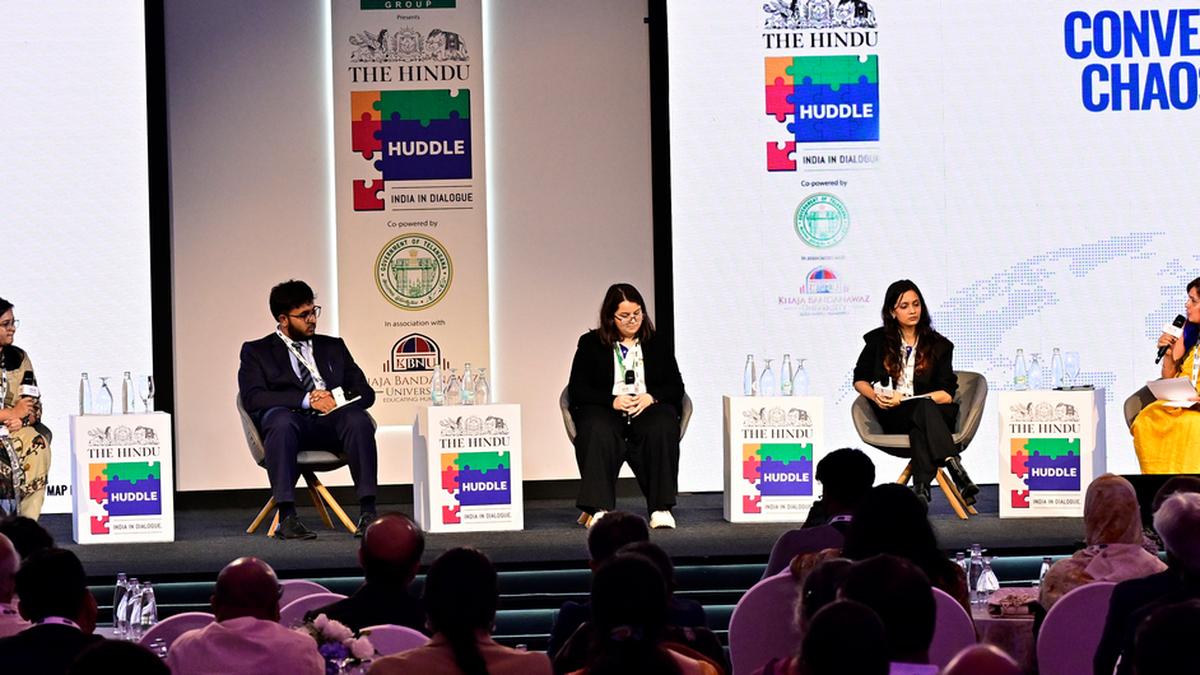
A panel discussion on ‘Degree or skills, what will matter in the future?’ in the student huddle organised as part of The Hindu Huddle in Bengaluru on Friday (June 5, 2026) turned into an incisive and critical analysis of the prevalent education system and the job market in the country, with young people coming up with interesting solutions to various issues.The panellists felt that there was an urgent need to integrate degrees with skills as skills were important, but degrees could not be discarded.The Hindu’s Maharashtra chief of bureau Vinaya Deshpande Pandit, who moderated the session, raised the issue of what would matter to young people in the coming days — formal education or skills learnt by candidates on or off the course.Ms. Pandit said she was extremely pleased to see that the younger generation was intelligent, innovative and had great clarity of thought.Aditi Singh, a management student from Amity University, said emphatically that she believed that ‘skills before degree’ was the way ahead. Anishka Chandra, studying biotechnology, said she believed skills were important, but she would not discard the importance of degrees. “Finally, I think it is degree before skills, as there is no way to consider a candidate eligible for a job,” she said.Abd Ur Rehman Mujahid, a graduate student of medicine, Khaza Banda Nawaz University, Kalaburagi said the relative importance of degrees or skills was highly sector-specific, as some fields required degrees while others required skills.“The issue is highly industry-specific. In medicine you need a degree, as you cannot treat someone or operate on someone by watching YouTube. At the same time, I read a report in The Hindu that there were over 26,000 [firms] in Bengaluru this year. If you ask the question as to how many founders have degrees, the answer may surprise us,” he said.Mr. Mujahid also said that the brand of the college, the perceived importance of the degree, and alumni networking were more important than skills, at least in some sectors.Premika Vallabhaneni, a post-graduate student of pathology, KBN University, felt that both degrees and skills were important, but there was a need to integrate them seamlessly.“Skills are and remain important but a degree is really important. There are several countries like Germany and Switzerland that have successfully integrated skills with academic curriculum. But they have not abandoned degrees,” Dr. Vallabhaneni said. “Also, our society is degree-driven. You are judged by what you are studying and not how well you can do something,” she said.“I keep hearing this argument that a degree without skills is useless. But to enter the employment arena, you need a degree. Therefore, both go hand-in-hand,” she said.Ms. Pandit asked the students if they thought that the current education system was giving them the necessary skills.To this, Ms. Singh felt that most degrees were preparing students for examinations and not for the job market. Ms. Chandra said that today’s students needed skills like communication. Mr. Mujahid felt that the curriculum in recent use was better than those in the past, as experiential learning was being introduced from the second year of degree in medicine and most other courses.Dr. Vallabhaneni said that the system tended to make students learn, but did not give them enough experience. Only fields like medicine give experience. Internships and project-based learning should be introduced in many more courses, she said.Ms. Pandit wanted to know if students were taught to be job givers in the present education system or not. “We all know that the world is changing. Is our education system attuned to future demands of the students?” she asked.Dr. Vallabhaneni felt that the general impression was that the value of a basic degree was being reduced and that was why the job market expected the youth to obtain more higher degrees.Mr. Mujahid felt that most courses lacked an element of innovation and that was the cause of low spirit of entrepreneurship. He felt that the continuing influence of the Macaulay system of education was creating clerks and not entrepreneurs or innovators. “It is all about memorisation and recall-based examination, and not innovation,” he said.Ms. Pandit countered this by saying that the Indian education system has undergone a lot of changes after Independence, by introducing innovation, internships, volunteering, learning on the job and others.Ms. Chandra said that a lot has changed, but there was room for more changes, to make students job-ready. Ms. Singh said that she was not very sure if the education system was making students job givers.Ms. Pandit sought their opinion on the influence of artificial intelligence (AI) on the future of education and employment.Mr. Mujahid felt that AI was a threat to some sectors, while in others, it was just an illusion of the threat. The Supreme Court has felt AI tools could be helpful tools, but could never replace a human judgment.Ms. Chandra said that understanding AI was a skill that most people needed, especially new-age teachers. Ms. Singh said she only felt that AI was a tool that can be helpful in various fields.Dr. Vallabhaneni said that AI’s credibility was a question to be judged by humans. She warned of the dangers of jobless growth, especially in days of AI usage explosion. Ms. Chandra said that the question about technological challenges has to be asked after asking the question as to how many people had access to technology.Dr. Vallabhaneni said that the issue of social equity was the most important question before human society. “In forming policies about education, employment or other issues, we should not forget the deprived communities, rural residents, the poor and the deprived. Just as we impart technical skills, we need to cultivate values of empathy and understanding. We need to teach young people social skills of human networking, communication and cooperation,” she said. Mr. Mujahid favoured universal access to higher education.Ms. Singh said that rural and urban students did not have equal resources and that they needed to be provided equal opportunities.To a question on what India should do to fix things in the areas of vocational and higher education, all felt that the skill gap in education needed to be filled. Youth had to be taught not only job skills, but also soft skills like networking and communication.Citing the recent example of Class 10 students who exposed loopholes in the CBSE on-screen marking system, Ms. Chandra said a policy about basic skill training in education was required.The Hindu Huddle is presented by the Sami-Sabinsa Group as the Presenting Partner. The event is co-powered by the Government of Telangana and held in association with Khaja Bandanawaz University.The event is further supported by Bank of Baroda, Larsen & Toubro, Apollo Hospitals, IIM Sirmaur, ICFAI Group, TAFE, Wizzmon, Uttarakhand Government, Associate Partners; Casagrand, Realty Partner; Toyota, Luxury Car Partner; Amity University Bengaluru, University Partner; Harrow International School Bengaluru, Education Partner; Meghalaya Tourism, State Partner; and NDTV 24x7, TV Partner.
Pressing need to integrate degrees with skills, say students
Students advocate for integrating skills with degrees, emphasizing the need for a balanced approach in education and job readiness.
1,143 words~5 min read