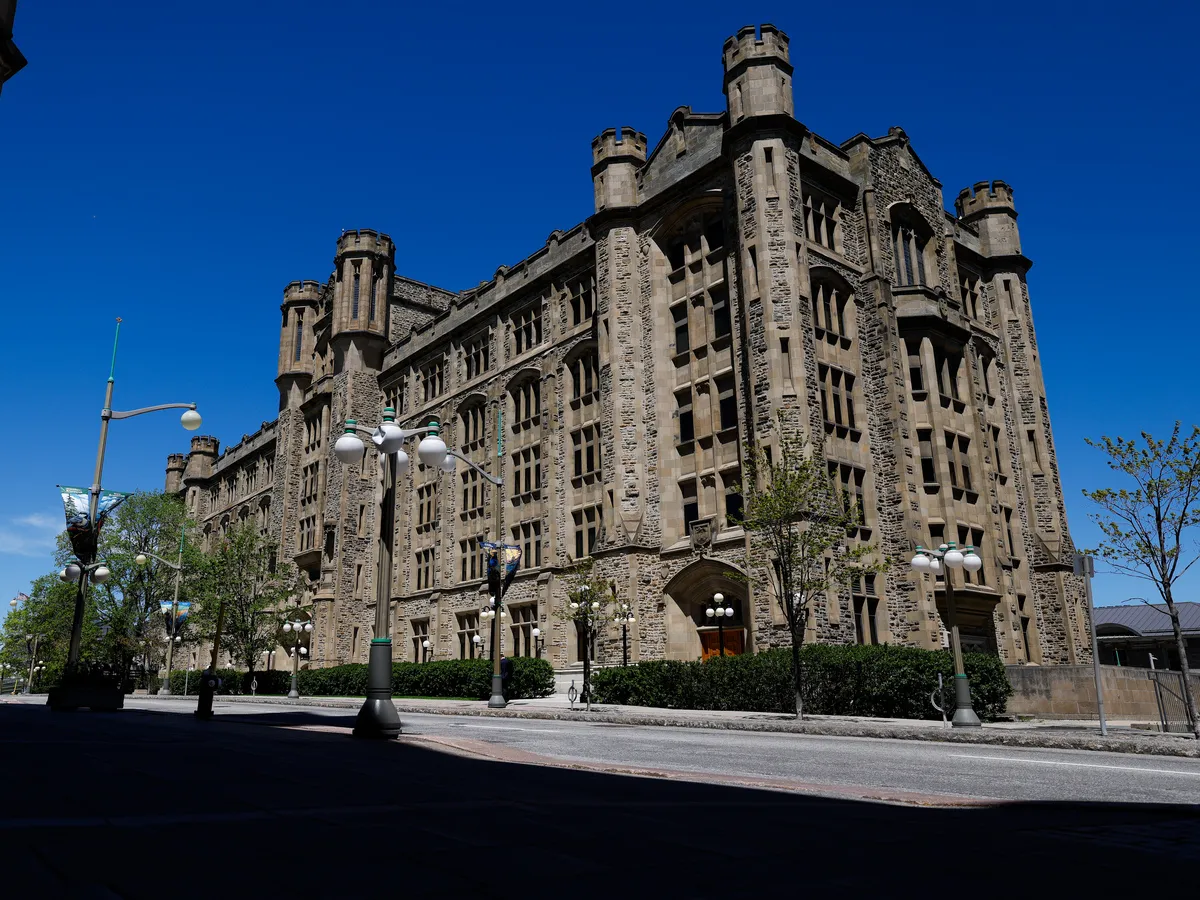
Skip to Content News Archives Economy Energy Oil & Gas Renewables Electric Vehicles Mining Commodities Agriculture Real Estate Mortgages Mortgage Rates Finance Banking Insurance Fintech Cryptocurrency Work Wealth Smart Money Wealth Management Investor Personal Finance Family Finance Retirement Taxes High Net Worth FP Comment Executive Women Puzzmo Newsletters Financial Times Business Essentials More Innovation Information Technology FP500 Podcasts Small Business Lives Told Tails Told Shopping Financial Post Store Obituaries Place a Notice Advertising Advertising With Us Advertising Solutions Postmedia Ad Manager Sponsorship Requests Classifieds Place a Classifieds ad Working Profile Settings My Subscriptions Saved Articles My Offers Newsletters Customer Service FAQ News Economy Energy Mining Real Estate Finance Work Wealth Investor FP Comment Executive Women Puzzmo Newsletters Financial Times Business Essentials HomePersonal FinanceTaxesTaxpayer went to the wrong court after CRA penalized her for TFSA overcontributionsJamie Golombek: A British Columbia taxpayer learned the hard way that challenging a decision starts with the CRA, not the Tax CourtLast updated 1 hour ago You can save this article by registering for free here. Or sign-in if you have an account.Canada Revenue Agency headquarters in Ottawa. Photo by HYUNGCHEOL PARK/Postmedia filesWe independently select everything we recommend. Buying through us may earn us a commission, which supports our work.One of the most attractive features of contributing to a tax-free savings account is the ability to subsequently withdraw as much money as you want, tax-free, whenever you want, and recontribute the funds withdrawn back to your TFSA, beginning the following calendar year.Subscribe now to read the latest news in your city and across Canada.Exclusive articles from Barbara Shecter, Joe O'Connor, Gabriel Friedman, and others.Daily content from Financial Times, the world's leading global business publication.Unlimited online access to read articles from Financial Post, National Post and 15 news sites across Canada with one account.National Post ePaper, an electronic replica of the print edition to view on any device, share and comment on.Daily puzzles, including the New York Times Crossword.Subscribe now to read the latest news in your city and across Canada.Exclusive articles from Barbara Shecter, Joe O'Connor, Gabriel Friedman and others.Daily content from Financial Times, the world's leading global business publication.Unlimited online access to read articles from Financial Post, National Post and 15 news sites across Canada with one account.National Post ePaper, an electronic replica of the print edition to view on any device, share and comment on.Daily puzzles, including the New York Times Crossword.Create an account or sign in to continue with your reading experience.Access articles from across Canada with one account.Share your thoughts and join the conversation in the comments.Enjoy additional articles per month.Get email updates from your favourite authors.Create an account or sign in to continue with your reading experience.Access articles from across Canada with one accountShare your thoughts and join the conversation in the commentsEnjoy additional articles per monthGet email updates from your favourite authorsSign In or Create an AccountorThis feature makes the TFSA a great savings option for short- or medium-term goals, such as a wedding reception or a new roof. Contribute for a few years, allow the funds to grow unencumbered by tax, withdraw them tax-free to fund your savings goal and then recontribute those funds when available (so long as it’s not the same year as the withdrawal) to enjoy decades of permanent tax-free growth for life.For example, let’s say Jeremy graduated from school in 2024, started his first job and managed to set aside $7,000 after-tax in his TFSA each year for the past three years, totalling $21,000 of contributions. He invested in an S&P 500 exchange-traded fund, such that his TFSA is now worth about $29,000. He decides to withdraw the funds this month to help him buy a new car. The funds can be withdrawn tax-free, and next year (2027), Jeremy will be able to re-contribute the full $29,000 withdrawn in 2026, in addition to potentially contributing the 2027 dollar limit, projected to be $7,500 (but not yet confirmed by the Canada Revenue Agency).Get the latest headlines, breaking news and columns.By signing up you consent to receive the above newsletter from Postmedia Network Inc.A welcome email is on its way. If you don't see it, please check your junk folder.The next issue of Top Stories will soon be in your inbox.We encountered an issue signing you up. Please try againBut this flexibility to withdraw and recontribute has also landed many taxpayers in hot water with the CRA when funds withdrawn are recontributed in the same calendar year and there is no unused TFSA contribution room available. Take the most recent case, decided earlier this month, involving a British Columbia taxpayer and her TFSA.The taxpayer’s troubles began on April 3, 2024, when she withdrew $27,000 from her TFSA, but recontributed it on May 9, 2024. As of December 31, 2023, the taxpayer’s unused TFSA contribution room was $29,843, and with $7,000 of new TFSA room opening up on January 1, 2024, she did not yet have a TFSA overcontribution, as she had $36,843 ($29,843 plus $7,000) of available room for 2024.But, that wasn’t the end of the story as the taxpayer withdrew a further $27,000 from her TFSA on September 6, 2024, and recontributed it four days later on September 10, 2024.The penalty for overcontributing to your TFSA is one per cent per month for each month you’re over your limit. In this case, for 2024, the taxpayer’s TFSA contribution limit was $36,843, but she contributed $54,000 in total in 2024 ($27,000 twice), meaning she was over by an excess of $17,157 ($54,000 minus $36,843), as her withdrawals wouldn’t get added back to her TFSA contribution room until the following year, 2025.As a result, the CRA charged the taxpayer an overcontribution tax for September, October, November and December 2024. It applied a penalty tax of one per cent each month on the $17,157 excess TFSA contributions, or approximately $172 each month for the four months in 2024 she had an overcontribution, for a total penalty tax of $686.The CRA also assessed the taxpayer a late-filing penalty as any taxpayer who overcontributes to a TFSA is supposed to self-report their overcontributions annually by filing the Form RC243, TFSA return by June 30 of the year following the overcontribution. Failure to file the RC243 on time comes with its own penalty of five per cent of the balance owing, plus one per cent of the balance owing for each full month that the return is late. In this case, the CRA charged the taxpayer a $34 penalty (five per cent of $686).The taxpayer, who was self-represented, decided to fight the TFSA overcontribution tax in Tax Court, where she argued that the TFSA deposits made on May 9, 2024, and September 10, 2024, consisted entirely of funds withdrawn earlier in the same year and did not represent new savings or additional capital. In court, she testified that her plans changed after the withdrawals, and so she simply re-contributed the funds. She acknowledged her mistake, and emphasized that she did not intend to overcontribute to her TFSA.But none of this mattered as the taxpayer was in the wrong court, and should also have first requested relief from CRA. As the Tax Court judge explained, while the taxpayer had hoped the court would simply cancel the tax assessed for her excess TFSA contributions, as well as to cancel the penalty and related interest, that is not the Tax Court’s role, which is limited to determining the correctness of the CRA’s assessment.Having recalculated the TFSA tax and penalty and determining that they were accurate, the judge was unable to order the CRA to cancel the tax and penalty charged as it did not have jurisdiction.Instead, a taxpayer who wishes to dispute a TFSA overcontribution tax must first write to the CRA requesting that it waive or cancel it, which the agency has the power to do if it can be established the tax arose “as a consequence of a reasonable error” and the overcontribution is withdrawn from your TFSA “without delay.” If the CRA refuses to cancel the tax, you can take the matter to federal court, where a judge will determine whether the CRA’s decision not to waive the tax was reasonable.The Tax Court judge was therefore left with no choice but to dismiss the case, leaving the door open for the taxpayer to write to the CRA to request relief, explain her error, and hope that the CRA will cancel the tax and penalty. If it refuses to do so, the taxpayer can then seek a judicial review of the CRA officer’s decision in federal court.Jamie Golombek, FCPA, FCA, CFP, CLU, TEP, is the managing director, Tax & Estate Planning with CIBC Private Wealth in Toronto. Jamie.Golombek@cibc.com.If you liked this story, sign up for more in the FP Investor newsletter. Join the Conversation This website uses cookies to personalize your content (including ads), and allows us to analyze our traffic. Read more about cookies here. By continuing to use our site, you agree to our Terms of Use and Privacy Policy.
Taxpayer went to the wrong court after CRA penalized her for TFSA overcontributions
Jamie Golombek: A British Columbia taxpayer learned the hard way that challenging a decision starts with the CRA, not the Tax Court. Read on
1,499 words~7 min read