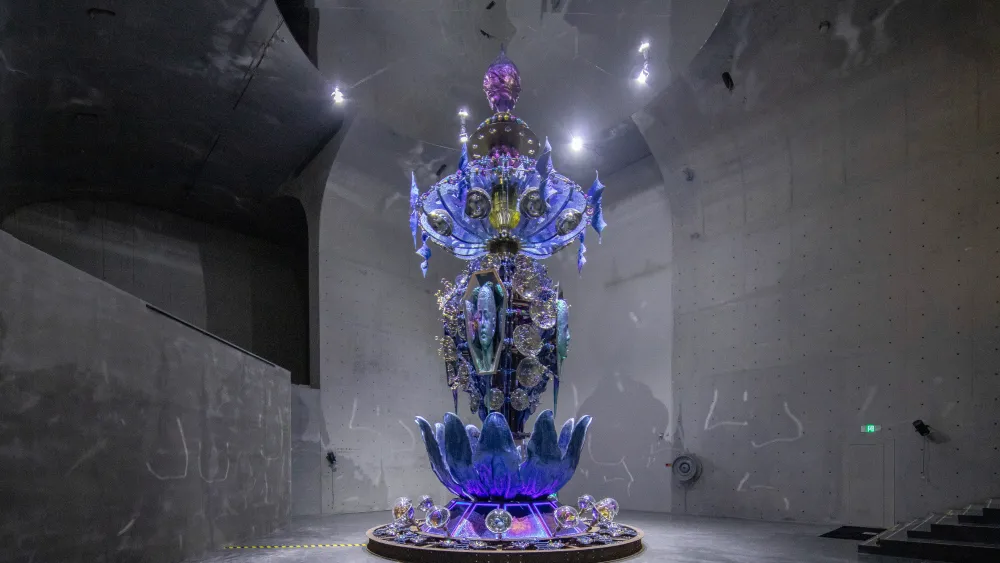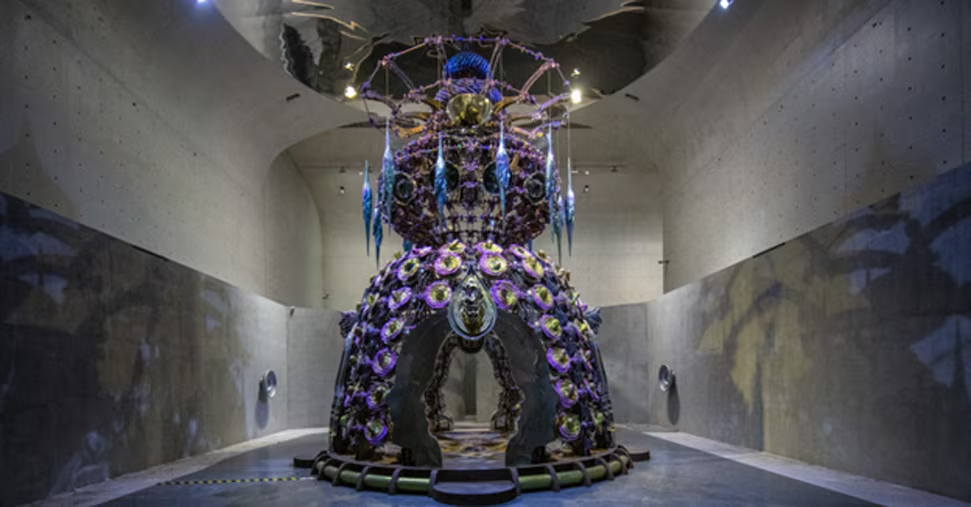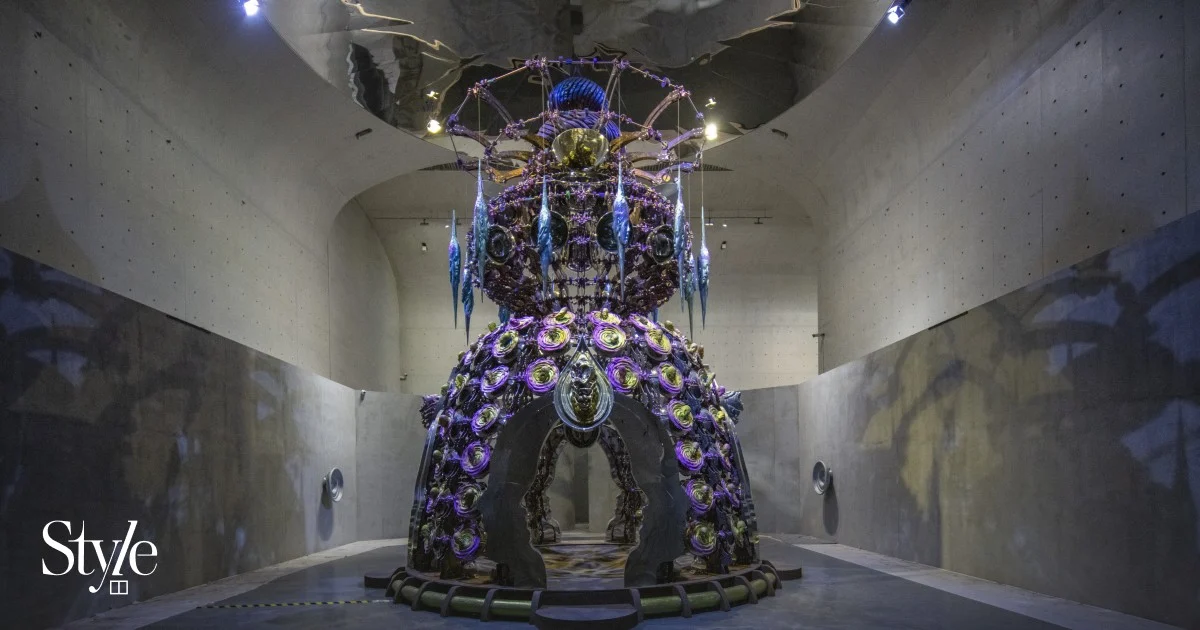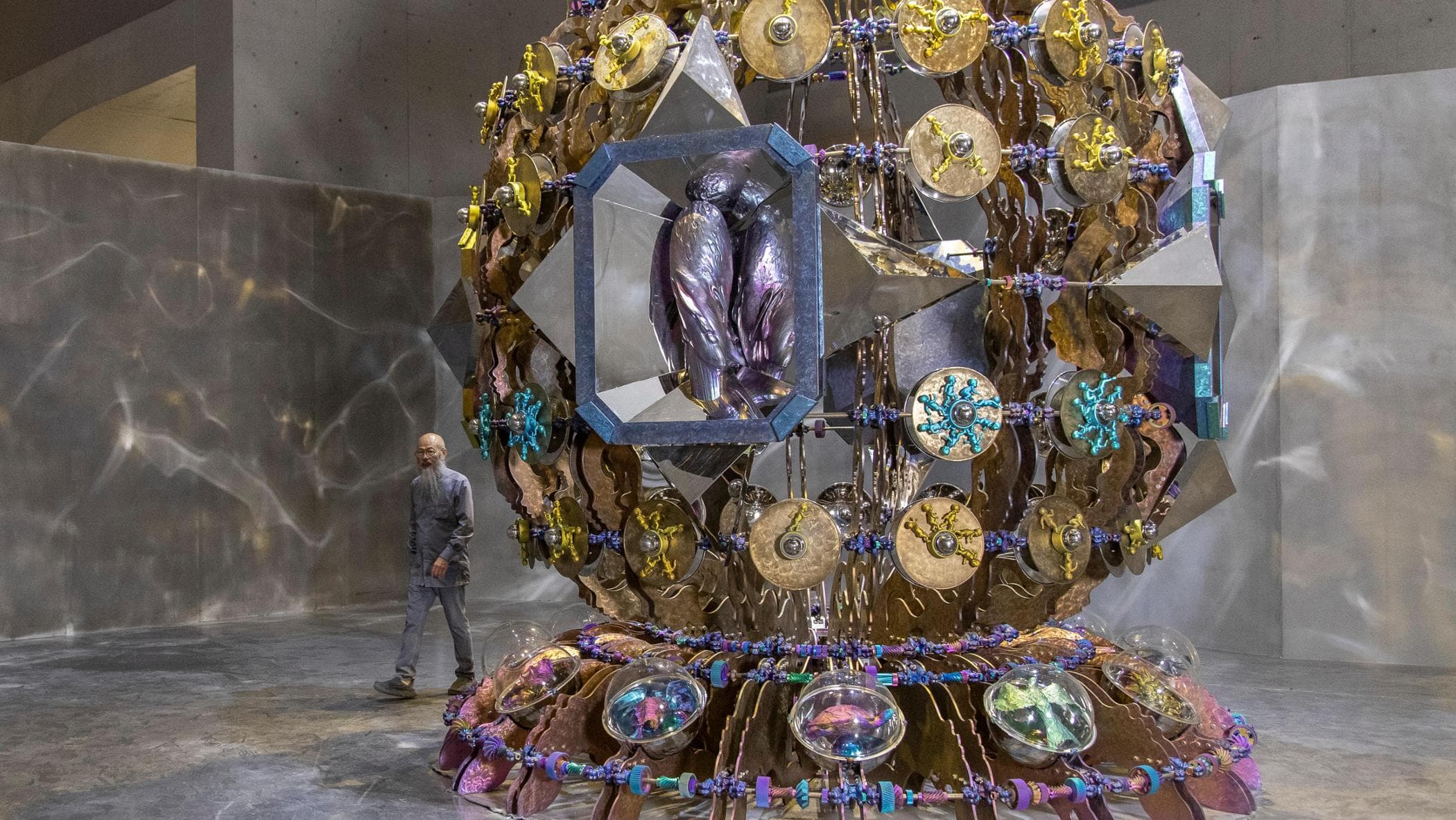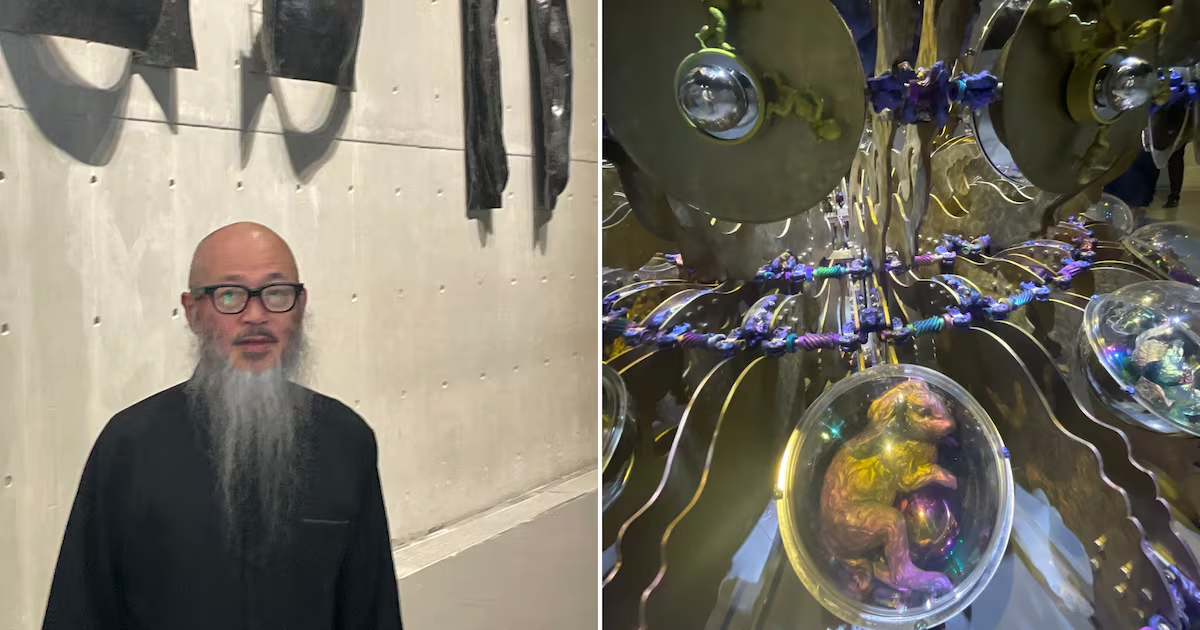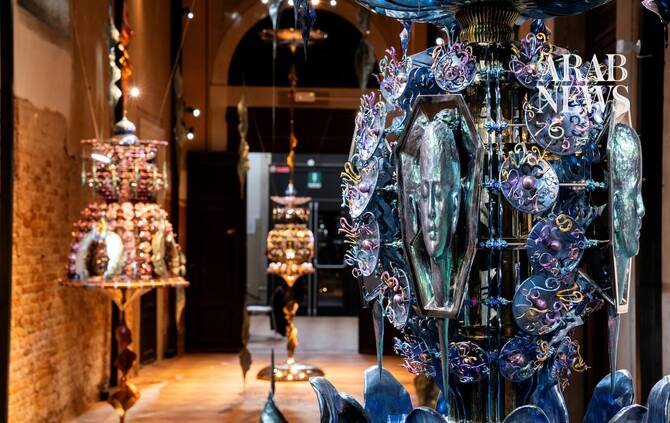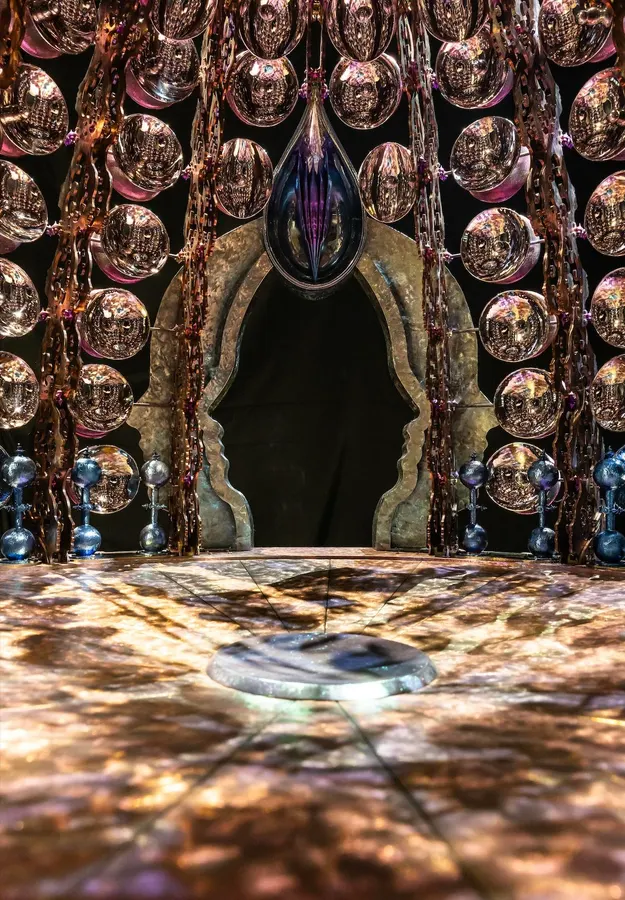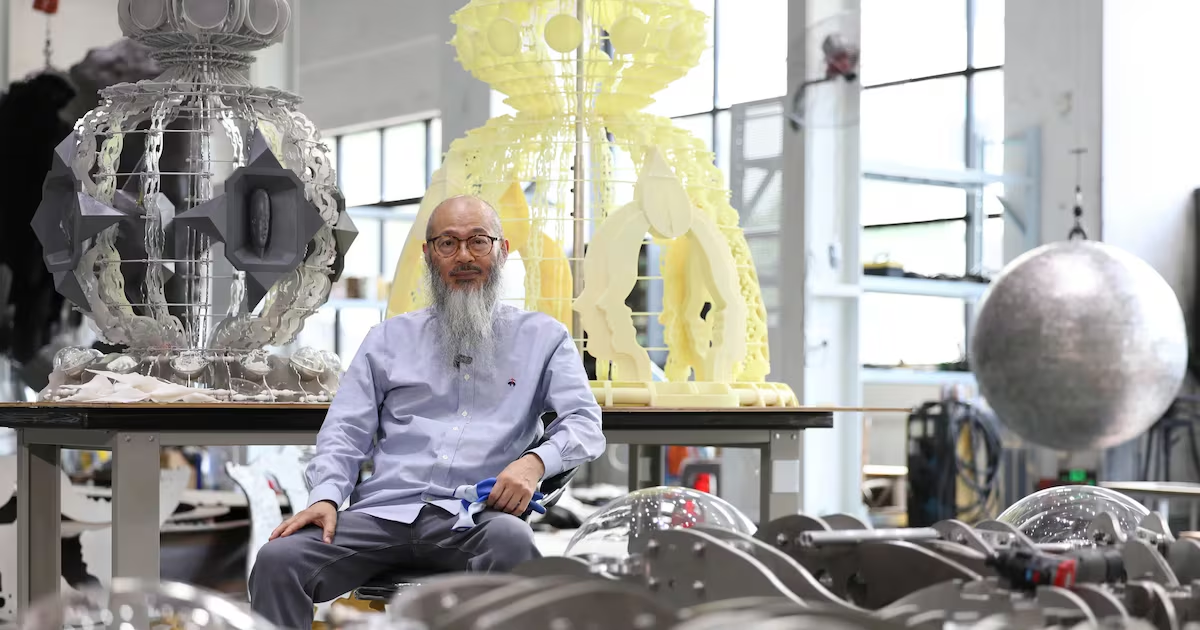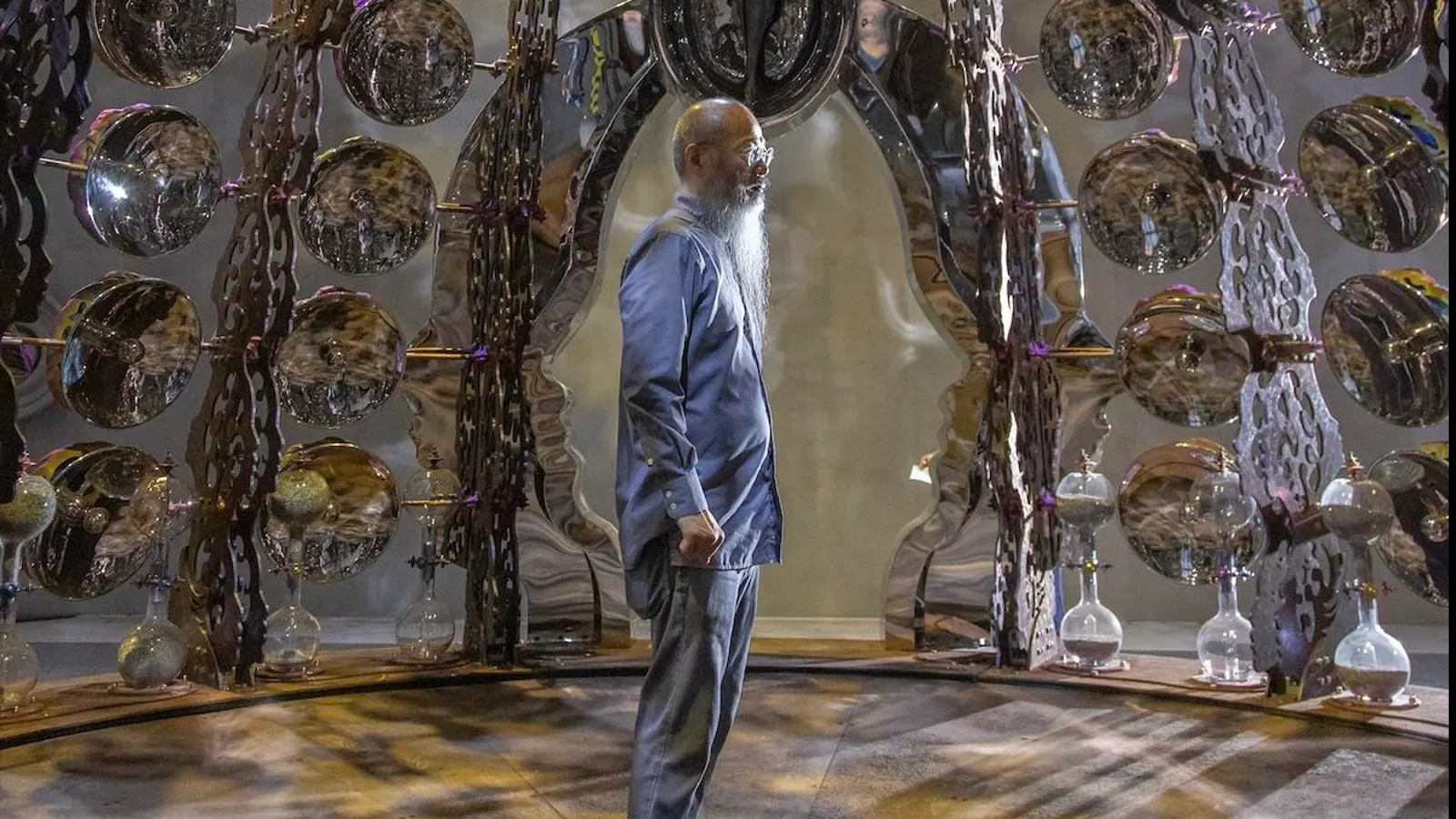
Wallace Chan standing inside the Vessels of Other Worlds 30-foot Growth sculptureJJYPHOTOPicture the sweeping scale of Gustav Mahler’s Third Symphony, with its meditation on the cycle of life, combined with the cosmic ambition of 2001: A Space Odyssey. That begins to suggest the scope of Wallace Chan's latest creation, Vessels of Other Worlds, a two-city exhibition that links Venice and Shanghai through art, technology and philosophy.The second chapter of the exhibition opened July 16 at Shanghai’s Long Museum West Bund. At its center stand three titanium sculptures—or “vessels”—each rising more than 30 feet and assembled from more than 5,500 titanium components secured by over 20,000 screws. Together they form the most ambitious project of Chan’s career.Wallace Chan standing by his 30-foot Vessels of Other Worlds Birth sculptureJJYPHOTOThe exhibition began May 8 inside Venice’s historic Chapel of Santa Maria della Pietà to coincide with the opening of the 2026 Venice Biennale. This exhibition featured five-foot versions of the same three vessels. The Venice and Shanghai installations remain connected through three live video portals, creating a continuous connection between the two cities until both exhibitions close in October.Chan has described Venice and Shanghai as being united by water.“Venice grows from water while Shanghai is surrounded by it,” he said. “I want my works to become a bridge between cultures.”MORE FOR YOUWallace Chan, 'A Dialogue Between Material and Time III' reprised for Vessels from a previous exhibitionTian FangfangThe three vessels represent birth, growth and rebirth, drawing inspiration from the Olea Sancta—the sacred oils used in Catholic rites of blessing and purification. They also embody broader themes that recur throughout Chan’s work: transformation, memory and spirituality.The first vessel, symbolizing birth, explores a place beyond memory. Chan describes the beginning of life as “a beam of light” forever just beyond human reach.Engineering Meets Mythology With Wallace Chan’s VesselsThe exhibition is curated by Chan’s longtime collaborator James Putnam, founder and former curator of the British Museum’s Contemporary Arts and Cultures Programme.Putnam notes that each vessel carries a distinct color corresponding to its stage of life—yellow for birth, red for growth and blue for rebirth. Beneath their monumental scale lies detailed engineering, with thousands of gears, mechanical elements and titanium components combining structural precision with symbolic imagery.One of Wallace Chan's distorted faces used in the 'Vessels of Other Worlds' exhibitionJJYPHOTOThe sculptures reward close inspection. Human faces emerge from distorted forms that appear stretched through time, echoing motifs found in Chan’s earlier titanium sculptures. Owls, bats and dragons drawn from Chinese mythology seem suspended inside transparent spheres, while cherub-like children run in circles. Mirrored discs scatter reflections across anodized titanium surfaces that shift between luminous blues, reds and golds.Putnam sees the vessels as metaphors for the human body itself.“They are capable of holding what is intangible—time, emotions and consciousness,” he said. “His vessels carry memory and spiritual energy, embodying a sense of purpose and transformation.”Details of Wallace Chan's 'Vessels of Other Worlds' Rebirth titanium sculptureJJYPHOTOChan is rarely literal when discussing his work, preferring poetic ambiguity over direct explanation. Yet, in a prepared statement, he offered one of his clearest descriptions of the exhibition.“I build the monumental from the microscopic,” he said. “This is how the universe takes form: vast presences arise from the unseen and the minute. Stars are born from particles; mountains and rivers gather from dust; life grows from cells.”Wallace Chan’s Use Of Titanium As An Artistic MediumChan has long been one of contemporary jewelry’s most influential pioneers in titanium. Although he was not the first jeweler to embrace the metal, he recognized its artistic potential decades before it became widely accepted.Known primarily for aerospace engineering and medical implants, titanium is both light and strong. Through anodization, it also produces vivid, iridescent colors without pigments—an effect Chan has mastered in both his jewelry and monumental sculptures.Artistic details in Wallace Chan's 'Vessels of Other Worlds' Growth sculptureJJYPHOTOBeyond the three vessels, the Long Museum surveys Chan’s recent Venice Biennale projects, including Titans (2021), Totem (2022) and Transcendence (2024).It also incorporates Mythos, his current installation at Venice’s Scala Contarini del Bovolo, where four titanium sculptures occupy the Renaissance spiral tower. Inspired by Tintoretto’s Mercury and the Graces, Chan reimagines the Three Graces as abstract forms while transforming Mercury into planetary and sculptural imagery. Smaller versions of these works appear in Shanghai.Wallace Chan And The Rhythm of ThreeThroughout the exhibition, groups of three recur with consistency: three vessels, three earlier projects, three stages of life.Chan says the pattern emerged naturally rather than through deliberate planning.“I did not begin by saying, ‘Everything must be three,’” he said. “I do not want numbers to become a rigid formula.”Wallace Chan standing by his 30-foot 'Vessels of Other Worlds' Rebirth titanium sculptureTian FangfangInstead, he believes the number reflects life’s natural rhythms.“Three creates movement. It introduces relationship, tension, exchange and transformation. In life we often understand things through three stages: beginning, development and return; birth, growth and rebirth; past, present and future.”Looking back, he now sees Titans, Totem, Transcendence and Vessels of Other Worlds as a continuous artistic progression, with each project raising questions answered by the next.Wallace Chan’s Masters Jewelry CreationUnexpectedly, the exhibition introduces several sculptures carved from obsidian, the volcanic glass whose deep black surface has recently captivated Chan.The exhibition concludes with a gallery devoted to the jewelry and gem carvings that first established his international reputation. While his monumental installations continue to expand in scale and ambition, his jewelry remains the purest expression of his artisanship and craftsmanship.Among the highlights are examples of his signature Wallace Cut gemstones, butterfly brooches shimmering with colored gems set in anodized titanium, intricately carved gemstone sculptures and several previously unseen works, including textured green writing instruments wrapped in a web of gold and diamonds.Shanghai’s Long Museum West Bund built on the site of a former coal-loading terminal The Long MuseumThe exhibition occupies more than 40,000 square feet inside the Long Museum, itself built on the site of a former coal-loading terminal overlooking the Huangpu River. To accommodate the installation, galleries were extensively renovated, with new walls and higher ceilings constructed specifically for the exhibition.Museum director Wang Wei described Chan’s work as an invitation to slow down.“His work has always explored life, growth and rebirth while embodying profound philosophical reflection,” she said in Mandarin. “In today’s fast-paced world, [we need] the strength to pause, to become still and to feel more deeply.”When Chan addressed the audience in Mandarin, he departed from his prepared remarks, twice stopping to compose himself. Later he told me that he had been thinking about something his son recently told him—that at 70 he works too hard and spends too little time caring for his own health.It has not changed his outlook.“I will continue to create, and my work will always return to materials, time, space and scale, which have been at the heart of my practice from the beginning,” Chan said afterward. “True completion still lies a lifetime ahead.”Wallace Chan’s Vessels of Other Worlds is being held at the Pieta Chapel, Venice, until October 1 and at the Long Museum (West Bund), Shanghai, until October 25.
Wallace Chan’s Monumental Vessels Of Other Worlds Arrives In Shanghai
The second chapter of the two-city exhibition opened July 16 at Shanghai’s Long Museum West Bund. It is the most ambitious project of Wallace Chan’s career
1,174 words~5 min read