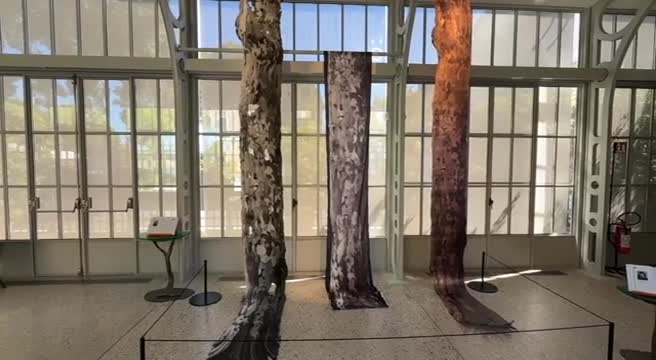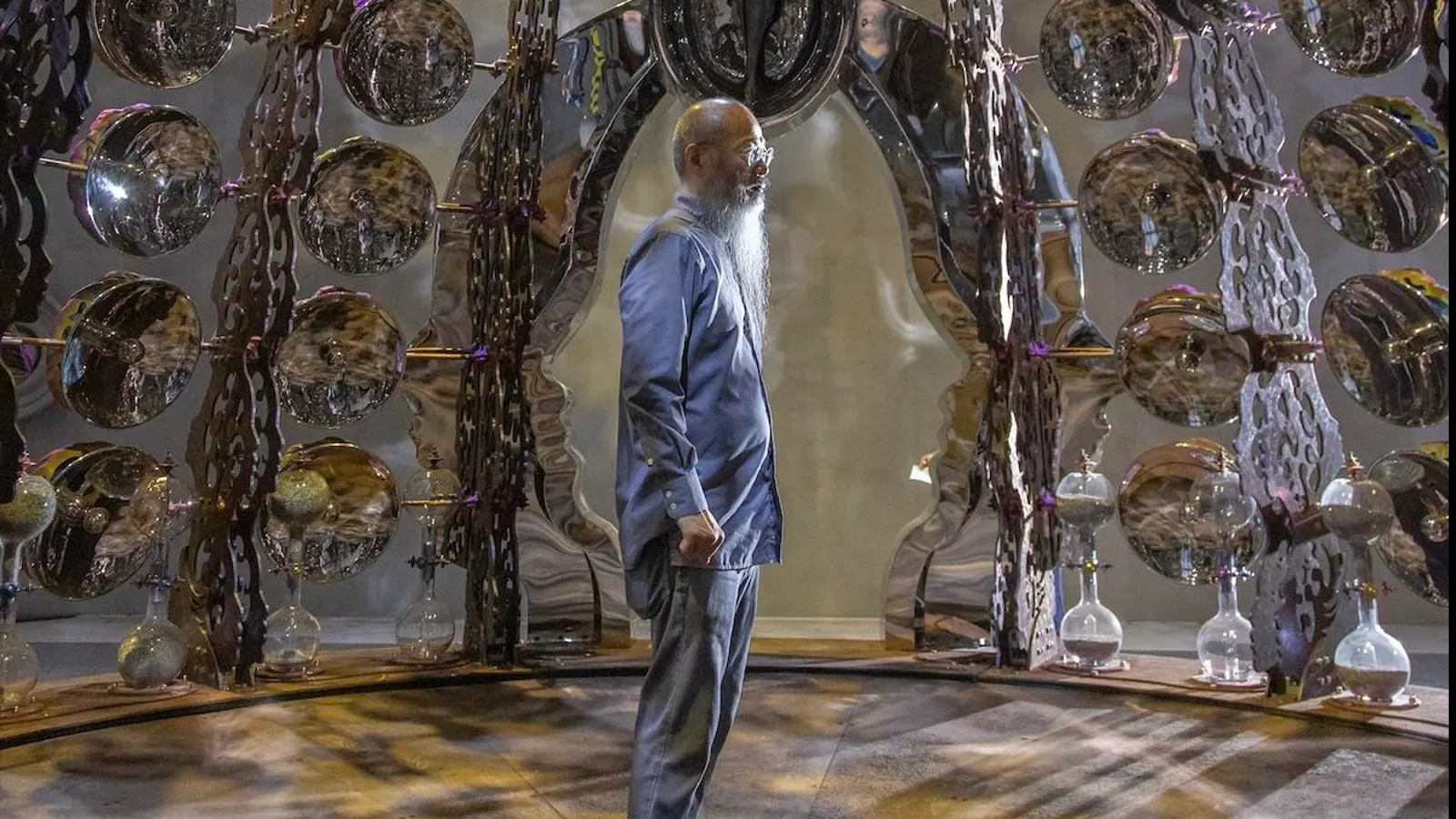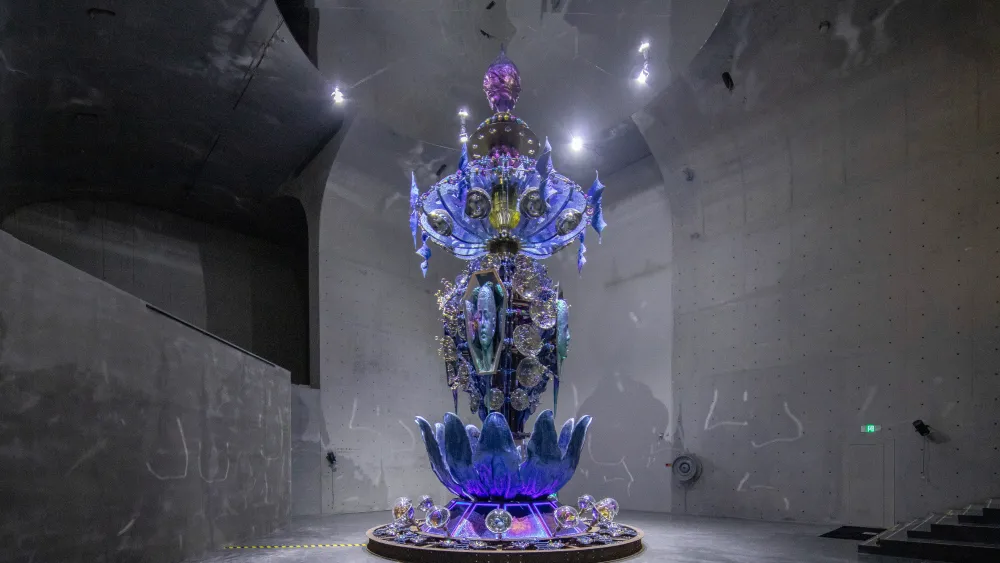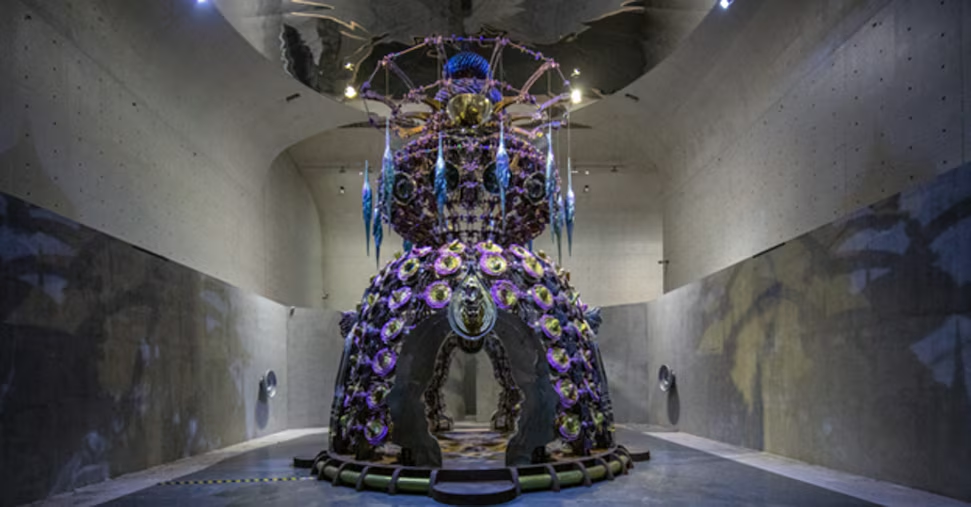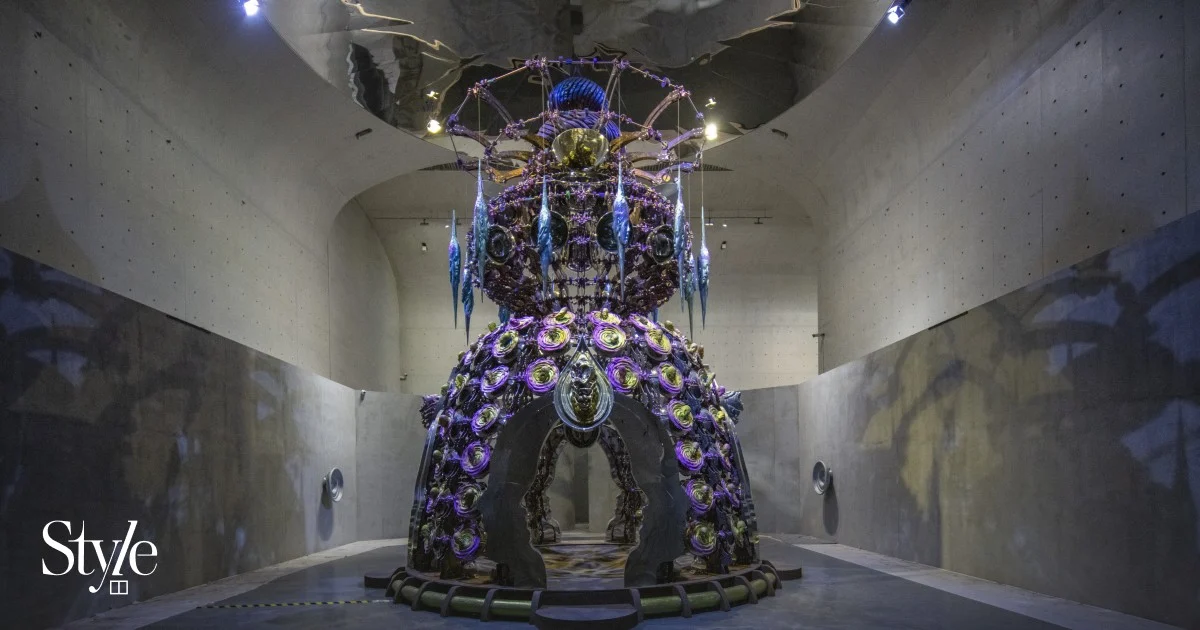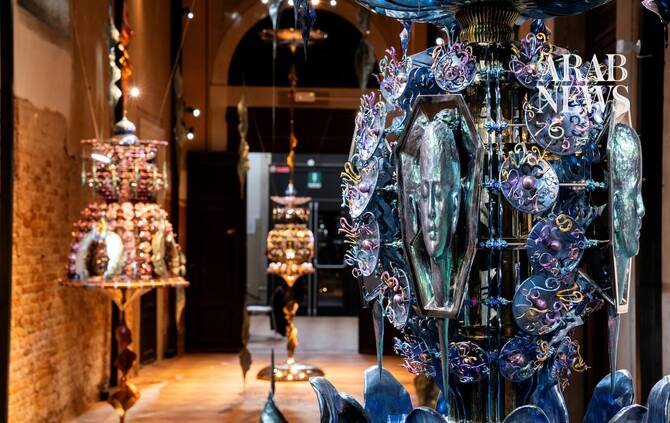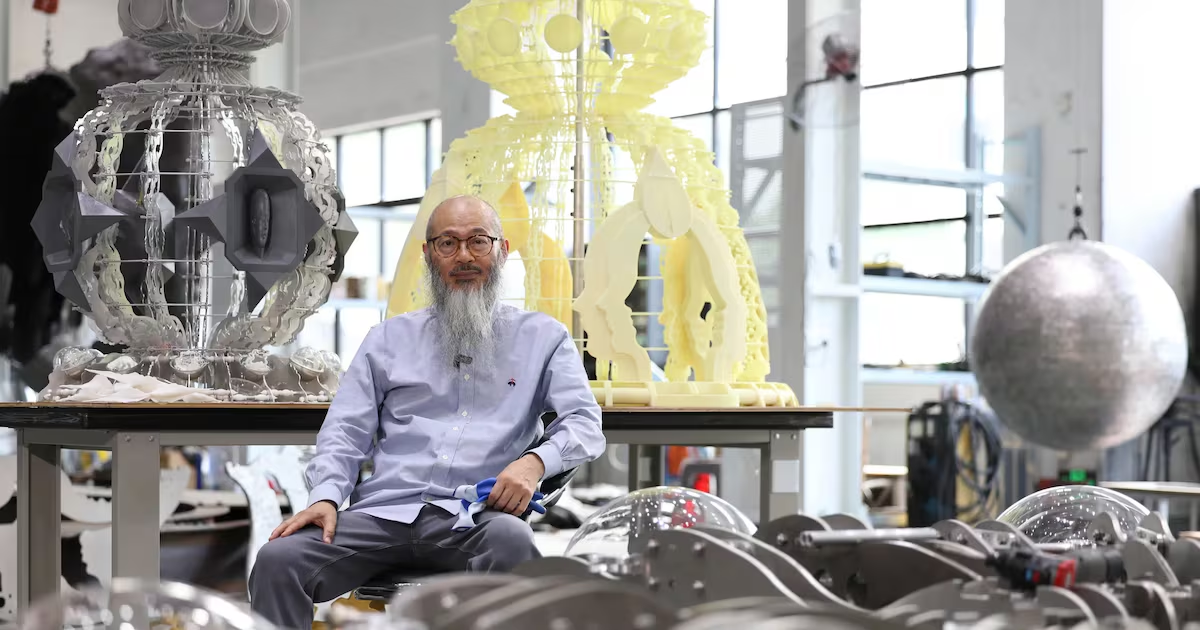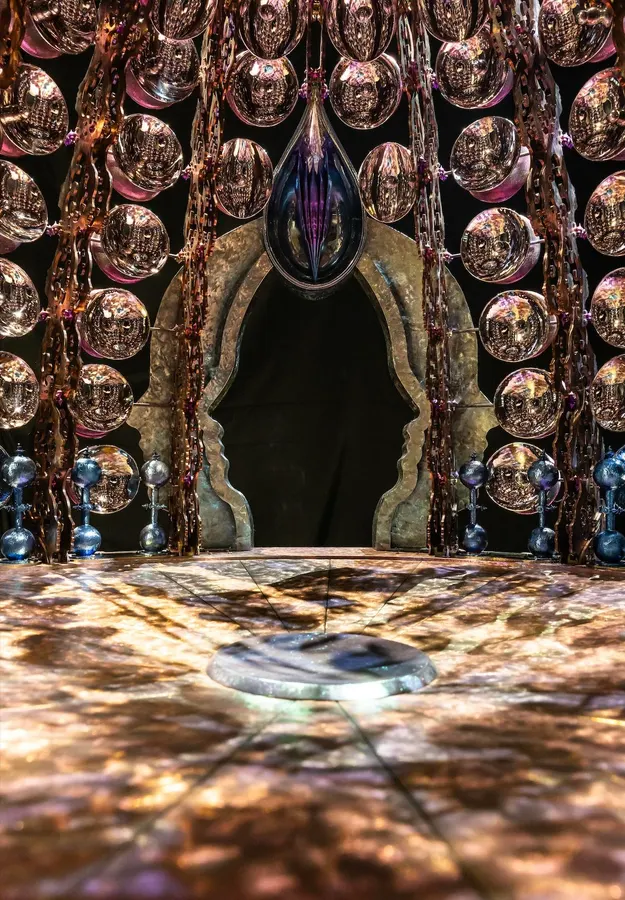
The entrance to the Wallace Chan exhibit, "Vessels of Other Worlds" in the the Chapel of Santa Maria della PietàAnthony DeMarcoArtist Wallace Chan has unveiled his most ambitious art project to date in a church in Venice. Vessels of Other Worlds is a connected dual-city exhibition spanning two continents that explores the cycle of life, Buddhist beliefs, Catholic rituals, water symbolism and futuristic imagery. The project is partially inspired by a 16th-century painting as well as Chan’s own earlier creations.The first installment, which opened May 8, is being held at the Chapel of Santa Maria della Pietà, a venue familiar to Chan. Two years ago, he staged an exhibition in the narrow side chapel adjacent to the main church. As with his previous Venice projects, the exhibition coincides with the Venice Biennale.The Rebirth Sculpture from Wallace Chan's Vessels of Other Worlds@HaiboAt the center of the presentation are three titanium sculptures, or “vessels,” each approximately five feet high. Titanium has been Chan’s material of choice since the 1980s for both his high jewelry creations and monumental sculptures. Larger versions of the same works, standing about 33 feet high, will be displayed outside the Long Museum beginning July 18. Both installments will remain on view through October.The exhibition is curated by James Putnam, founder and former curator of the British Museum’s Contemporary Arts and Cultures Program.MORE FOR YOUWallace Chan’s Secular Interpretation of Religious RitualsOil and water play central roles in the installation, which, like many of Chan’s creations, contains layered meanings. The vessels themselves are inspired by the Catholic ritual of Olea Sancta (Holy Oils), the three sacred oils used in sacraments and blessings and consecrated during the annual Chrism Mass in Holy Week. These include the Oil of the Sick, the Oil of Catechumens and the Sacred Chrism.Chan explained that two years ago he encountered stone carvings of three oil vessels in a Venetian church. After learning about Olea Sancta from the church’s caretaker, he began interpreting the imagery through the lens of his Buddhist training and broader worldview.The Birth Sculpture from Wallace Chan's Vessels of Other Worlds@Haibo“I used the oil vessels not because of Catholic iconography, but because I see something common among many religions,” Chan said through an interpreter. “You can find oil vessels not only in the West, but also in Eastern temples and other churches. Since I’m not confined to one religion or culture, I want to use these vessels to expand and transcend.”Another inspiration was The Garden of Earthly Delights (1490–1510) by Dutch artist Hieronymus Bosch. The famed triptych is generally interpreted as a warning against temptation, though scholars have debated its meaning for centuries.Babies casted in titanium on the Birth Sculpture one of the details in his large vessels@HaiboChan said he initially believed the painting was contemporary because of its vibrant colors and fantastical imagery, including objects that resembled his own vessels. While the work influenced him, he was especially struck by the painting’s imaginative details and seemingly futuristic vision.“I found it shocking and surprising what was depicted in the paintings,” he said. “It seemed beyond his time. I also want to create something beyond my own time.”Connecting Venice and Shanghai Through Water and TechnologyEach of the three vessels represents birth, growth and rebirth—or reincarnation, a central Buddhist concept—symbolized respectively by the colors yellow, red and blue. Hundreds of smaller motifs cover the sculptures. The third vessel, for example, contains circular discs symbolizing water, which Chan associates with rebirth.“Water is the perfect symbol for reincarnation because it exists in a constant cycle of transformation,” Chan said. “It becomes part of our lives, then changes into air, snow and rain before beginning again.”One of the expressionless, genderless faces that appears on his sculptures@HaiboWater also serves as a conceptual bridge between Venice and Shanghai.“Both Venice and Shanghai are cities defined by water,” he said. “Venice grows from water while Shanghai is surrounded by it. I want my works to become a bridge between cultures.”One of the twisted faces that appear suspended throughout the exhibition@HaiboTechnology provides another connection between the two cities. Three screens arranged like a triptych at the altar display live video streams of the monumental vessels currently in Chan’s workshop in China. Once the larger sculptures are installed at the Long Museum in July, the streaming feeds at both locations will visually link Venice and Shanghai in real time.Among the exhibition’s many details are small titanium babies running in circles around the first vessel. The figures were especially challenging to create because they were cast in titanium, a process far more difficult than casting traditional precious metals because of titanium’s lightweight structure, strength and high melting temperature. Other miniature titanium forms—including dolphins, sharks and ladybugs—appear inside transparent spheres embedded throughout the sculptures. Each vessel is crowned with a gourd, a traditional symbol of longevity, fortune and prosperity.The Growth Sculpture from Wallace Chan's Vessels of Other Worlds@HaiboThe works also reference Chan’s earlier Venice projects — Titans (2021), Totem (2022) and Transcendence (2024). Giant titanium face sculptures from previous installations reappear among the vessel surfaces, while elongated, twisting faces hang throughout the space. Chan describes the expressionless, genderless faces as symbols transcending the boundaries of space and time while transforming conflict into enlightenment.Inside the Growth Sculpture@HaiboUnlike his previous installation of monumental titanium figures in the chapel’s long, narrow layout, this exhibition creates a more balanced environment, allowing visitors to move more freely through the space.Wallace Chan’s ‘Mythos’Not content with a single major exhibition, Chan has also mounted a second project at the Scala Contarini del Bovolo, the 85-foot spiral tower constructed in the 16th century.Wallace Chan at his Mythos site-specific exhibition at the Bovolo TowerFederico SuteraThe site-specific installation, also curated by James Putnam, features four outdoor titanium sculptures positioned on one of the tower’s upper levels and extends indoors with additional works and a soundtrack referencing the Venice Biennale’s theme, “Minor Keys.”The presentation draws inspiration from Mercury and the Graces (1576–77) by Italian Renaissance painter Tintoretto. Chan reimagines the three Graces as abstract forms, while Mercury is represented as a planet. The god’s winged staff appears as intertwined serpents, and his winged helmet is transformed into a titanium face sculpture.Shadows and light, inside Wallace Chan's Mythos exhibitionFederico SuteraVisitors encounter shifting perspectives of the sculptures while ascending the tower’s circular staircase.Inside, three suspended titanium-and-iron sculptures create moving patterns of light and shadow. At the center is a quartz crystal accompanied by recordings of titanium being hammered and polished. Another room contains a freestanding titanium sculpture activated by hidden speakers that play recordings of Chan’s monologue when visitors approach.Nita Ambani Wears Wallace Chan Jewels in VeniceAlthough Chan is now widely recognized for his large-scale installations, he first gained international prominence as a high jewelry artist and continues to create jewels for collectors.Wallace Chan's Intertwining Love earrings worn by Nita Ambani in VeniceWallace ChanOne of his jewelry creations recently appeared at the Venice Biennale. Nita Ambani, regarded as one of India’s most influential women, attended an event celebrating the return of the Indian Pavilion to the Biennale wearing sculptural Wallace Chan earrings. Named Intertwining Love, the earrings are crafted from rosewood, sapphires, rubies, aquamarines, pink tourmalines and yellow diamonds and titanium.Wallace Chan to Turn 70 Years OldFor most people turning 70 is a milestone moment. For Chan it’s an inconvenience because he must talk about it rather than talk about his works.“I repeated many times today that I do not feel old, and so it doesn’t reflect my age at all," Chan said through his interpreter. “I feel perhaps you can see these works are probably created by someone more mature. But, but to me I feel like a child.”He continued, “Still, every day I wake up with a great sense of curiosity and I cannot wait to explore and work and create. So, I don’t feel the age. I don’t feel aging. I feel very energetic and motivated, and I look much more into the future."Wallace Chan Federico SuteraAnd what does the future look like? “I am waiting for the future to tell me.”Wallace Chan’s dual site exhibition, Vessels of Other Worlds, will run till October 18 at the Chapel of Santa Maria della Pietà in Venice and from July 18 till October 25 at the Long Museum in Shanghai.Wallace Chan’s exhibition, Mythos, will run till October 18 in Venice.
Wallace Chan Opens Ambitious Dual-City Exhibition In Venice
Wallace Chan’s exhibition, “Vessels of Other Worlds,” will run till October 18 in Venice. The second installment will be held July 18 - October 25 in Shanghai
1,381 words~6 min read