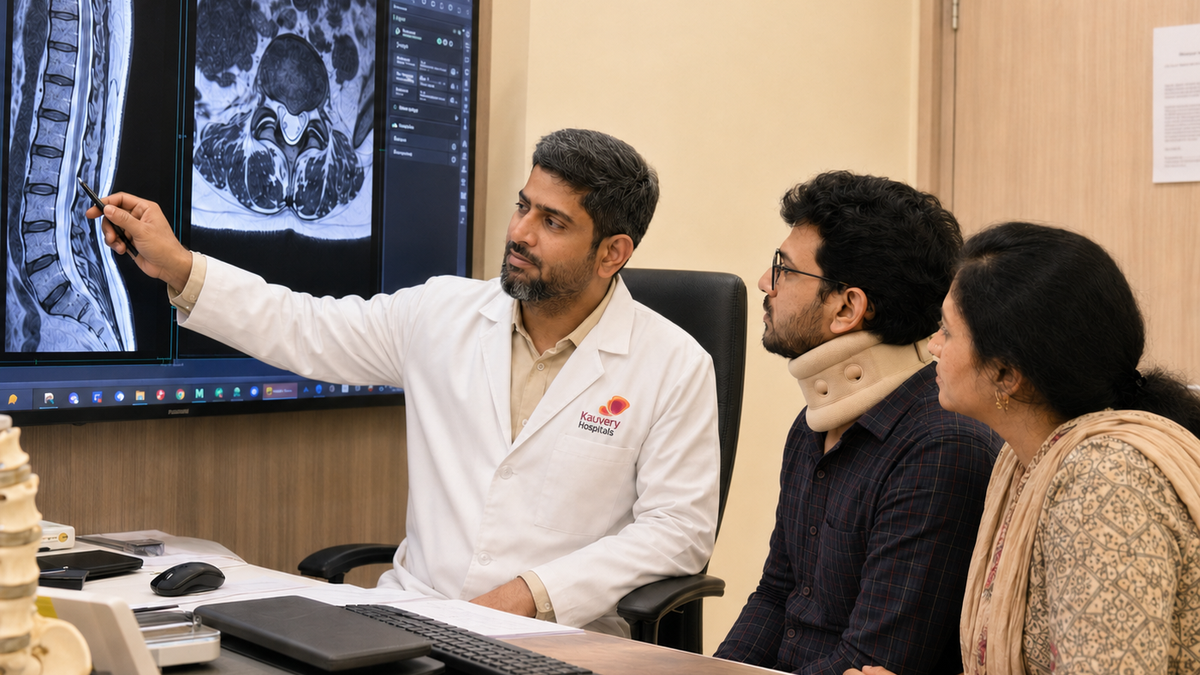
A persistent headache, a numb hand, an unsteady walk, or pain shooting down the leg may be easy to dismiss. Three specialists explain what can wait, what needs medical attention, what constitutes an emergency, and how modern brain and spine care moves from diagnosis to recovery.ByDr Ramakrishna EaswaranDirector, Neurosciences, Kauvery Hospitals, Bangalore RegionWith clinical inputs from Dr Tejus MN Raoand Dr Tejeswara RSA software professional began dropping his coffee mug. He blamed long hours at the laptop. His fingers also felt numb, but the sensation came and went, so he bought a wrist support and worked around it.In another home, a family noticed that their mother had started repeating the same question. She still cooked and recognised everyone, so they put it down to age.Elsewhere, a man with back pain found that the front of his foot occasionally caught the floor. He waited for the pain to settle.None would have described themselves as neurologically unwell. They had ordinary complaints and ordinary explanations. That is often how conditions affecting the brain, spinal cord and nerves first enter a person’s life.“Patients rarely arrive saying, ‘I have a neurological disease,’” says Dr Ramakrishna Easwaran, Director of Neurosciences at Kauvery Hospitals, Bangalore Region. “They arrive with a change they can no longer explain. We must decide whether it is harmless, needs attention, or has made time important.”Dr Ramakrishna has practised neurosurgery for more than three decades and is a part of the Kauvery Institute of Neurosciences, with experience across microsurgery, skull-base and neurovascular procedures, endoscopic brain and spine surgery and intraoperative neuromonitoring.Most headaches do not indicate a brain tumour. Many disc bulges never require an operation. A memory lapse does not mean dementia. Yet sudden weakness, a first seizure, a new loss of balance or progressive difficulty using the hands should not be normalised.The useful questions are simple. Did it begin suddenly? Is it worsening? Has it changed how the person functions? Did another symptom appear with it?When minutes matterNeurological emergencies often announce themselves through a sudden loss of function.A face may droop. One arm may feel weak or numb. Speech may become slurred or difficult to understand. Vision may disappear in one eye. Someone who was walking normally may abruptly lose balance.These are warning signs of stroke. They require emergency assessment even when they improve within minutes. Temporary symptoms may represent a transient ischaemic attack, often called a warning stroke, and do not prove that the danger has passed.“People still wait because the weakness improved or the speech returned,” says Dr Tejus MN Rao, Senior Consultant in spine, neurosurgery and endovascular stroke intervention at Kauvery Hospitals, Marathahalli. “A stroke does not become less urgent because the first symptoms were mild. Early access to stroke and neurology care in Bangalorecan significantly improve outcomes, particularly when treatment begins within the recommended time window.”Dr Tejus is trained in brain and spine surgery as well as neuro-intervention, the branch of treatment that reaches blood vessels in the brain through thin tubes called catheters.Doctors first establish whether a blood vessel has become blocked or has ruptured. A CT scan can quickly detect bleeding. Other scans may show the blocked vessel and the amount of threatened brain tissue. Some patients with a clot-caused stroke may qualify for clot-dissolving medicine. In selected cases, specialists can remove a large clot through a thin tube passed through an artery, a procedure called mechanical thrombectomy.Time remains crucial, but treatment does not depend on the clock alone. Symptoms, the affected vessel, brain imaging, general health, and the amount of salvageable tissue shape the decision. Current stroke guidance supports endovascular clot removal for selected large-vessel strokes, with imaging helping teams identify patients who may benefit.A sudden, exceptionally severe headache also needs urgent assessment, particularly when it reaches maximum intensity within seconds. Doctors call this a thunderclap headache. It may have a less dangerous cause, but it can accompany bleeding around the brain.A first seizure needs medical assessment. A convulsive seizure lasting five minutes or longer, repeated seizures without recovery, breathing difficulty, or a seizure associated with injury requires emergency help.The spine has emergencies too. New difficulty passing urine, loss of bladder or bowel control, numbness around the genitals or inner thighs, and rapidly worsening leg weakness can indicate pressure on the nerves at the lower end of the spine.This is called cauda equina syndrome. Delay can leave lasting problems with movement and bladder, bowel or sexual function.Symptoms that deserve an appointment, not panicMany neurological conditions do not require an ambulance. They do deserve an appointment.A familiar migraine that follows its usual pattern differs from a headache that has changed character, wakes the patient repeatedly, becomes steadily more frequent, or appears with weakness, confusion, persistent vomiting, vision change or a seizure.“Headache is common, and fear of a brain tumour is also common,” says Dr Tejeswara RS, Consultant Neurologist and Stroke Specialist at Kauvery Hospitals. “Most patients with headache do not have a tumour. We look closely when the pattern changes, the examination is abnormal, or another neurological symptom appears.”Memory needs the same measured approach. Everyone forgets a name or misplaces a key. Concern rises when memory loss affects independence.Repeating questions, getting lost on familiar routes, making unusual financial errors, missing medicines, losing familiar words, or showing a marked change in judgement deserve evaluation. Families often notice these changes first.Numbness can arise at several points along the nervous system. A hand may feel numb because a nerve is trapped at the wrist. A neck problem may irritate a nerve root. Pressure on the spinal cord can affect both hands, balance and walking. A brain problem may produce sudden numbness on one side.“Location, timing and company matter,” Dr Tejeswara says. “Which fingers are affected? Is there weakness? Did it start suddenly? Are both legs involved? Did balance change?”Back and neck pain become neurological when they affect nerves or the spinal cord. Pain shooting into a limb, loss of grip, foot drop, increasing weakness, hand clumsiness, imbalance or repeated falls should not be treated as ordinary muscle pain.Difficulty fastening buttons, changes in handwriting or frequent tripping can signal loss of function rather than pain alone.Why the examination still mattersA neurological consultation can look deceptively simple. The doctor asks the patient to walk, follow a finger with the eyes, push against a hand, identify a light touch, remember a few words or touch a finger to the nose.Each task tests a pathway.Strength, reflexes, eye movements, speech, coordination and gait help locate a problem in the brain, spinal cord, nerve root or peripheral nerve. They also explain why two people with similar scans may receive different advice.“The scan is important, but the patient is the beginning of the diagnosis,” Dr Tejeswara says. “A person can have disabling symptoms with an initially normal scan. Another can have several MRI abnormalities and no related symptoms. We must connect the evidence.”What your MRI report can and cannot tell youMedical reports often reach patients before the specialist appointment. Their language can alarm because radiologists write primarily for other clinicians.Words such as lesion, atrophy, mass effect, stenosis, compression and degeneration describe an image. They do not always state the final diagnosis or predict what happens next.The American College of Radiology has recognised this comprehension gap, noting that patients increasingly receive reports before a referring doctor has reviewed the findings with them.A disc bulgemeans that part of a spinal disc extends beyond its usual boundary. Disc bulges become more common with age, and many do not cause symptoms.A disc protrusion or extrusion describes a more focal displacement. Foraminal narrowing means that the opening through which a spinal nerve exits has narrowed. Nerve-root compression suggests pressure on that nerve.The finding matters when its location matches the patient’s pain, numbness, weakness and examination.“We do not operate on an MRI,” Dr Tejus says. “We operate when the symptoms, neurological findings and imaging identify the same problem, and when surgery offers a better balance of benefit and risk than continued non-surgical care.”Canal stenosis means narrowing of the central spinal passage. Cord compression means pressure on the spinal cord. Cord signal change or myelomalacia can indicate stress or injury within the cord. When it appears with hand clumsiness, weakness or walking difficulty, it needs timely review.Brain reports have their own unsettling vocabulary.No acute intracranial abnormality generally means the scan did not show a new major bleed, a large established stroke, marked swelling or an obvious mass at that time.It does not exclude migraine, epilepsy, metabolic disturbances or very early or small stroke.White-matter hyperintensities are bright areas on certain MRI sequences. They may reflect changes in small blood vessels associated with age and vascular risks, but they can also occur with migraine, inflammation and other conditions. The phrase describes an appearance, not one disease.Cerebral atrophy means reduced brain volume. Some volume loss occurs with ageing. Doctors consider the pattern, degree, age and symptoms before deciding what it means.Mass effect means that a lesion, bleed or swelling is pressing on nearby structures. Midline shift means that pressure has displaced central brain structures.An enhancing or ring-enhancing lesion absorbs contrast differently from surrounding tissue. Tumours can enhance, but so can infection and inflammation.A report is evidence. It becomes a diagnosis only after someone places it beside the patient.When the blood affects the brain and nervesNot every neurological symptom begins with a structural problem.A blood glucose level below 70 mg/dL is considered hypoglycaemia, or low blood sugar. It can cause sweating, confusion, unusual behaviour, weakness, seizures or loss of consciousness, particularly in someone taking insulin or certain diabetes medicines.Laboratories commonly mark a sodium level below about 135 to 136 mmol/L as low. The effect depends on the cause and how quickly it fell. A rapid fall can cause headache, confusion, drowsiness or seizures.Vitamin B12 deficiency may cause numbness, imbalance, weakness, and cognitive symptoms. A level below about 200 pg/mL is commonly considered low, while 200 to 300 pg/mL may be treated as borderline and interpreted with other tests.Long-term high blood sugar matters differently. An HbA1c of 5.7 to 6.4 per cent lies in the prediabetes range, while 6.5 per cent or higher meets a diagnostic threshold for diabetes in non-pregnant adults, usually with confirmation when symptoms are absent. Diabetes raises stroke risk and can damage peripheral nerves.These values help doctors ask better questions. A single number should not become a self-diagnosis. Reference ranges can also vary between laboratories and clinical situations.What to do with an AI explanationMany patients now upload blood reports, MRI findings or CT summaries to an artificial intelligence tool before meeting a doctor.The attraction is clear. It can translate “cervical canal stenosis” into ordinary language within seconds.That can improve a consultation. It can also create false certainty.The tool usually has the report text, not the full-quality images. It cannot test reflexes, strength, speech, gait or sensation. It may not know whether weakness began yesterday or whether pain has remained stable for five years.“Use AI to understand the vocabulary,” Dr Tejeswara says. “Use a clinical team to understand what it means for you.”Patients should remove names, hospital numbers, phone numbers and other identifying details before using a public AI service. They should use the response to prepare questions, not to start, stop or delay treatment.Five questions help:Does this finding explain my symptoms?Is it new, old, or incidental?Does its location make it important?Do I need treatment now, follow-up imaging, or no immediate action?Which change requires emergency care?When treatment does not mean surgeryA neuroscience institute should not measure its value by how many symptoms it turns into operations.Many headaches need medicine, trigger management and reassurance. Stroke prevention may require control of blood pressure, diabetes, cholesterol, sleep apnoea or heart rhythm. Nerve pain may improve with physiotherapy, posture correction, medicine or a targeted procedure.Some tumours need observation. Many disc problems settle without surgery.“Surgical judgement includes knowing when not to operate,” Dr Ramakrishna says. “The most technically possible treatment is not automatically the best treatment for the person.”Surgery becomes relevant when a structural problem threatens function, produces progressive neurological loss, causes dangerous pressure, remains uncontrolled despite appropriate treatment, or carries a risk that outweighs the risks of intervention.How complex treatment has changedModern planning has transformed advanced neurosurgery in Bangalore, giving neurosurgeons more information before and during an operation to improve precision while protecting critical brain and spinal functions.Neuro-navigation uses CT or MRI data to create a three-dimensional map that helps the surgeon locate a lesion and plan a route through the brain. The destination may lie close to areas responsible for speech, movement or vision.In selected patients with tumours near these areas, the team may recommend awake brain surgery.The name can sound alarming. The patient remains comfortable and closely monitored, and may sleep through parts of the operation. During the stage requiring functional testing, the team may ask the patient to count, name pictures, speak or move a hand.“An MRI shows us where the tumour lies,” Dr Ramakrishna says. “It cannot always tell us precisely where language or another function sits in that individual brain. Awake mapping allows the patient to guide us while we work.”Awake surgery allows teams to test speech, movement, vision or understanding while operating near brain areas that control these functions. Computer-guided navigation can create a three-dimensional map from MRI or CT images to improve surgical orientation.Intraoperative neurophysiological monitoring tracks electrical signals through nerves, the spinal cord or motor pathways during selected operations. A meaningful change can warn the team and allow the surgeon to pause or alter the approach.Technology does not remove risk or make every difficult case operable. It helps experienced teams make more precise decisions.The same principle applies to the spine. Minimally invasive techniques can reduce tissue disruption in selected procedures, but a small incision does not define a good operation. The procedure must adequately relieve pressure, stabilise the spine when necessary and protect nerves.Stroke intervention has also changed treatment. A specialist can sometimes reach a blocked brain artery through the blood vessels and remove the clot without open brain surgery. Imaging helps identify which patients may benefit. Speed, selection and an organised stroke pathway remain inseparable.“At the Kauvery Institute of Neurosciences, a multidisciplinary team of brain and spine specialists in Bangaloreworks together to provide seamless care, from diagnosis and emergency stroke intervention to rehabilitation, ensuring patients receive the right treatment at every stage of recovery.Neuro-anaesthesia and critical-care teams guide the acute phase. Physiotherapists, speech therapists and cognitive specialists work on the abilities that illness interrupted.Patients do not experience these as separate departments. They experience one problem moving through several expert hands.Recovery begins before the operationA technically successful procedure does not automatically return a person to ordinary life.After a stroke, a patient may need to relearn how to stand, swallow or form a sentence. After brain-tumour surgery, fatigue, weakness or changes in concentration may affect the return to work. Following spinal-cord compression, nerves may need time to recover after the pressure has been removed.Rehabilitation should form part of treatment planning, not follow it as an afterthought.“Families often ask when the patient will be normal,” Dr Ramakrishna says. “We should answer honestly. We explain what we expect, what remains uncertain and what the patient can work towards. Hope becomes more useful when it comes with a plan.”Access begins with recognitionNeurological conditions cause more illness and disability worldwide than any other broad group of health conditions. More than one in three people globally live with a neurological condition.Yet access means more than placing a scanner or operating theatre within reach.World Brain Day 2026 carries the theme “Brain Health: Access for All.” It calls for earlier intervention, stronger local capability, prevention, continuity of care and fairer access to neurological expertise.For a patient, access begins with knowing that a temporary speech problem still needs emergency care. It means recognising that progressive hand clumsiness is not simply age. It means receiving a clear explanation of an alarming scan, reaching the right specialist and continuing rehabilitation after the immediate danger has passed.The public does not need to diagnose every neurological condition at home.It needs to recognise when a change deserves attention.A comprehensive neuroscience team must take it from there: from symptom to diagnosis, from diagnosis to the right treatment, and from treatment back to life.
The Symptoms You Shouldn’t Learn to Live With
The Symptoms You Shouldn’t Learn to Live With
2,696 words~12 min read