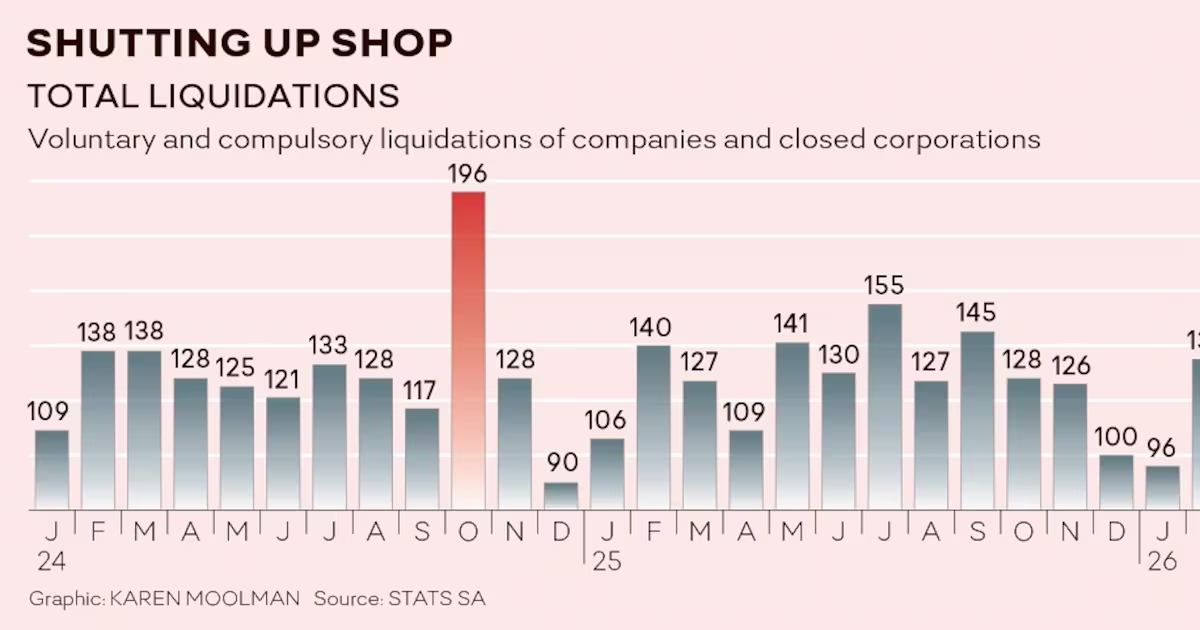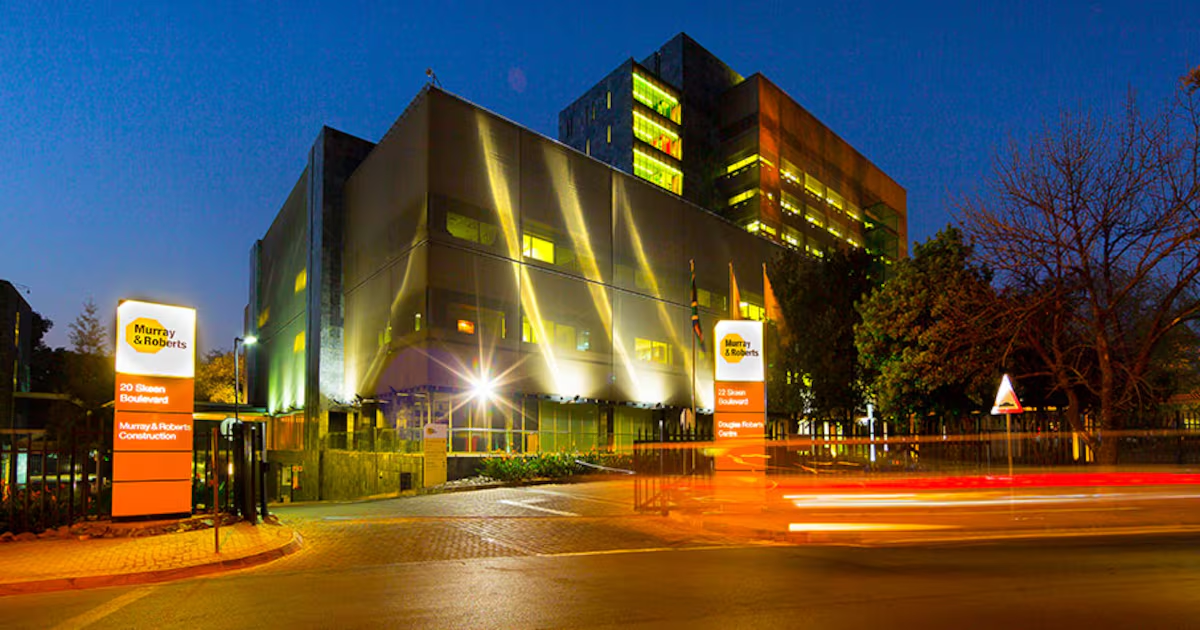
South Africa is losing companies at an alarming rate. Stats SA reports that 225 companies were placed into liquidation in May. So far this year, 1,116 companies have entered liquidation. Behind each failure lies more than the loss of a business: jobs disappear, creditors suffer losses, and productive economic capacity is permanently destroyed.While liquidation continues to dominate the headlines, two of South Africa’s largest corporate restructurings recently reached significant milestones that tell a more positive story. Murray & Roberts completed the implementation of its R1.27bn restructuring transaction, preserving about 2,600 jobs, while Group Five concluded one of the country’s most complex business rescue processes with all creditors paid in full and the prospect of a return to shareholders.Fifteen years since the country’s introduction of business rescue legislation in 2011, one needs to pause, take stock and ask, is South Africa’s business rescue framework finally coming of age?In principle, business rescue, if used early, is a powerful and necessary tool for struggling companies. Unfortunately in many cases, by the time business rescue is considered, the business is no longer capable of being rescued. Business rescue is built for intervention — not reaction — and is designed to operate at the point of financial distress, not financial collapse.If stakeholders support the business rescue practitioner’s efforts to restructure the debt, the company’s workforce and its contracts in a manner that makes the business more effective and profitable, there is no reason why the company cannot exit from its business rescue process with a credible, practical and workable plan. In principle, business rescue, if used early, is a powerful and necessary tool for struggling companies. Unfortunately in many cases, by the time business rescue is considered, the business is no longer capable of being rescued. Either the company is restructured in a way that allows it to continue trading, or there is a wind-down or sell-off of the businesses or subsidiaries of the company to third parties which supports a financial distribution to creditors and, in some instances, to shareholders far better than one would ever have seen in a liquidation.Business rescue practitioners must carefully consider the requirement of the “reasonable prospect of rescue”. It requires a credible, supportable basis on which the company can be rehabilitated. The threshold is not satisfied by the mere hope that conditions might improve. Looking at the outcome in Murray & Roberts and Group 5, the results speak for themselves.Murray & Roberts In one of the most significant corporate restructurings in recent South African history, Differential Capital and its consortium of investors, working with the company’s business rescue practitioners (Metis Strategic Advisors), concluded a transaction resulting in the acquisition of the equity of the mining division of Murray & Roberts (in business rescue) for R1.27bn.The adopted business rescue plan gained 100% creditor approval in April, and the transaction, which was completed on June 25, secured the transfer of numerous local and foreign subsidiaries (in South Africa, Canada, Australia, Portugal, Chile and numerous other jurisdictions) to the Differential Capital-led consortium. The sale enables the business rescue practitioners to settle all secured debt and funding obligations. The transaction preserves about 2,600 jobs and safeguards vital mining capabilities that will continue to contribute meaningfully to the South African economy.Group 5 In Group 5, the business rescue practitioners (Metis Strategic Advisors) of Group Five and Group Five Construction (“Group Five”) announced the substantial implementation of their respective business rescue plans, which has now concluded their business rescue proceedings. In March 2019, Group Five collapsed into business rescue with about R7bn in creditor and contingent exposures, more than 2,300 individual creditors, 119 active construction projects and almost 6,000 employees employed in about 180 companies across 38 countries. At the time, it was estimated that an immediate liquidation of Group Five would result in secured creditors receiving as little as 65c in the rand and concurrent creditors no more than 3.4c in the rand, not to mention the devastating impact that a liquidation would have on employment and the construction industry generally. At that time, there was no prospect for any shareholder recovery. Group Five’s business rescue proceedings took the form of a structured wind-down, with projects being completed, debtors being recovered, and key subsidiaries such as Intertoll Europe and Everite being sold as going concerns. Over 60 entities and asset sales were completed within the business rescue process, and a substantial number of jobs were retained. As Dave Lake from Metis put it, “The process has overachieved in its primary objectives: maximising recoveries for creditors and lenders; saving jobs and business entities; settling tax obligations; and unlocking some value for shareholders, while stabilising and restructuring a highly complex group in an orderly manner.”Various issues in the administration of the business rescue proceedings were dealt with, including resolution of litigation with certain shareholders and resolution of various creditors’ claims, as well as attending to other commercial aspects, which included the conclusion of financing agreements and the disposal of Group Five’s subsidiaries and businesses. In what is an incredible success story for business rescue in South Africa, not only have all creditors, including concurrent creditors, been paid in full (100c in the rand), but it is expected that a surplus return will be delivered to shareholders as well. This is an exceptional outcome for a business rescue process.Used as the statute intended, business rescue remains a workable, effective mechanism for preserving value in the South African economy, a structured framework within which businesses can reorganise, negotiate with stakeholders and, where necessary, compromise on debts and access new capital.So, as we have seen in the Murray & Roberts and Group 5 examples, business rescue can work. Hopefully in time, we will see more companies exit from business rescue on a similar basis.• Dr Levenstein is head of insolvency and business rescue at Werksmans Attorneys. The firm was involved in the Murray & Roberts and Group 5 business rescue proceedings.
ERIC LEVENSTEIN | Business rescue comes of age as major restructurings preserve jobs and creditor value
Major restructurings show early intervention can save firms, jobs and creditor returns
983 words~4 min read