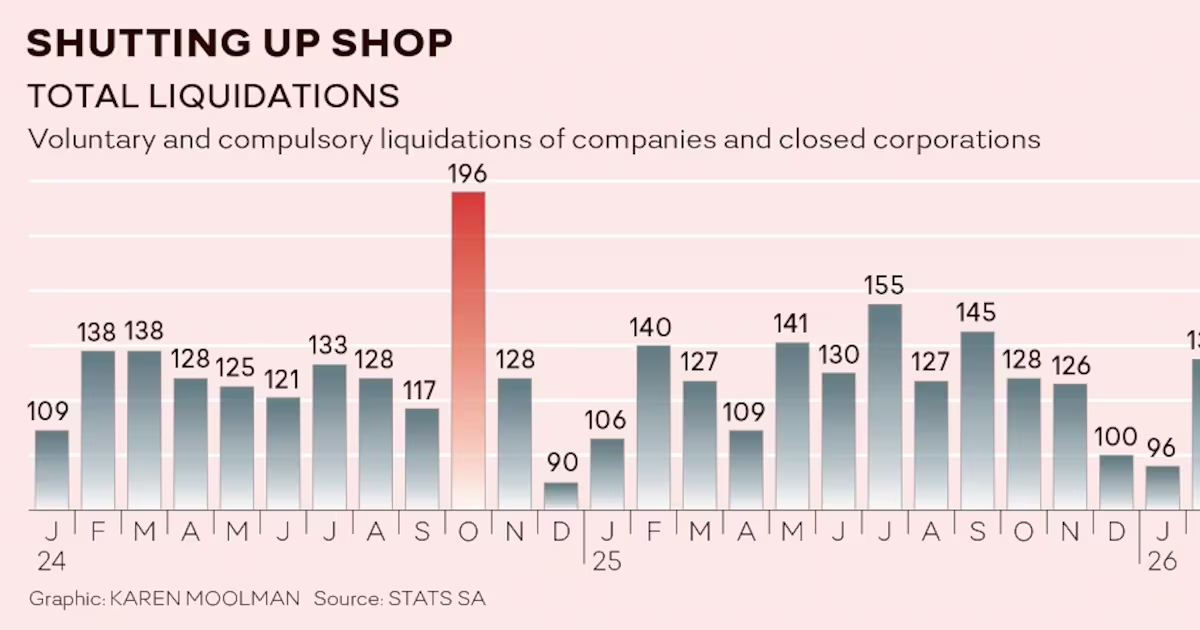
South Africa’s corporate distress landscape is deteriorating rapidly. Statistics SA reports that 891 companies have already entered liquidation in 2026, including 233 in April alone. At the same time, business confidence has weakened amid growing economic uncertainty, rising costs and geopolitical instability. For many companies the focus has shifted from financial pressure to survival. Many boards continue to rely on traditional responses to financial distress that are often implemented too late. By the time directors consider formal business rescue proceedings, significant value may already have been destroyed, creditors may be exposed to greater losses and jobs placed at risk. Conversely, liquidation remains the default outcome for too many distressed companies, effectively ending any prospect of recovery. South African corporates need to consider a more proactive restructuring model. Internationally, the appointment of a chief restructuring officer (CRO) has become an increasingly important tool in stabilising distressed businesses before they reach the point of no return. Yet despite the success of CRO-led restructurings in other jurisdictions, the role remains underutilised in South Africa. In the right circumstances boards of stressed companies should first consider the appointment of a CRO, allowing a fresh look at the business and effective turnaround strategies. Of course, financial pressure may be too severe, requiring an urgent filing for business rescue, where the benefit of a moratorium on claims against the company provides the required breathing space needed in the restructuring process. The default position is, of course, a filing for liquidation, which effectively ends the life of the company with subsequent job losses and cessation of trade. But it takes a brave director to recognise the decline of the company into the abyss of financial disaster. In a cash-strapped entity the board won’t easily admit a potential slide towards business failure and actively seek the outside assistance of an independent supervisor such as a CRO. Board members of failing companies need to accept that the slow slide towards financial distress is often a consequence of their own limited management skills in being able to trade the entity out of its financial distress. Directors who aren’t used to making unpopular and difficult decisions can become paralysed by fear, which makes the need for the appointment of an independent turnaround consultant even more necessary. The risk of personal liability and opening oneself up to scrutiny by creditors after the company has filed for insolvency should persuade directors to engage a CRO as early as possible. A CRO would have as an objective the restructuring of the affairs and business of the company, to ensure the entity can continue to trade into the future on a solvent and effective basis. To do this the CRO needs to remain independent and do his best to make hard decisions for the commercial benefit of the operation. The achievement of stability and being able to trade profitably without continued decline are the CRO’s objectives. A restructuring led by a CRO is aimed at delivering an entity back into the market with its debt restructured, operational and financial changes having been made, with cash-burn reduced, prejudicial contracts (such as prejudicial leases) renegotiated or terminated, and with management and employees realigned to upscale business profits and upside for shareholders and stakeholders. The objective must be to maximise the returns for lenders and creditors faced with the potential fallout of enormous debt write-offs in the event that these companies file for business rescue or liquidation. In the recent RT Global CRO study (March 2026), The CRO in Transition – Restructuring that Creates (More) Value, conducted together with the IFUS-Institute in Europe, submissions were made in support of the CRO restructuring option. RT Global submitted that “in many crisis situations the CRO is still brought in as a ‘firefighter’, far too late, and in an environment already shaped by political dynamics, and with the CRO having limited decision-making authority”. RT Global were of the view that “the CRO office, with clear governance and real executive authority, is becoming the international standard in restructuring. The CRO mandate determines whether restructuring remains an issue of damage control — or becomes a strategic leadership tool." For South African corporates to realise the advantages in appointing CROs in failing entities, the CRO must be brought in as early as possible and before significant damage has affected the business. This requires a change in mindset, with directors and management needing to be mature enough to recognise the need for intervention and supervision, and to do so as early as possible. CROs must be given clear and concise mandates, with the required milestones in place. Targets for the achievement of both operational and financial turnaround must be set upfront, so all stakeholders are on the same page from day one. Realistic outcomes must happen within as short a time as possible so the turnaround can be given the best possible chance to succeed. For South African corporates, agility in distressed situations must be a priority, particularly in volatile and uncertain times. The appointment of a competent CRO who has the ability to create stability and a workable turnaround for the company must bode well for distressed companies and for the South African economy. Levenstein is head of insolvency & business rescue at Werksmans Attorneys.
ERIC LEVENSTEIN | SA’s liquidation crisis demands a new restructuring model
New mindset needed as business leaders face personal liability in insolvency cases
871 words~4 min read