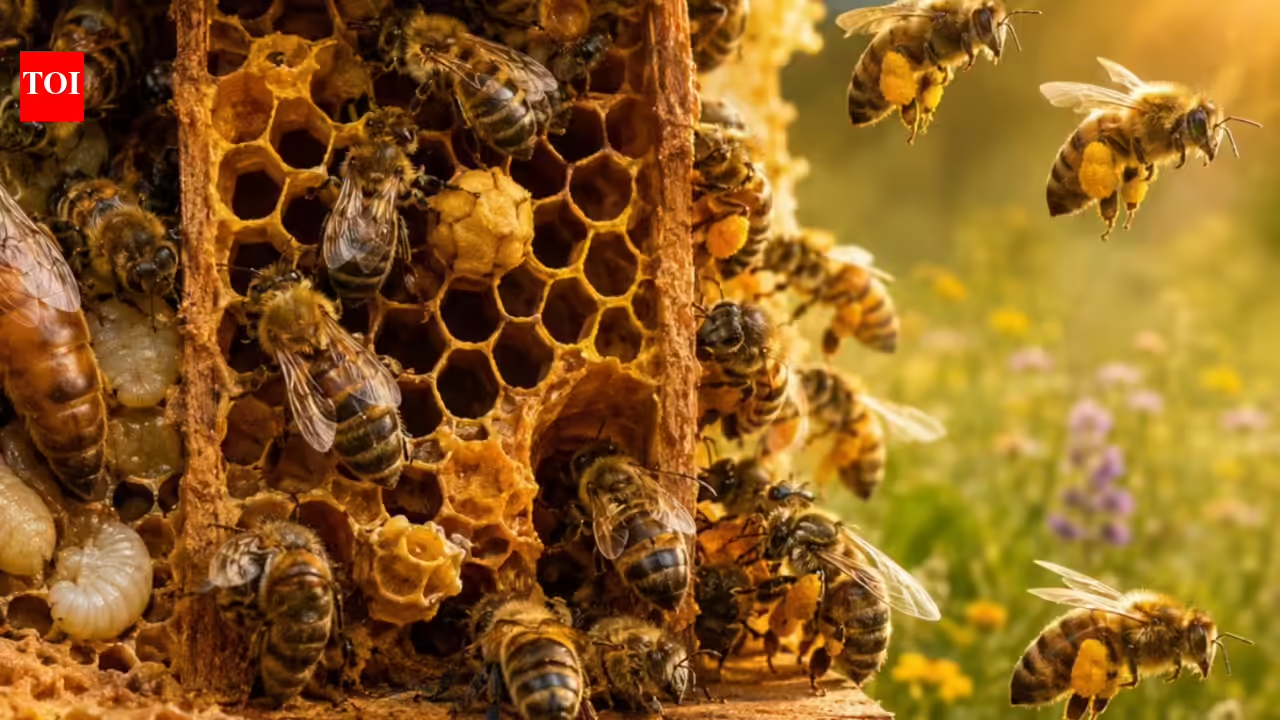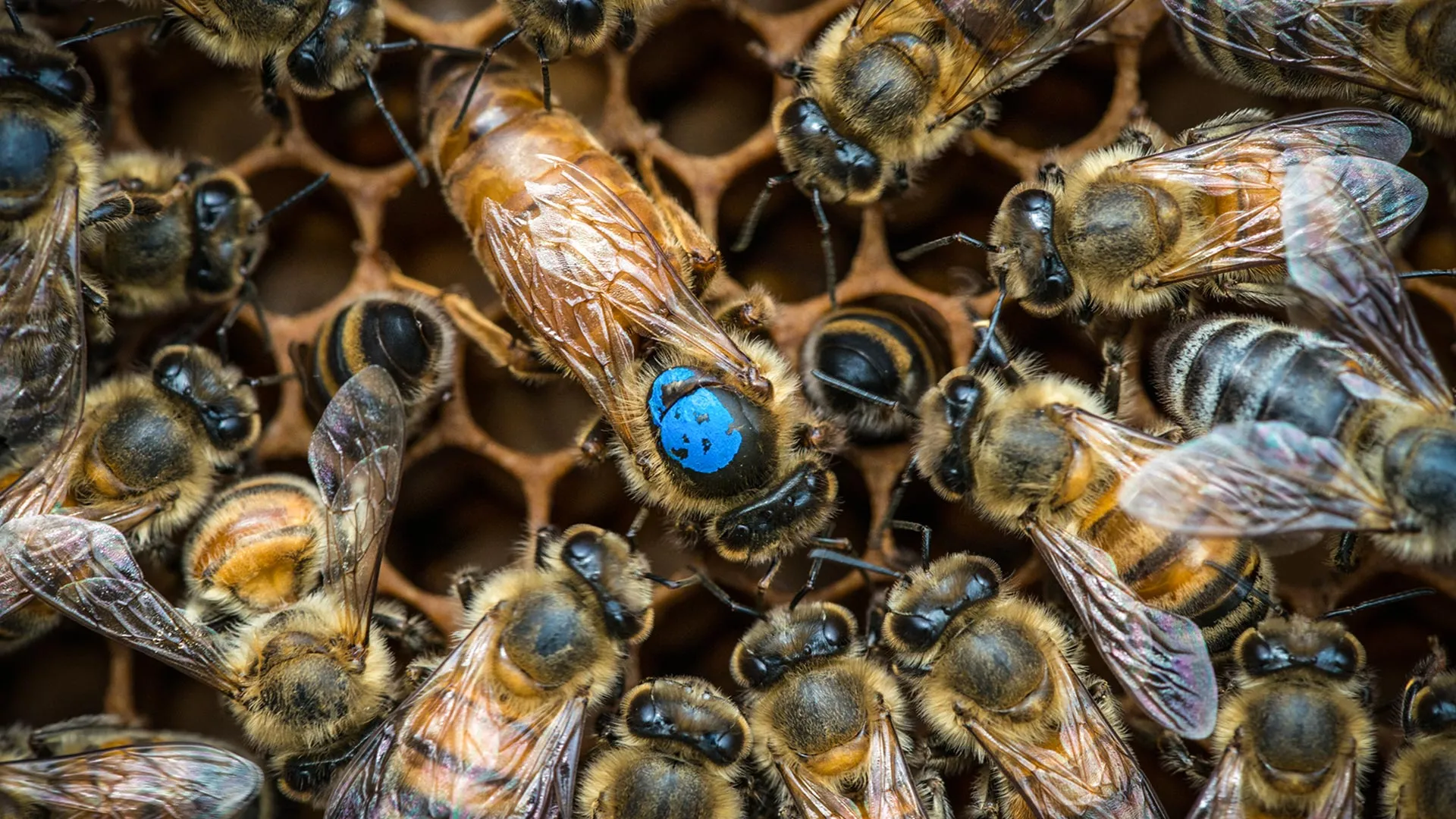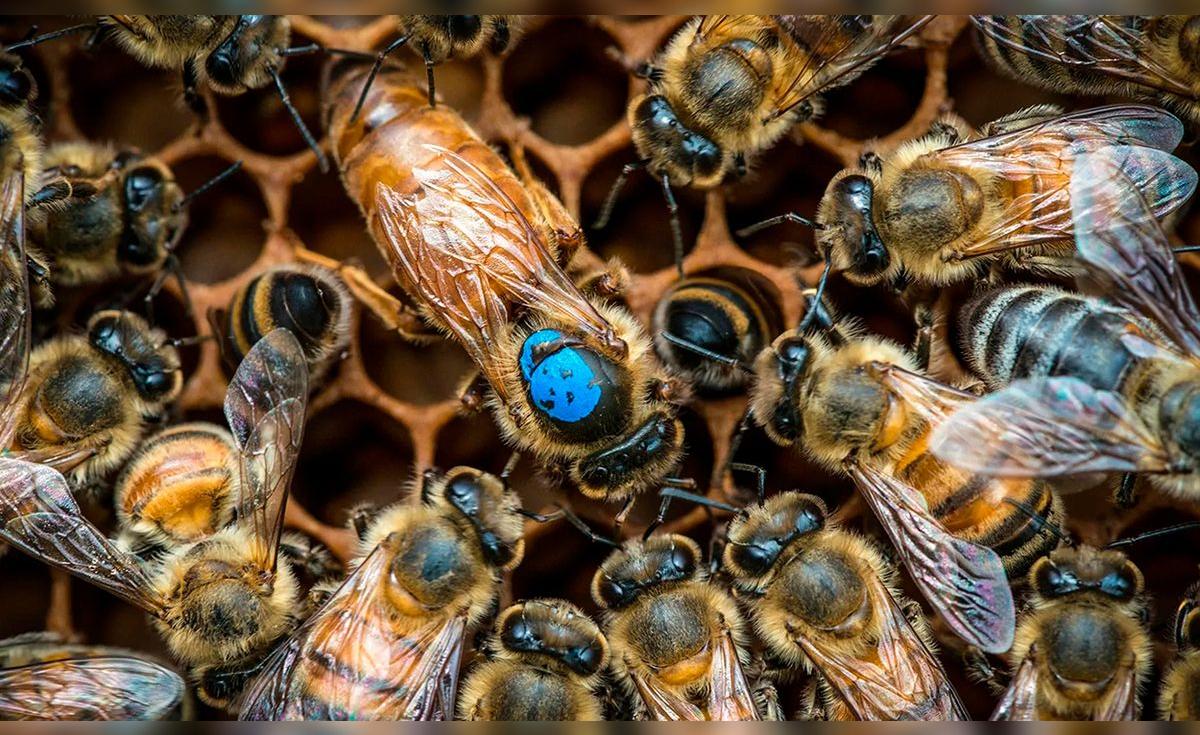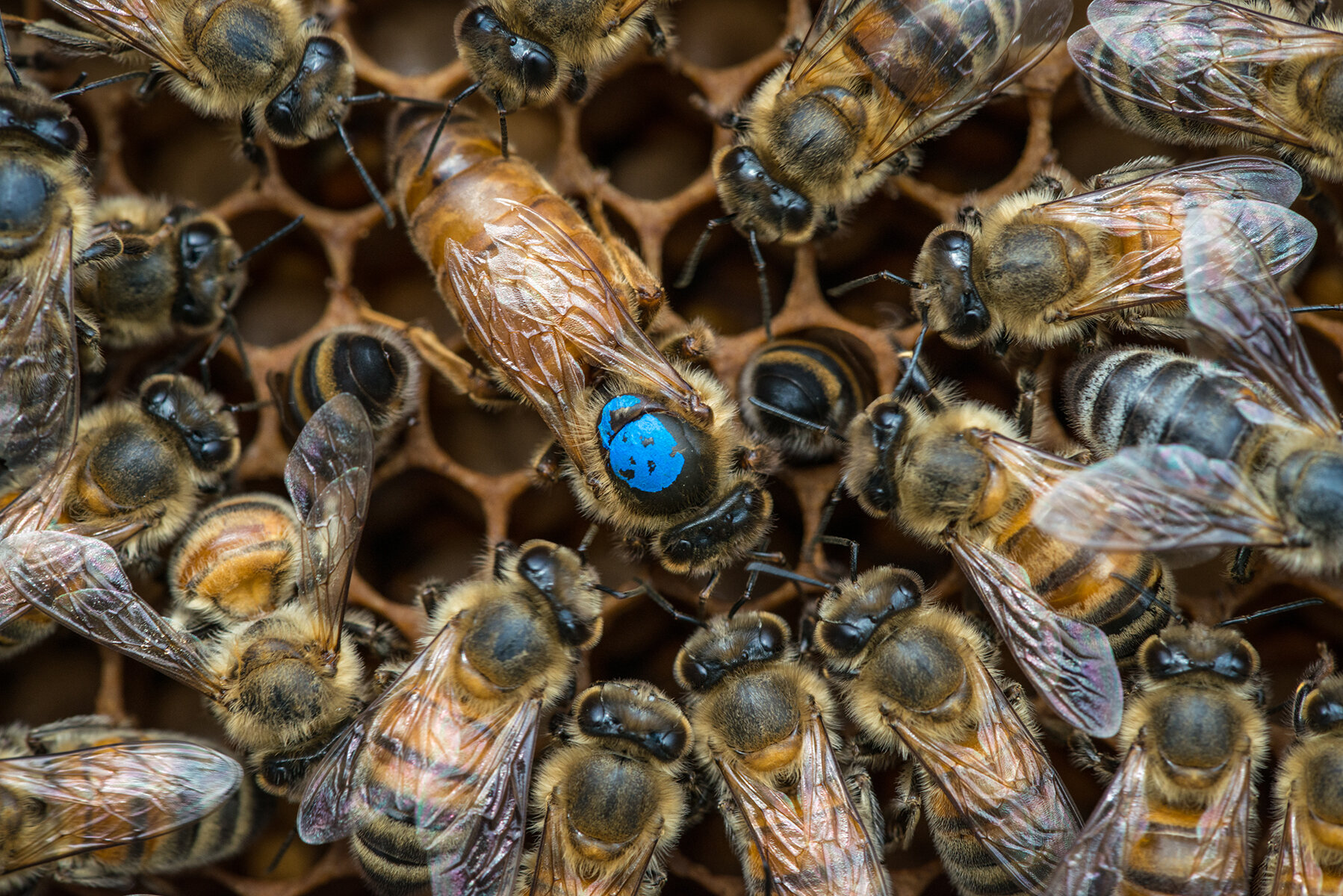
The queen (center, with the blue dot) is cared for and fed by young worker bees. As these bees get older, they take on other tasks in the hive. Credit: HHU/Institute of Evolutionary Genetics
What determines which tasks bees perform in their colony? Biologists from Heinrich Heine University Düsseldorf (HHU) and the universities in Cologne and Frankfurt/Main have investigated the role neural activity plays in this process. In an article published in the Proceedings of the National Academy of Sciences, they explain that by manipulating a specific gene, they can selectively inhibit neural circuits in bees and thus influence their work behavior.
Whether in human or bee societies, tasks must be reliably divided among members of the community for it to function properly. While humans consciously organize and distribute tasks, there is no central planning in a bee colony. Nevertheless, the organization of tasks among the bees (Apis mellifera) works well.
Depending on their age, worker bees perform different tasks: Young bees care for the queen and larvae. Subsequently, they perform construction tasks and guard the hive. Only late in life do they leave the hive to forage for food. The performance of the different tasks is controlled by the interaction of about 1 million neurons in the bee brain. However, how the nervous system controls this age-dependent task organization was previously unknown.