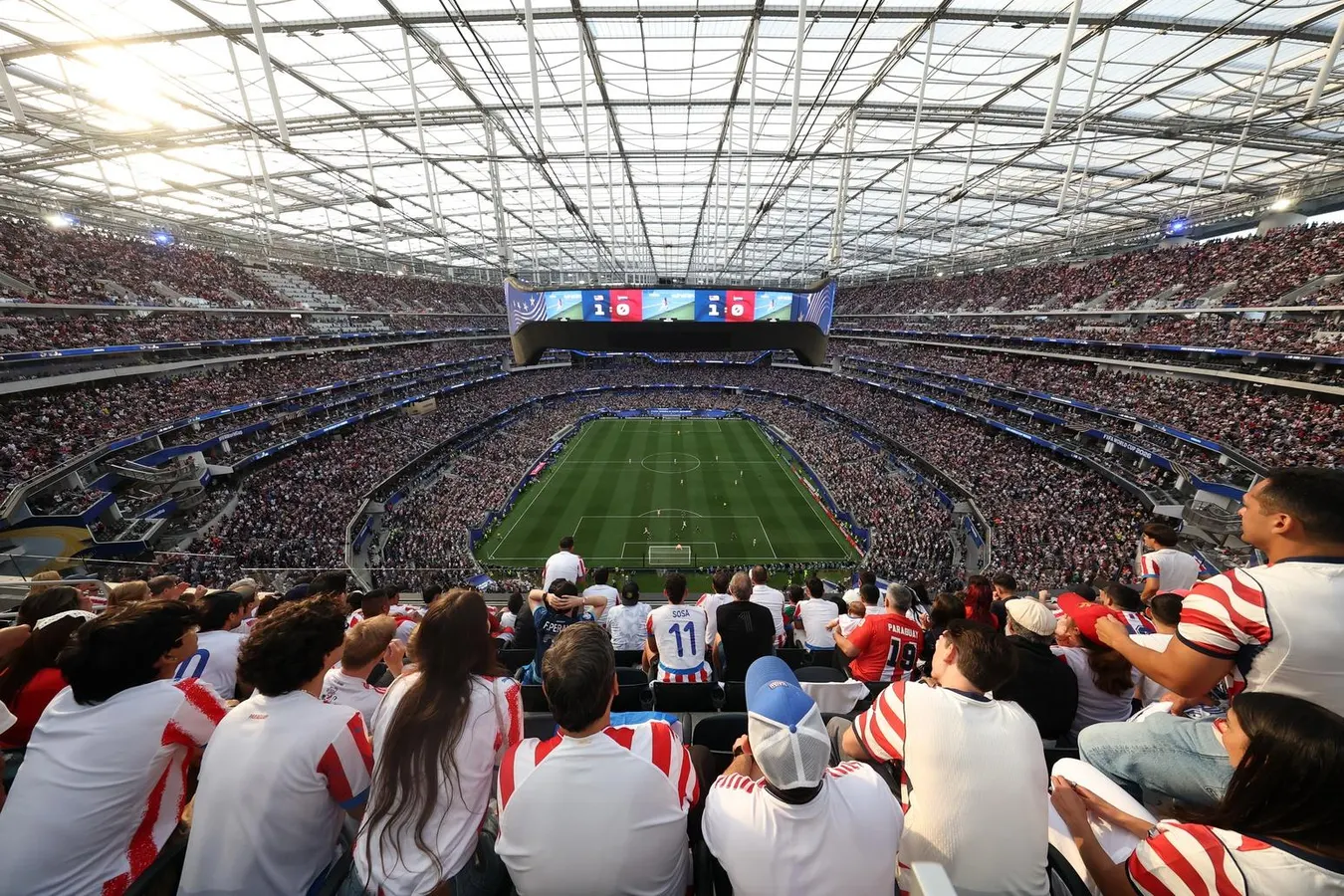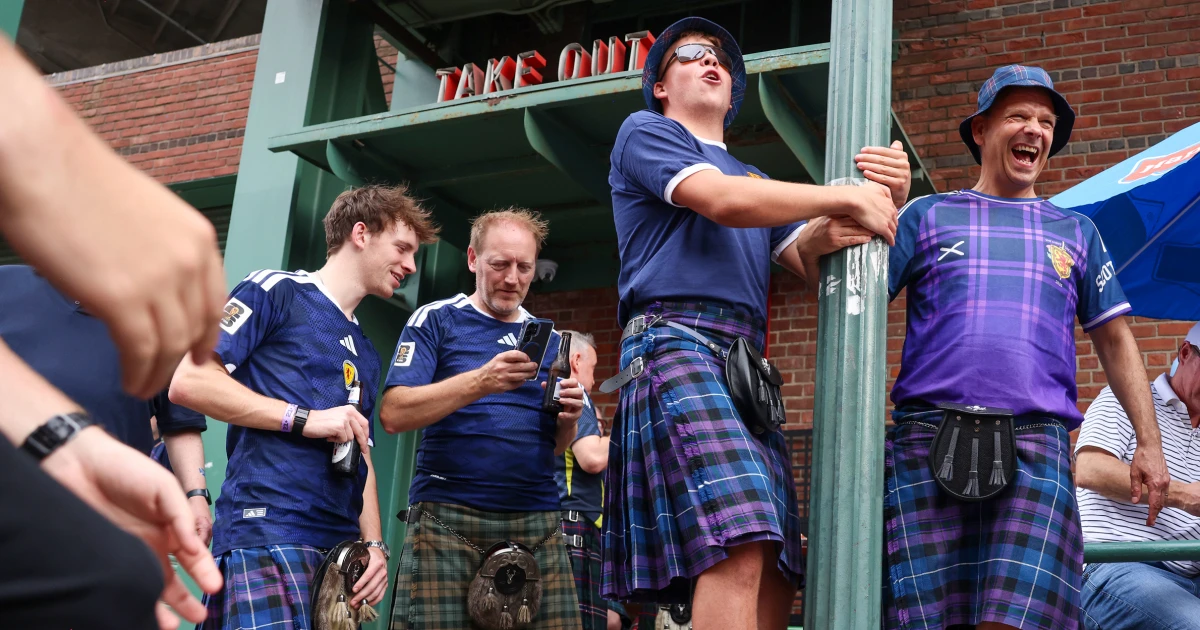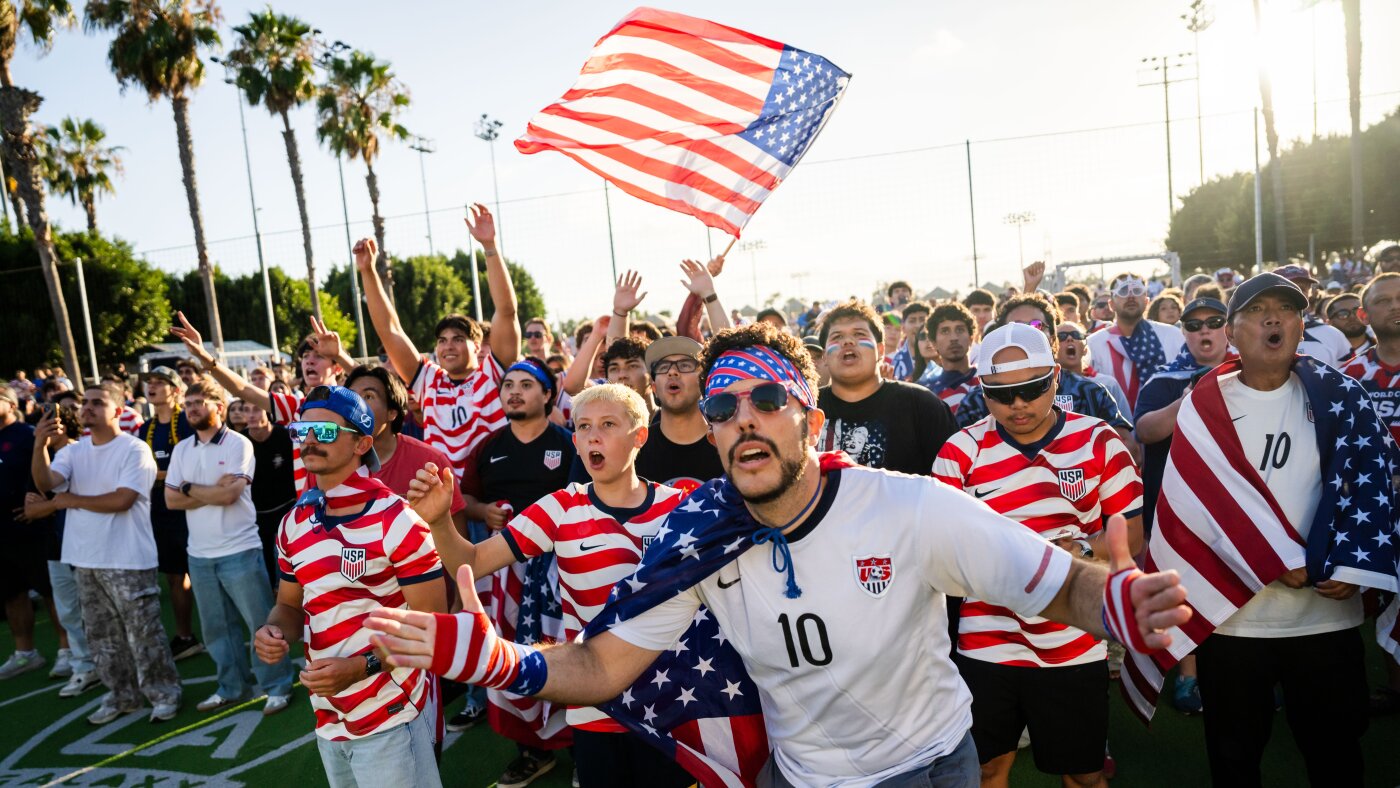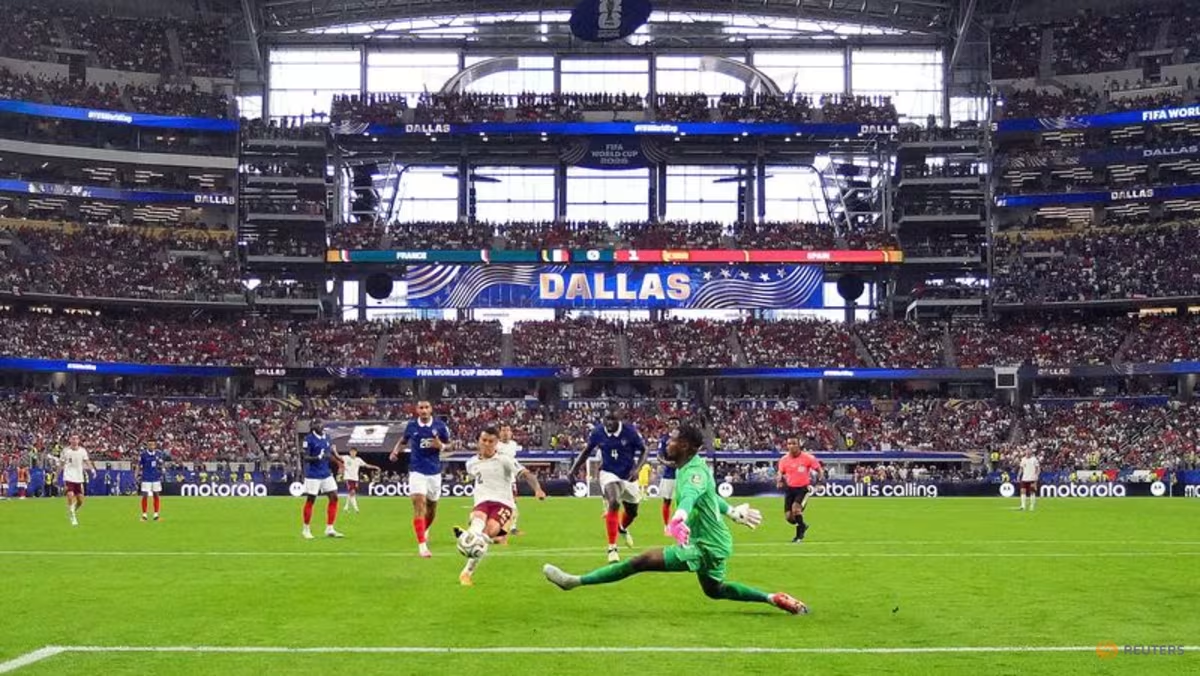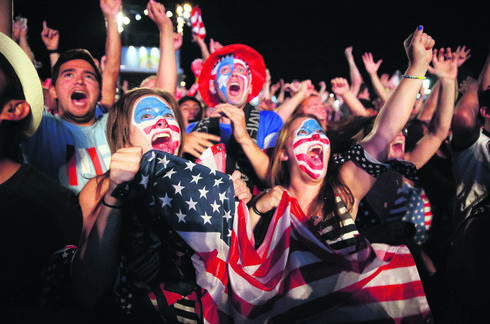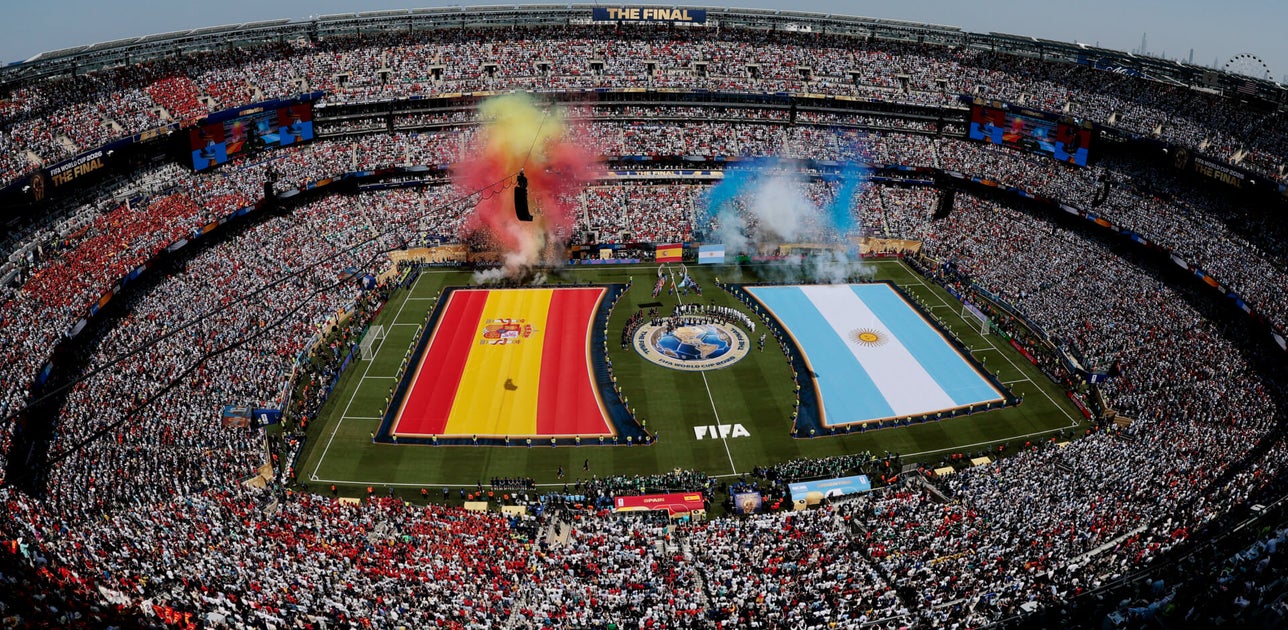
EAST RUTHERFORD, N.J. — They arrived this summer at the steel and concrete monuments to sport around the continent, flooding through the gates and into their seats to absorb a game that, for so many, still feels imported.They cheered for a U.S. team that wanted to change how people thought about American soccer; adopted the countries that were based in their communities; sang songs with Scottish fans at Fenway Park and rowed like vikings in Dallas and New Jersey; and fell in love with its stars, captivated by the grace of Kylian Mbappé, the power and personality of Erling Haaland, the ageless class of Lionel Messi.On Sunday afternoon, they traversed out to the Meadowlands, many wearing the red and yellow of Spain or Albiceleste of Argentina. But others donned U.S. jerseys, here simply to take in the spectacle of a World Cup final. They watched a Spanish team that controlled the game but needed more than 105 minutes to find a goal before downing Messi and Argentina, 1-0, to win the World Cup.Thirty-two years ago, a record three-and-a-half million people made similar journeys. That 1994 World Cup reintroduced a sport to the wider United States that had crumbled with the North American Soccer League in the 1980s and survived mostly in immigrant communities around the country. It launched a professional league and gave soccer a path forward in this country.This 2026 World Cup has presented an entirely different opportunity for soccer in America.MLS spent the past three decades building out infrastructure and permanence for the sport, its stadiums and training facilities now featuring during the tournament; its 30 teams now operating around North America, many with robust fanbases, though all still clawing for greater relevance.The Premier League mainstreamed the sport a decade prior, when it signed a television deal with NBC and turned Saturday mornings into new traditions of pubs and pints across the country.The FIFA video game raised a generation of Americans on the sport’s brightest players and most historic clubs.“Ted Lasso” and “Welcome to Wrexham” became pop-culture crossovers that introduced new audiences to the sport’s powerful storytelling tools; to promotion and relegation and to the way clubs are intertwined with the communities in which they exist.Why the U.S. was actually the perfect host for the World CupHenry Bushnell and Lia GriffinThe promise of 1994 was fulfilled. Three decades later, this World Cup was about launching a new phase of growth. Its legacy will be determined on different timelines and by different measures. Success will undoubtedly be judged by the record television audiences and sold-out stadiums (despite sky-high ticket prices), and the $15 billion FIFA says this World Cup cycle has generated in revenue.But the true lasting impact will take longer to decipher.“It’s been a terrific 39 days, but bringing the Cup to the U.S. has always been about: What does it do to accelerate the growth of the game? So it’s Monday (the day after the final) that matters,” said former U.S. Soccer president Sunil Gulati, who played a leading role on the 1994 World Cup organizing committee and helped bring the 2026 edition to North America.“The macro picture has always been about: what does it look like the day after (the tournament ends)? How does it accelerate the growth of the game? In many different ways. And I think it will. How quickly? How much? Remains to be seen.”But the impact won’t be felt just on those macro levels. It will also be about the people it inspired to grab hold of soccer and all it offers. The next generation of players and coaches, but also executives and investors that will shape the future of soccer in America — just as the 1994 World Cup did.Fans in an El Paso, Texas, bar cheer on the USMNT during the round of 32 win vs. Bosnia and Herzegovina (USA TODAY Network / Reuters Connect)The generational impactLandon Donovan was 12 when he walked into the Rose Bowl to watch Argentina play Romania on July 3, 1994.“Until that point, soccer was just sort of a fun game that I did and enjoyed, but there was never really an end goal,” Donovan once reflected. “There was nothing at the end of the rainbow, so to speak. After seeing that, I realized, ‘That’s pretty cool, pretty special. That’d be a dream to be able to do that some day.’”Donovan would go on to become one of the best players in American soccer history — and would make his World Cup debut just eight years after that 1994 tournament. He was not, of course, the only player inspired by that tournament. Clint Dempsey was left in tears that he could not see Diego Maradona play at the Cotton Bowl due to the Argentine icon’s suspension. Drew Moor, who won two MLS Cups and earned five U.S. caps, remembered the impact of seeing Brazil play the Netherlands at that same stadium.“I remember Brazil scored late; we were sitting in the Brazil section … I saw this kid crying that was about my age, and I was like, ‘This kid is crying because his country just advanced to the semifinals,’” Moor said. “That was the day that I fell in love with soccer.”Jesse Marsch, the American who would go on to manage Canada at this World Cup, sat in the front row of the upper deck watching Italy play Bulgaria in a World Cup semifinal in New Jersey.“It was exciting, the possibility of having that kind of soccer culture back home,” Marsch recalled. “We absolutely needed that 1994 World Cup in our country to give our sport a chance.”Pelé, donning an American flag tie, and Whitney Houston on stage at the 1994 World Cup final at the Rose Bowl (Mike Nelson / AFP / Getty Images)Three decades later, a new generation is being inspired. Whether it’s 5-year-olds playing hallway soccer in their socks, pretending to score at the Azteca; or pre-teens on youth fields who spent marathon days watching their favorite players; or even young MLS homegrown stars like Cavan Sullivan, 16, and Julian Hall, 18, who were in attendance at Sunday’s final.Across the country, a new generation fell in love with the players they usually see from a distance and on a TV screen. In their backyards, they saw Jude Bellingham’s goals and Cape Verde’s unwavering belief and Spain’s suffocating quality. More importantly, they lived the culture around the games that spilled out onto streets, that caused marching bands to learn national anthems and fans to take over Times Square.This generation will have a better chance to do something with that inspiration.The key difference between 1994 and now wasn’t just that American players then couldn’t fathom playing professional soccer, but that there was no real route to do so — at least domestically. Sullivan and Hall, unlike Donovan and Dempsey’s generation, grew up with a professional league and academies. They were at the final as guests of Adidas, Sullivan a member of the Philadelphia Union who’ll move to Manchester City when he turns 18, Hall the top goalscorer this season for Red Bull New York.This World Cup represents more for American soccer in part because of the infrastructure that was built on the back of 1994 — not just the soccer-specific stadiums and training grounds, but also the academies and pathways that led to a generation of players who captured the country’s attention earlier this summer.“America’s next Christian Pulisic or Leo Messi somewhere along the way might have attended a game, and perhaps is going to be sitting in the stands in the World Cup final, and will see the greatest players in the world, and say, ‘Wow, I want that to be me,’” MLS commissioner Don Garber told The Athletic.MLS commissioner Don Garber at the 2026 World Cup draw last December (Roberto Schmidt / AFP / Getty Images)The failure of the loss to Belgium in the round of 16, though, emphasized that there is still a lot of work left to do for the USMNT to have players who can compete with the world’s best.“One of the things that came out of the World Cup beyond the spectacle … was: how do we work together on the men’s side, with U.S. Soccer and with the entire youth development community, to ensure that we have better alignment?” Garber said. “What does the entire ecosystem need to do to ensure that you know we’re better in the next World Cup? And all taking a bit of responsibility. That doesn’t just fall on the league; it falls on the entire ecosystem to be better.”In some ways, the growth of American soccer — even with so much still to improve — has created an environment in which there will be what Gulati called “diminishing returns” on the influence of this tournament.“Now, the game’s at a different place,” Gulati said. “So we’re not gonna start a new league out of this, you’re not gonna see a 20 percent growth in participation … or things like that. Because the game is much more a part of American society than it was 30 years ago.”But there are still ways to capture the momentum of this summer’s World Cup in the shorter term. In some ways, it turns up the pressure on MLS.The future of American soccerGarber was a 36-year-old NFL executive when he walked by Brazilian samba dancers in the packed parking lots outside of the Rose Bowl and into the stadium for the 1994 World Cup final. It was the first soccer game he ever attended.The Queens, New York, native helped create the NFL Experience two years prior and worked with U.S. Soccer president Alan Rothenberg to help put together a similar program for the World Cup. Garber attended that Brazil-Italy final as a guest of Coca-Cola.“I’m a marketing guy by heart, and said, ‘Wow, this is bigger than everything that exists in this country,’” Garber recalled. “And I got totally caught up in it. … If not for that ’94 World Cup match, I probably wouldn’t be the commissioner of Major League Soccer. It began my love affair with the sport.”That same day in the same stadium, Phil Anschutz saw the passion of the fans and determined he would invest in American soccer. The billionaire businessman became one of the key stakeholders in MLS, owning several teams at one point. Anschutz helped turn the LA Galaxy into the league’s first global brand by signing David Beckham, a moment that would forever alter the course of professional soccer in the United States.It is a lesser-seen but vitally important part of the longer-term impact of a tournament like the World Cup. The enormous popularity of the event — the millions of people watching on television and the sold-out crowds — drives influence at corporate and executive levels, pushing more investment into the sport. Many of the organizers in 1994 became key figures for the next few decades in American soccer, from Gulati to future U.S. Soccer CEO Dan Flynn, promoter Charlie Stillitano and U.S. Soccer executive Tom King. And it drew others, like Anschutz and Garber, in.The next generation of the U.S. game’s decision-makers will likely have been influenced by this summer’s tournament, as well. This World Cup represented America’s, and Americans’, growing influence on the sport, the spotlight moment of an unprecedented run that included hosting the 2024 Copa América and 2025 FIFA Club World Cup. The continued investment by Americans in clubs overseas also shapes the evolving relationship between the country and the sport and its global economy.Scenes from the 2026 World Cup final halftime show (Mike Segar / Reuters)Another halftime show and another trophy ceremony on an American field — and again featuring U.S. President Donald Trump, for that matter — hardly felt or looked out of place. It is a new normal.That influence will likely only continue to grow.Among those in attendance on Sunday were U.S. Soccer CEO J.T. Batson and LAFC co-owner Larry Berg, a candidate to replace Garber as commissioner of MLS. But somewhere in the crowd might be others who will have been convinced to be a part of what comes next.The responsibility on them may be even bigger, simply because it’s their job to take the foundation that has been built over the past 30 years and grow it into something that leverages the soccer passion the country showed this summer.“It can’t be a rock concert, it can’t be (that) the trucks are coming in and putting on a great show, and then they leave town, and they go to the next place,” Garber said.“The fans came here for the World Cup, and they saw something that they never expected in our country. And I think even people in our country felt the same thing. They saw we almost revisited and rediscovered who we are, not just as a country, but as a soccer nation.“Every day, there were just shocking things that would happen, that if we can’t capitalize on, then, y’ know, shame on us.”
The 1994 World Cup influenced a generation of Americans. What will 2026’s impact be?
There's no denying a landmark World Cup will leave an indelible mark on America. But what will be its legacy? And who will it galvanize?
2,163 words~10 min read