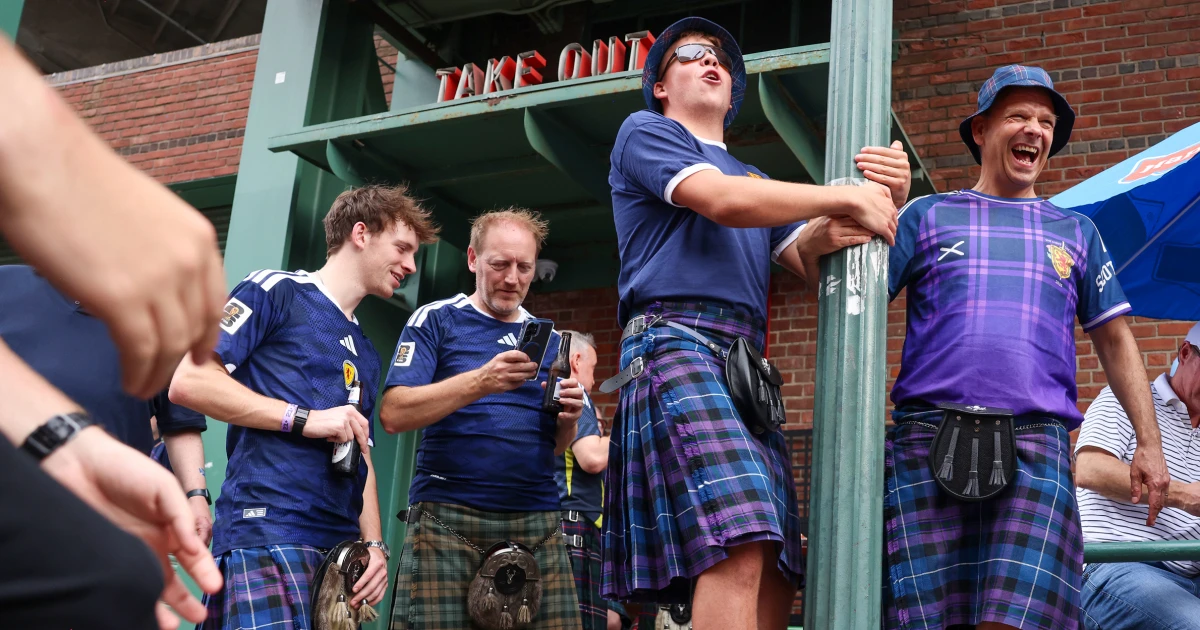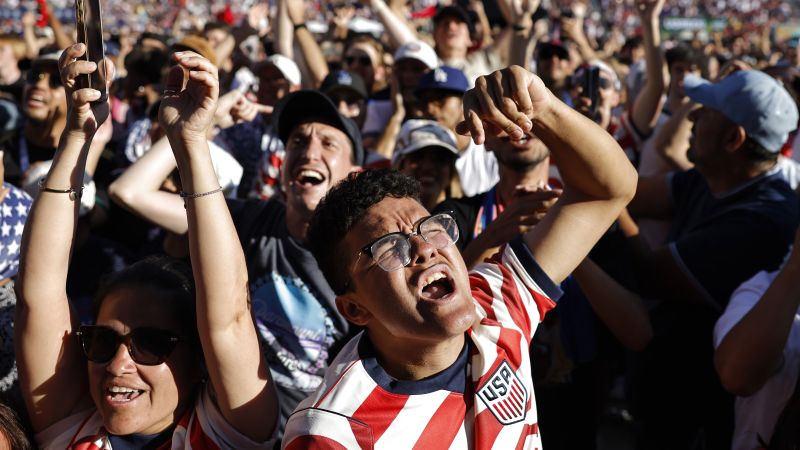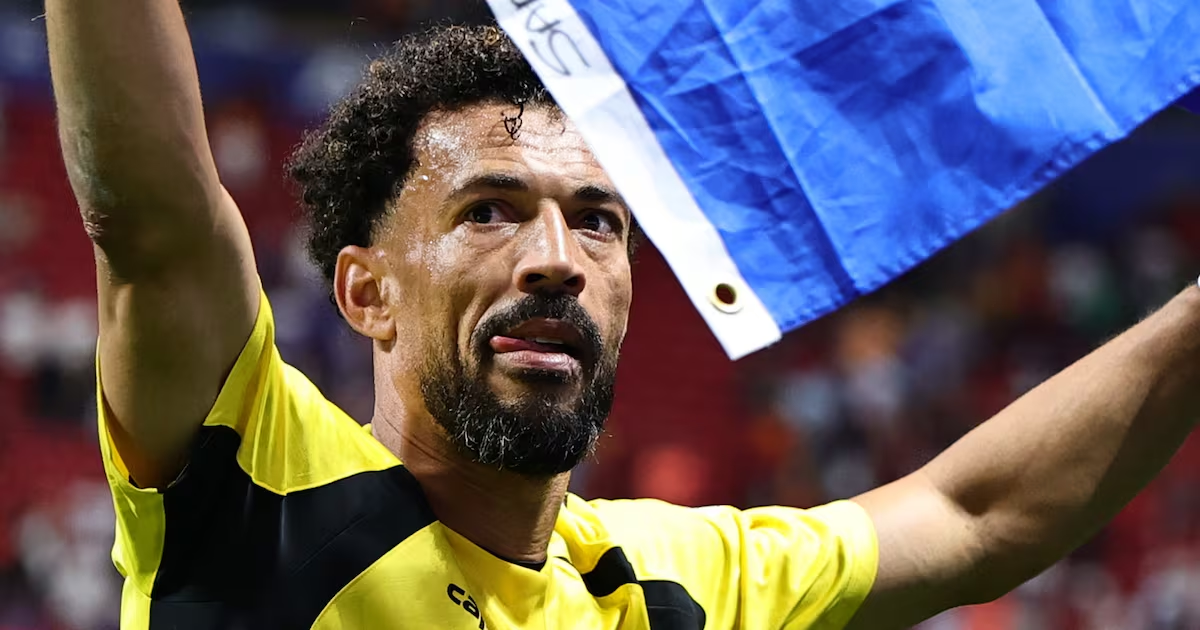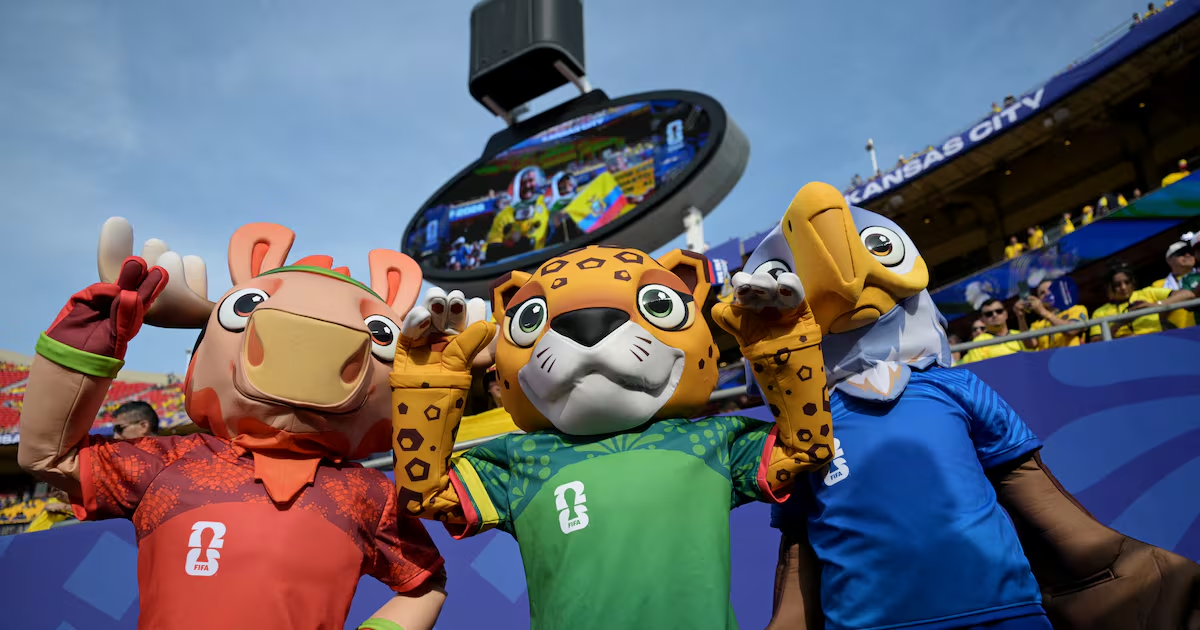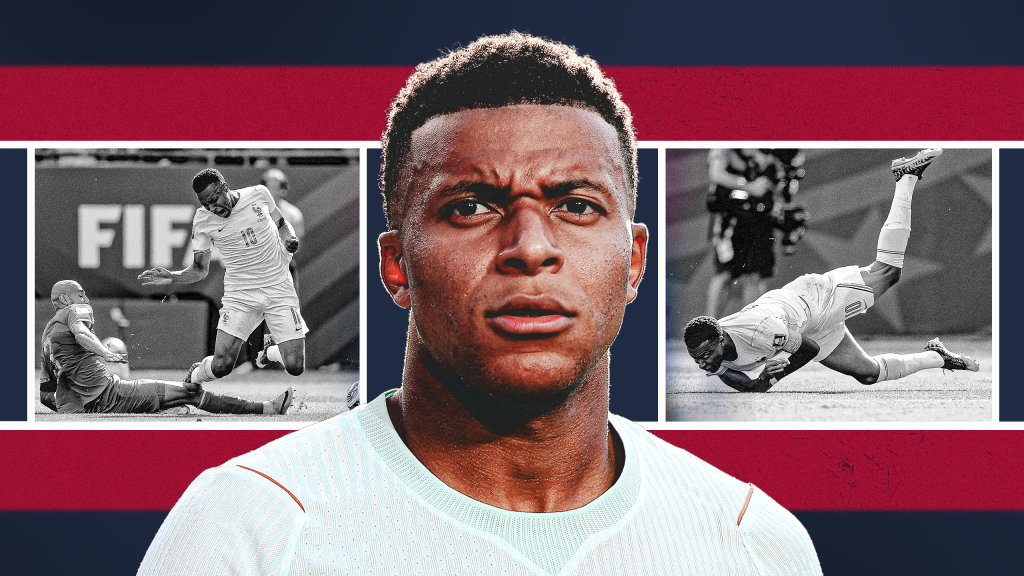
Memory is a shifty little bugger, and there’s no telling how it’ll hold up under time’s erosive strain, but it’s probably safe to say the ebullient cultural exchange that took place here in the U.S. during our portion of the 2026 FIFA World Cup will endure in our collective recollection of the event. Visitors from the four corners of the soccer-worshipping earth descended upon our huge and beautifully chaotic country and a whole bunch of them seemed to fall in love with the place and its people.If you’re looking to subvert your conditioning, there may be no more effective method of busting out of the default settings than witnessing tens of thousands of strangers giddily embracing the aspects of American culture that we all tend to take for granted. First, there was the Scotsman in the 10-gallon hat marveling at the near-parodic excess of a Buc-ee’s rest stop emporium (“These people know what they’re doing! … I don’t even know what that is, but I need to buy it.”)Then there was the German traveler who posted, “The European mind can’t comprehend this” alongside a panoramic photo of the 88,042 other fans who’d descended upon Auburn’s Jordan-Hare Stadium for the June 9 Argentina-Iceland friendly. Meanwhile, Boston did its part to make visiting fans feel at home, so much so that a mutual admiration society took root during the Tartan Army’s brief takeover of Beantown’s taprooms.We watched as travelers from the Pacific Rim temporarily lost contact with reality after their first bite of Texas barbecue and thrilled at the spectacle of a Viking horde rowing its way “down” the red TKTS stairs in Times Square. In exchange, millions of casual fans who’ve probably never watched a Premier League match developed a fond fascination with Norway striker Erling Haaland, who took a little piece of Americana back home with him in the form of an alcoholic taxidermy raccoon.Even the French appeared to be won over by the how-you-say ambiance Américaine, which is no mean feat. While our Gallic cousins in many respects function as a sort of psychic antimatter to the U.S. archetype—they horde their smiles and often speak with a wounding frankness; basically, they’re New Yorkers with more euphonious accents—social media has been awash with cooly delighted Parisians steering pickup trucks through mud wallows and saying nice things about our food. Zut alors!The love fest has been so effusive that David Blitzer admitted that he was pleasantly surprised to discover that soccer hooliganism played no role in FIFA’s sprawling tournament. Speaking Thursday afternoon during a panel at a sports-business forum convened by The Wall Street Journal, the founder and managing partner of Harris Blitzer Sports & Entertainment said, “I thought there were going to be brawls” during the England-Argentina semifinal, before adding that the fans in Atlanta were “spectacular.” (While Lionel Messi memeified himself by presenting his De Niro Face to Jude Bellingham, the Argies and Brits in the stands managed to keep things copacetic.)For his part, MLS commissioner Don Garber’s off-the-cuff take was well-nigh poetic. “I think the world came to the United States … for World Cup matches and they’re walking away with a different sense and perspective of what our country is all about,” Garber told the WSJ audience. “I didn’t expect that. The World Cup delivered something that is what makes soccer, or football, the Beautiful Game. You have this identity and culture and moments that allow you to, for a period of time, show who you really are—and all of that lives in our country.”Now that everybody’s got a case of the warm and fuzzies, here comes the inevitable bit where we talk about how our native enthusiasm for supersized novelty will inevitably piss off even the most enthusiastic converts to the American Way. Gianni Infantino & Co. have yet to decide if the mandatory hydration breaks are here to stay or if this year’s experiment will prove to be a one-off, but in a case like this money tends to have the loudest voice in the room. European fans have been particularly vocal about how much they despise the disruptions, although given their contrarian stance on perfectly normal summer staples like air conditioning and ice in cold beverages, maybe this is one of those ferme la bouche moments.Look, we get it: The American propensity to bovinely submit to a steady diet of force-fed advertisements is sadder than Rebecca Lowe was after England’s 2-1 loss to its bitter rivals, but like Fox’s studio anchor, we’ve all got to stiffen that upper lip. As the British Ministry of Information never tires of exhorting its citizens, we must Keep Calm and Watch David Beckham in That Home Depot Ad for, Like, the Millionth Time. Or something like that.That the new advertising wrinkle effectively will have paid off Fox’s rights fee for this World Cup should serve as an indication that FIFA’s experiment is about to cross over into the territory of SOP. Again, no official decree has been handed down from Zurich, but if the stateside TV ratings are anything to go by, a few minutes of commercial intrusiveness per match certainly didn’t seem to cost Fox much in the way of viewership. (On an even more practical note, it’s hard to imagine a player turning his nose up at the “hydration” element; during the Independence Day match between France and Paraguay, the humidity made it feel as if the ambient temperature in Philadelphia had reached 105ºF.)Given that FIFA is about to bring the media rights to the 2030 and 2034 World Cup to market for a whole lot more than the fire-sale price that Fox paid ($485 million) for this year’s tourney, the prospect of earning some of the fee back in the middle of each half could attract more would-be bidders than ever before. Given the chumminess with which supply and demand tend to interact, a surfeit of suitors should only work in FIFA’s favor.Should FIFA elect to roll up the English- and Spanish-language rights into a single package, its next U.S. media partner can expect to pay nearly $4 billion for both upcoming tourneys. If FIFA doesn’t expand the field beyond the new 48-team format, the winning bidder will have to charge around $2.5 million per 30-second spot if the hydration breaks are to fully offset the cost of entry, and while that’s obviously way more than any sane marketer would agree to pay—it’s roughly 10 times what Fox was charging in the group stage matches—any opportunity to offset the expense of carrying the spectacle will be more than welcome.FIFA may still cave to the demands of the UEFA set, which brings to mind a throwaway line about human fallibility that Garber delivered on Thursday. When Blitzer teed him up with an encouraging, “You can’t mess this up!” (a nod to the campaign to convert World Cup fans into MLS supporters), Garber cracked, “Commissioners can always mess things up.” That note of refreshing candor got a big laugh from the sports-biz set.Fans outside the U.S. may kick up a fuss should FIFA make a permanent fixture of the hydration breaks, but such are the privileges of getting to call the shots from a position of absolute authority. (As Garber mused in a somewhat tangential context, “What could be better than sitting around and having the power to change the rules?”) Purists don’t care for the interruption in the game’s natural flow, but resistance remains futile as long as FIFA is in charge of ⌘+F’ing its way through the rule book.One aspect of the 2026 World Cup that nobody seems to have found fault with is its VAR-enforced policing of the sort of blatant flopping/diving that are a function of the decidedly European inclination toward foul-scrounging. If the all-seeing eye catches a player in the act of “simulation,” he may be presented with a yellow card, as was the case with the Swiss forward Breel Embolo in his team’s 3-1 quarterfinal loss to Argentina. Now, if you’re a fan of precision wristwatches, fancy chocolates and neutrality, you may not have been overjoyed by the referee’s ruling. After a lengthy VAR review, the yellow that had originally been issued to Argentina’s Leandro Paredes was summarily held out to Embolo; as he’d already picked up a yellow in the first half, the Swiss player was ejected from the match.Which isn’t to say that flops and dives have been cleared up altogether, as France’s Kylian Mbappé executed a tumble against Morocco that wouldn’t have been out of place if he’d been wearing an Italia jersey. Mbappé was subsequently awarded a penalty kick, which he failed to convert, thereby returning the karmic scales to plumb.It’s not a perfect solution, but the threat of earning a yellow card has gone a long way toward reducing the practice of indulging in the Dark Arts mastered by the long-absent Italians. Sadly, in discouraging all the phantom agonies, FIFA inadvertently seems to have done away with the equally farcical phenomenon that is Magic Spray®. In the absence of phony injuries, World Cup athletic trainers have had little cause to deploy the dermal refrigerant, which basically functions as an aerosolized placebo.Likewise, the respite afforded by the twin hydration breaks has also reduced the need for improvised periods of gentlemanly repose, which in turn has lessened the demand for the chilly spray.
The World Cup Vibes Have Been Immaculate, but Joy Comes at a Cost
OPINION: The World Cup saw memorable cultural exchanges and some great play. It also may have ushered in a new era of match stoppages.
1,555 words~7 min read