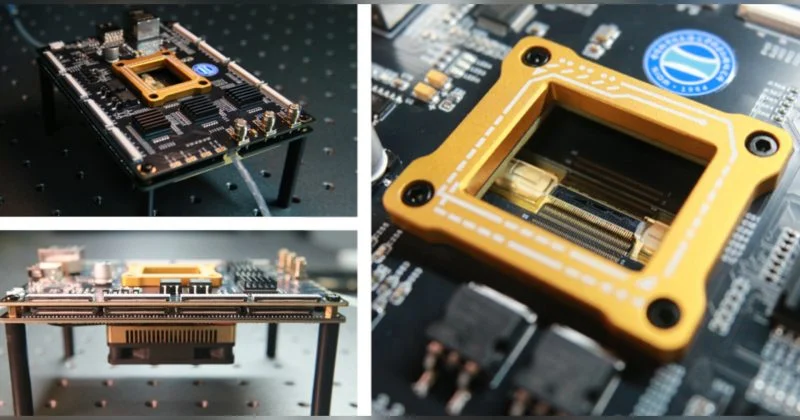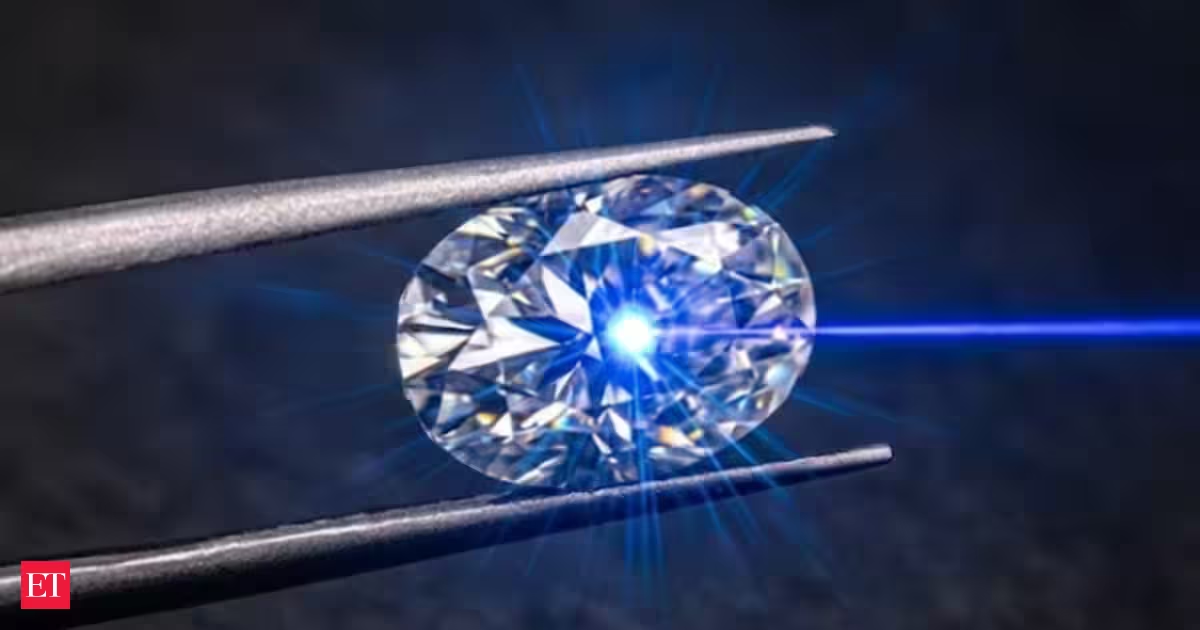
Researchers from China have developed a new type of storage technology that could protect data for an unprecedented period, potentially millions of years, by using tiny defects inside diamonds as microscopic memory units.A 2024 study published in Nature Photonics titled, ‘Terabit-scale high-fidelity diamond data storage’ by Jingyang Zhou and colleagues has introduced a terabit-scale diamond data storage system that researchers say combines extremely high storage capacity, rapid data writing, low energy use, and an estimated maintenance-free lifespan extending far beyond current storage technologies.The research team developed a diamond-based optical storage medium that uses fluorescent vacancy centers, tiny atomic-level imperfections inside diamonds, to encode digital information. These defects can be precisely created using ultrafast laser pulses and later read using fluorescence imaging.The researchers wrote that the technology addresses the growing challenge of preserving massive amounts of digital information generated every year.“Realizing efficient and durable data storage solutions is paramount,” the researchers said, adding that future storage systems need improvements in “storage capacity, data throughput, device lifespan and energy consumption.”Diamond turns into a microscopic data vaultTraditional storage systems such as hard drives (HDD) and solid-state drives (SSD) are widely used today, but they face limitations when it comes to extremely long-term preservation. Mechanical failures, electrical degradation, and the need for continuous maintenance can make storing data for centuries difficult.The researchers proposed diamond as an alternative because of its exceptional physical properties. Diamonds are among the hardest known materials, have high thermal conductivity, and can withstand extreme environmental conditions.The new system uses Frenkel defects, atomic-scale disruptions in the diamond lattice, specifically the general radiation 1 (GR1) centers. These defects behave like tiny storage units that can hold information.According to the study, the GR1 centers have remarkable stability, with researchers estimating that the storage medium could theoretically maintain information for around 10¹⁴ years at room temperature.The paper noted, “The GR1 centre shows ultrahigh fluorescence stability as a fluorescent defect and shows resistance to photobleaching, making it an ideal candidate for long-lasting and frequent reading.”More data than conventional storageThe experimental diamond storage medium achieved a storage density of 14.8 terabits per cubic centimeter, according to the researchers.They demonstrated a four-dimensional optical storage method by combining:three-dimensional positioning inside the diamonddifferent fluorescence intensity levels for additional data encodingThe researchers reported that their system achieved:14.8 Tbit/cm³ storage densitymore than 99% writing and reading fidelity200 femtosecond writing timeextremely low energy consumption at the nanojoule scaleThe team also demonstrated storing images and video data inside the diamond. In one experiment, they encoded a color image of Henri Matisse’s “Cat” and successfully recovered the stored information with a fidelity of 99.48%.They also stored “The Horse in Motion” (1887), considered the world’s first motion picture, inside the diamond medium.Laser pulses create invisible memory pointsThe process works by firing extremely short laser pulses into the diamond. These pulses create microscopic defects that represent stored data. The researchers used femtosecond laser pulses, pulses lasting just quadrillionths of a second, allowing them to create storage points smaller than the normal limits of optical systems.The study reported that individual storage units could reach sizes below 69 nanometers, enabling much higher storage densities than traditional optical discs.The paper explained, “A single low-energy femtosecond pulse can on-demand generate Frenkel defects in the diamond, functioning as individual storage units.”Faster reading and future possibilitiesBeyond long-term preservation, the researchers focused on making diamond storage practical by improving reading and writing speeds.They demonstrated parallel reading methods capable of processing thousands of storage channels simultaneously. The researchers estimated that future versions could achieve data reading speeds of 14.4 gigabits per second.They also suggested that improvements could push storage capacity even further.By combining additional techniques such as polarization and wavelength multiplexing, the researchers estimated that diamond storage could eventually reach 150 terabits per cubic centimeter.A possible future for archival storageThe technology is still at a research stage and would require major engineering advances before becoming a commercial replacement for hard drives, cloud storage, or data centers. One major challenge will be producing large-scale diamond storage discs at affordable costs. The researchers said that developing wafer-scale diamond discs would be an important next step toward practical applications.The team concluded that their approach could provide a future solution for preserving humanity’s growing digital archive.“We have developed and demonstrated a 4D diamond storage medium using atomic-level lattice structures engineering to meet the pressing requirements for long-term and high-capacity data storage.”If developed further, diamond-based memory could eventually become a digital time capsule, capable of preserving scientific records, cultural archives, and critical information for generations far beyond the lifespan of today’s storage devices.
Chinese scientists turn diamonds into futuristic data vaults that could preserve information for 100 trillion years with over 99% accuracy
Researchers developed diamond storage technology using atomic defects. This system offers immense storage capacity and extreme durability for data. It utilizes tiny imperfections within diamonds as microscopic memory units. The technology promises data preservation for potentially millions of years. This innovation could serve as a digital time capsule for future generations.
754 words~3 min read