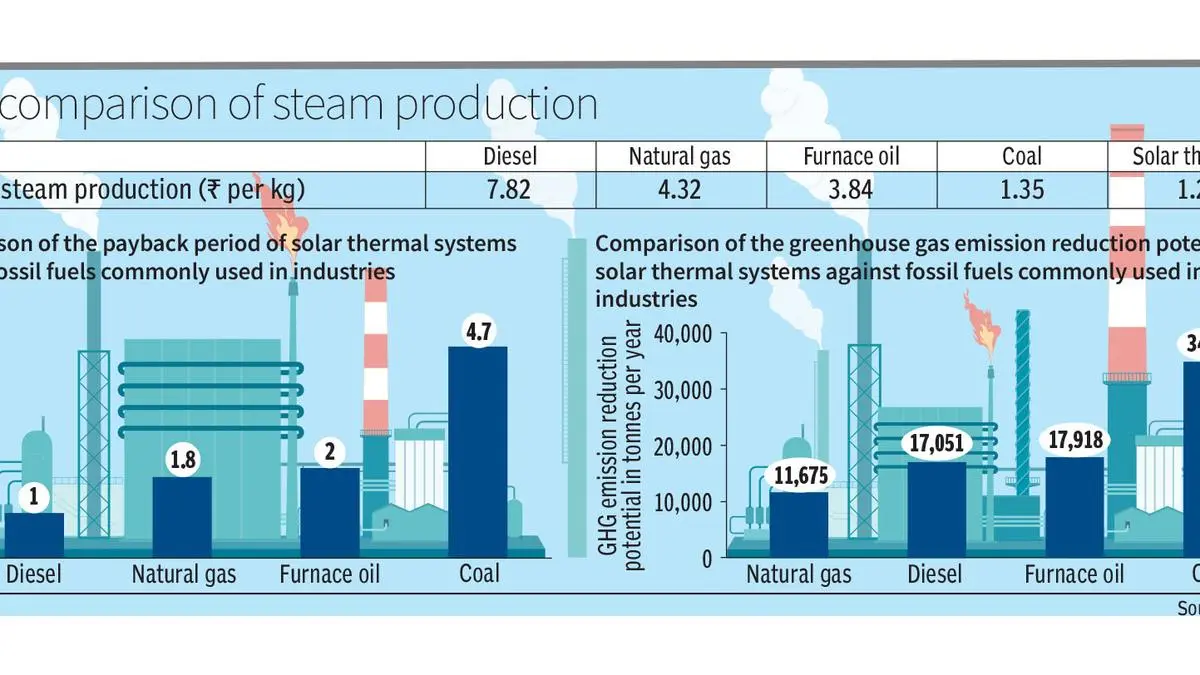
The greening of the power grid through renewable energy is rightly in focus to help meet the country’s commitment to achieving ‘net-zero emissions’ by 2070. However, another potential solution — solar thermal — remains overlooked.A major, silent challenge in industry is the need for ‘process heat’ — factories burn huge quantities of fossil fuels to boil water, create steam or run assembly lines. Solar thermal energy can be made available instantly, unlike the futuristic hydrogen fuel option.A solar thermal system is designed to absorb heat energy directly from the sun’s rays.In a policy-brief note, The Energy and Resources Institute (TERI) says India needs a “National Solar Thermal Mission, on the lines of the National Solar Mission and the more recent National Hydrogen Mission”, under the Ministry of New and Renewable Energy.ApplicationsThe real opportunity for solar thermal energy is in medium-temperature applications such as steam, hot air, hot water generation and cooling.It is, however, not suited for the kind of heavy-duty heating required in steel plants.In pharmaceutical and food processing industries, thermal energy makes up 60–75 per cent of the energy mix used for distillation, sterilisation, and blanching.Likewise, the dairy and textile sectors need huge amounts of hot water and steam for pasteurisation and fabric dyeing, respectively. Solar thermal lends itself well in such sectors.It lowers not only carbon emissions but also costs, compared with heat from fossil fuel. The note points out that these ‘sunrise’ sectors are expected to grow rapidly, as also their emissions, and would benefit from the use of solar thermal systems.While solar thermal has been around for a while, it has not made a significant impact yet. TERI describes it as a chicken-and-egg situation — market failure on both the supply and demand side.There are several reasons for the poor off-take: low awareness of the benefits; too little demand leading to poor supply; and the need to design solar thermal systems suited to specific needs, unlike solar panels, which are mass-produced and have standard usage.Cost advantageSolar thermal is especially feasible owing to the abundant resource — the country enjoys 250–300 sunny days a year, with annual radiation of 1,600–2,200 kWh/sqm. The technology ranges from inexpensive, low-temperature collectors to advanced tracking systems that hit 400 degrees C.It is highly competitive vis-a-vis electrification or hydrogen. When it comes to diesel, natural gas or furnace oil, while it costs ₹7.82, ₹4.32 and ₹3.84, respectively, to produce 1 kg of steam, solar thermal costs only ₹1.2. But pitched against coal at ₹1.35, solar thermal may struggle to compete without policy support. Here’s why: The payback period after switching from diesel to solar thermal is the quickest at one year, but from coal to solar thermal it could take as much as five years, making businesses hesitant to switch.TERI points out that replacing coal-fired industrial boilers with solar thermal systems provides by far the greatest reduction in carbon dioxide emissions (35,000 tonnes per annum) for a 10 tonnes per hour boiler. This is twice the saving achieved by replacing diesel (17,000 TPA), and even more for natural gas or furnace oil (11,000–18,000 TPA).With policy support, companies can surmount a combination of obstacles, including high upfront cost, land constraints, lack of tailored bank-financing, and shortage of skilled technicians.TERI recommends that the government should allow 10-year, green bond-backed loans, drop GST to the lowest tier, offer 50 per cent accelerated depreciation, and set up industrial special purpose vehicles (SPVs) to share the infrastructure costs among clusters of factories.Published on July 20, 2026
How solar thermal can ‘green’ manufacturing processes
Discover how solar thermal energy can significantly reduce costs and carbon emissions in manufacturing processes, promoting sustainability.
579 words~3 min read