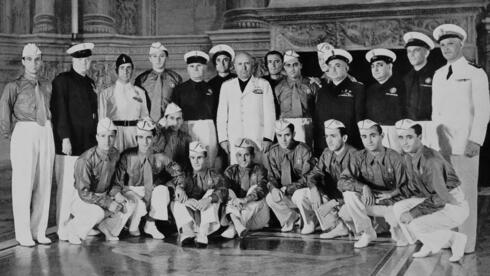
But whether that axiom applies to the quadrennial World Cup tournament is a different question.On occasions in the past, authoritarian governments have used the tournament to boost their regimes. Italian fascist leader Benito Mussolini did so when Italy hosted the 1934 World Cup, manipulating the games and handpicking officials to boost the chances for the home team, who went on to beat democratic Czechoslovakia in the final. Likewise, in 1978, Argentina’s dictatorship used both the tournament’s hosting and the national team’s victory to “sportswash” the brutal repression that had accompanied the military junta’s seizure of power.Fascist Italy hosted and won the second World Cup in 1934. Wikimedia Commons
In each of those notable cases, the team of an authoritarian country won the tournament. But as a political scientist and soccer enthusiast, I was curious to see how countries in authoritarian versus democratic countries had fared in the World Cup over time.
So in the run-up to this year’s tournament, I looked back through the records of the 22 past World Cups; I also cast an eye over the expanded 48 countries represented at the 2026 tournament.
For the World Cups between 1930 and 2018, I turned to Polity data, which looks at how power is concentrated in the political system. On a minus 10 to plus 10 scale, democracies are those with a Polity score of plus 6 and plus 10; autocracies have a minus 6 to minus 10; and anocracies – countries that are “partially free” – have a rating of minus 5 to plus 5.