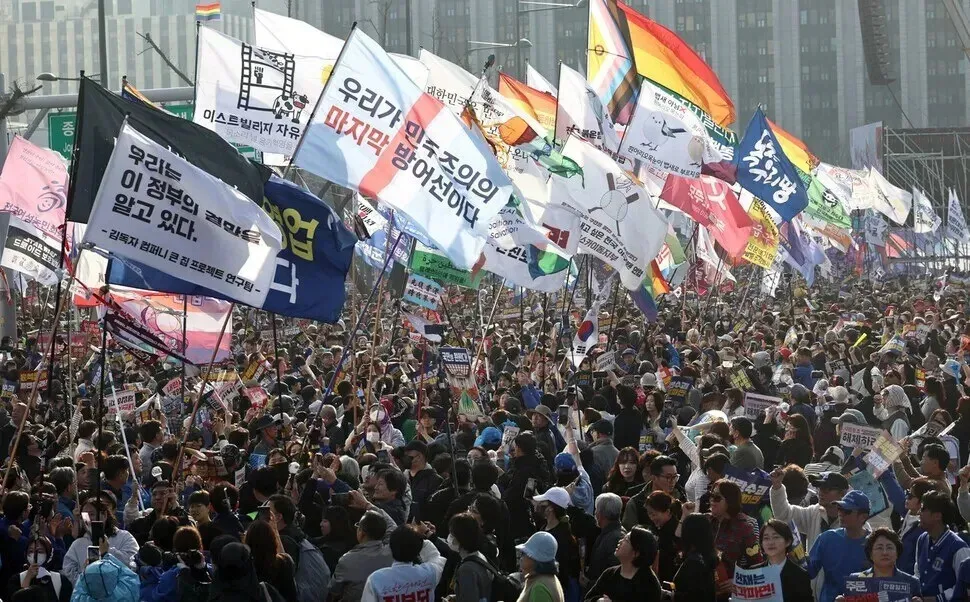
Dozens of flags fly above the crowd at a rally held on March 22, 2025, outside Gyeongbok Palace in Seoul, calling for Yoon Suk-yeol to be deposed after his abortive self-coup in December 2024. (Yoon Woon-sik/Hankyoreh)
According to a recent report, inequality in Korean society has returned to the level of the Japanese colonial period.A report published in late 2025 by the World Inequality Lab, co-founded by French economist Thomas Piketty, said that as of 2022 the share of income held by the top 1% of Korean earners was similar to the income concentration in the late Japanese colonial period.“An unequal regime is intolerable,” said Cho Don-moon, emeritus professor of sociology at the Catholic University of Korea. In his 2024 book “The Ideology of Inequality,” Cho wrote that Korean society cannot rise above inequality because Koreans have accepted the ideology of inequality as their ruling order.In his follow-up book “The Equal Society Project,” Cho explores strategies by which Korea might escape inequality and move toward a more equal society. The two books, the capstones of Cho’s academic career, are companion texts that provide a full account of inequality in Korean society and present alternatives.The book sets the tone in the preface, acknowledging that “this won’t be easy reading” because it’s “full of charts and figures.” The author evidently took to heart complaints that statistics and figures had undermined the readability of his previous work, which was aimed at general readers.So it seems almost puckish that this book contains so many complicated figures. Cho may also be signaling that since he’s reviewed so many credible sources, he can handle whatever counterarguments may be advanced.The first section of “The Equal Society Project” builds on Cho’s earlier text by reviewing the facts of inequality and the landscape of ideology. According to his analysis, members of Korean society regard the inequality issue as being severe, but doubt that it’s possible to achieve an equal society. There’s also a tendency for Koreans to hold contradictory attitudes — such as recognizing the need for government intervention to mitigate inequality but opposing tax increases for welfare programs.To address this skepticism, Cho calls for the adoption of a strategy of “non-reformist reforms” — that is, implementing a series of modest reforms that build trust while progressively raising the stakes.The US, the country typically benchmarked by Korean capitalists, has the worst inequality of any Western capitalist state. In its 2025 Global Rights Index, the International Trade Union Confederation gave Sweden a rating of 1, which means that labor rights are well protected, while the US received a rating of 4, which means that labor rights are jeopardized.The vision delineated in Cho’s book is a welfare society of gender equality such as what we see in Sweden, rather than in the US.Sweden enjoys equality along with economic abundance. There was severe class conflict in the early 20th century, but workers’ income and employment were stabilized over several decades, with universal welfare made available to the public.The model of a single male breadwinner collapsed, and gender equality was incorporated into the labor market. The key to these advances was turning the working class into a political force and creating a coalition with the victims of inequality.