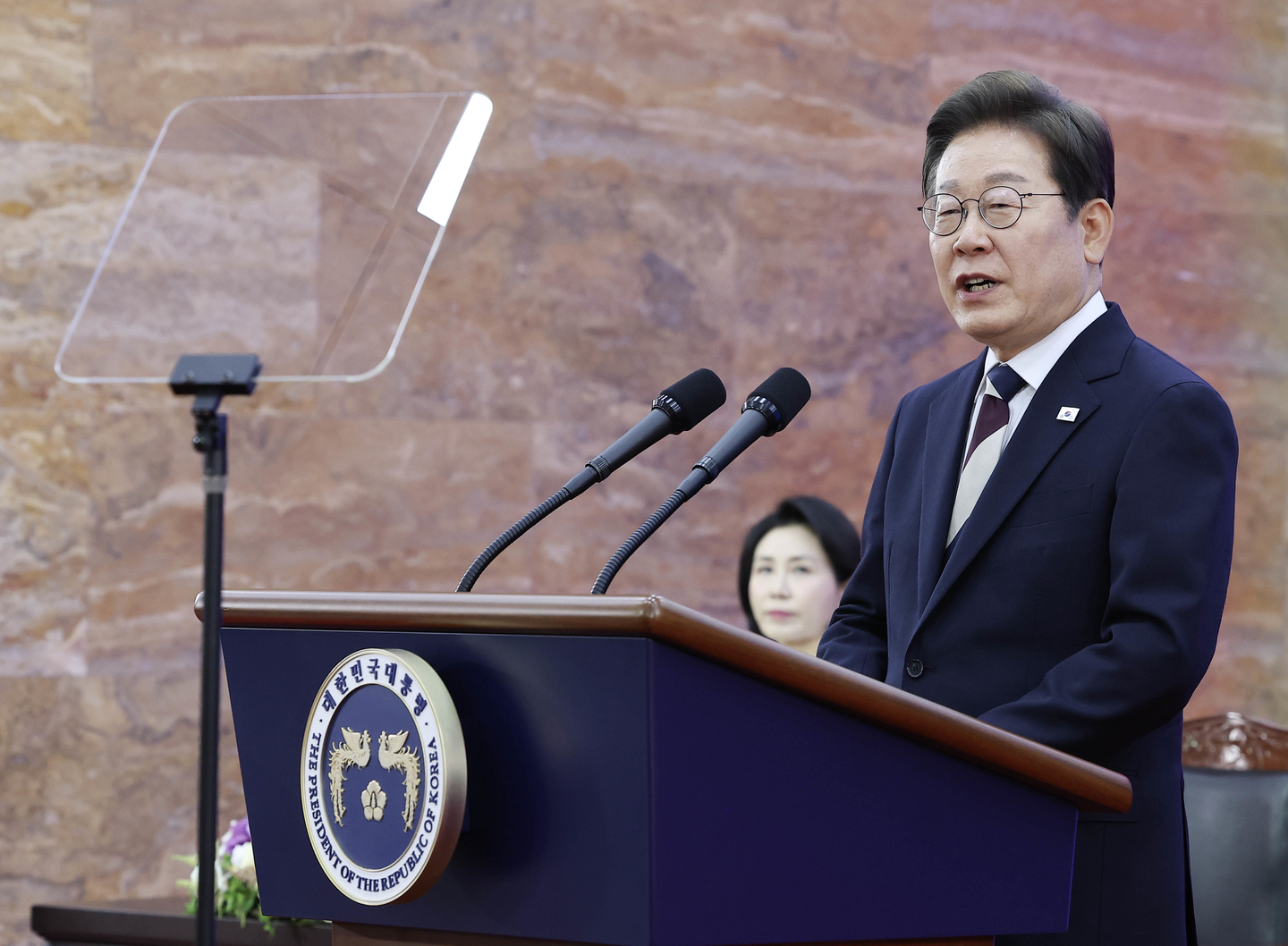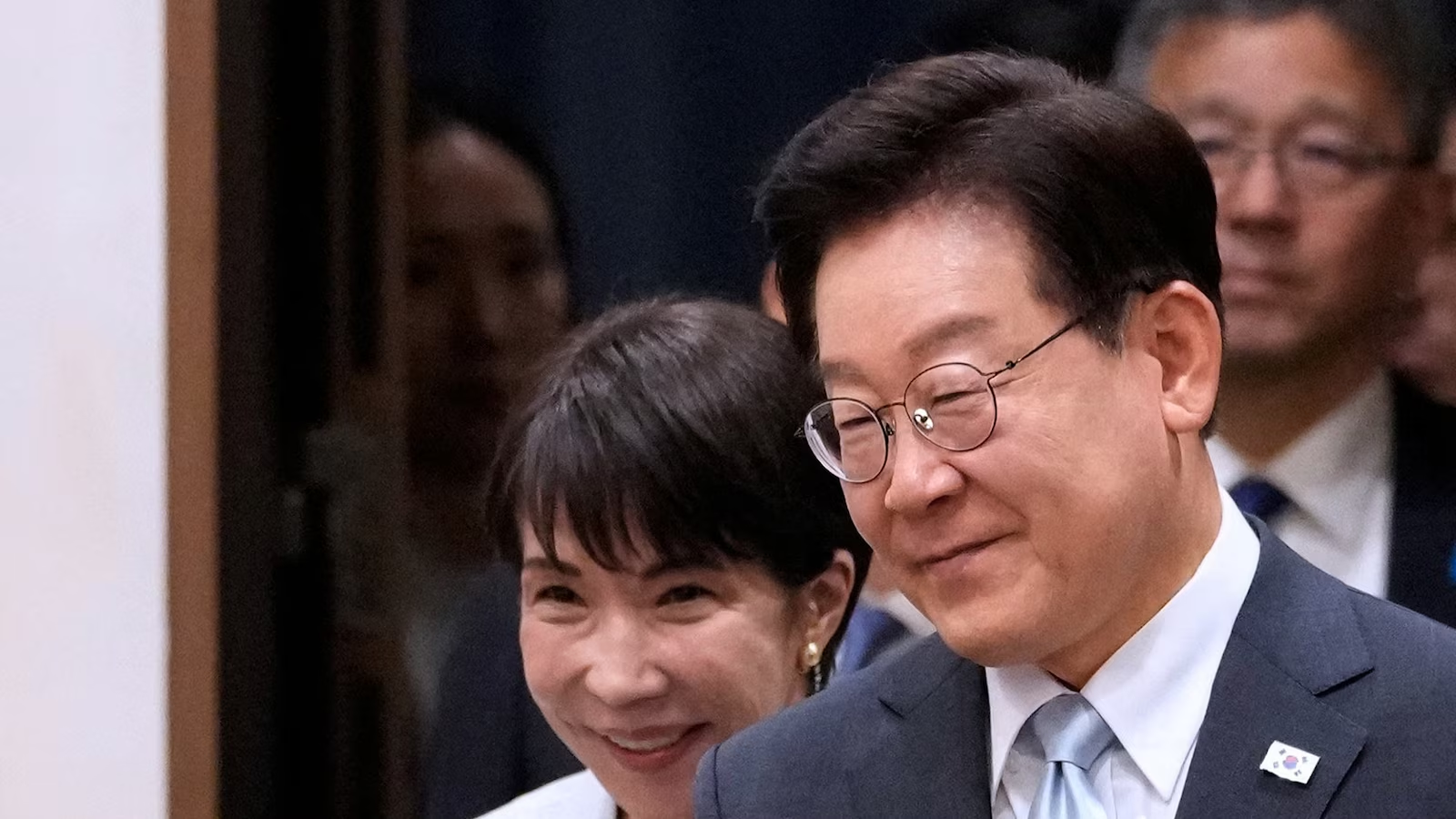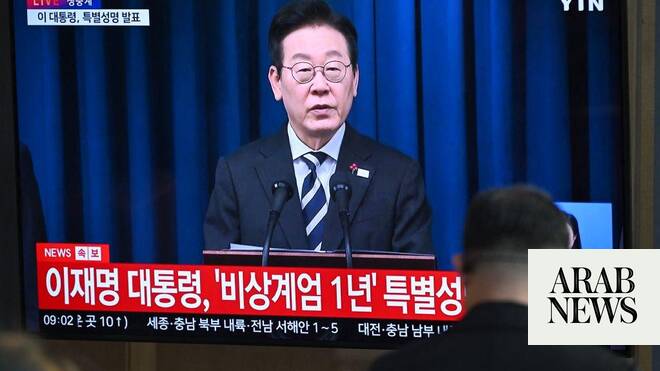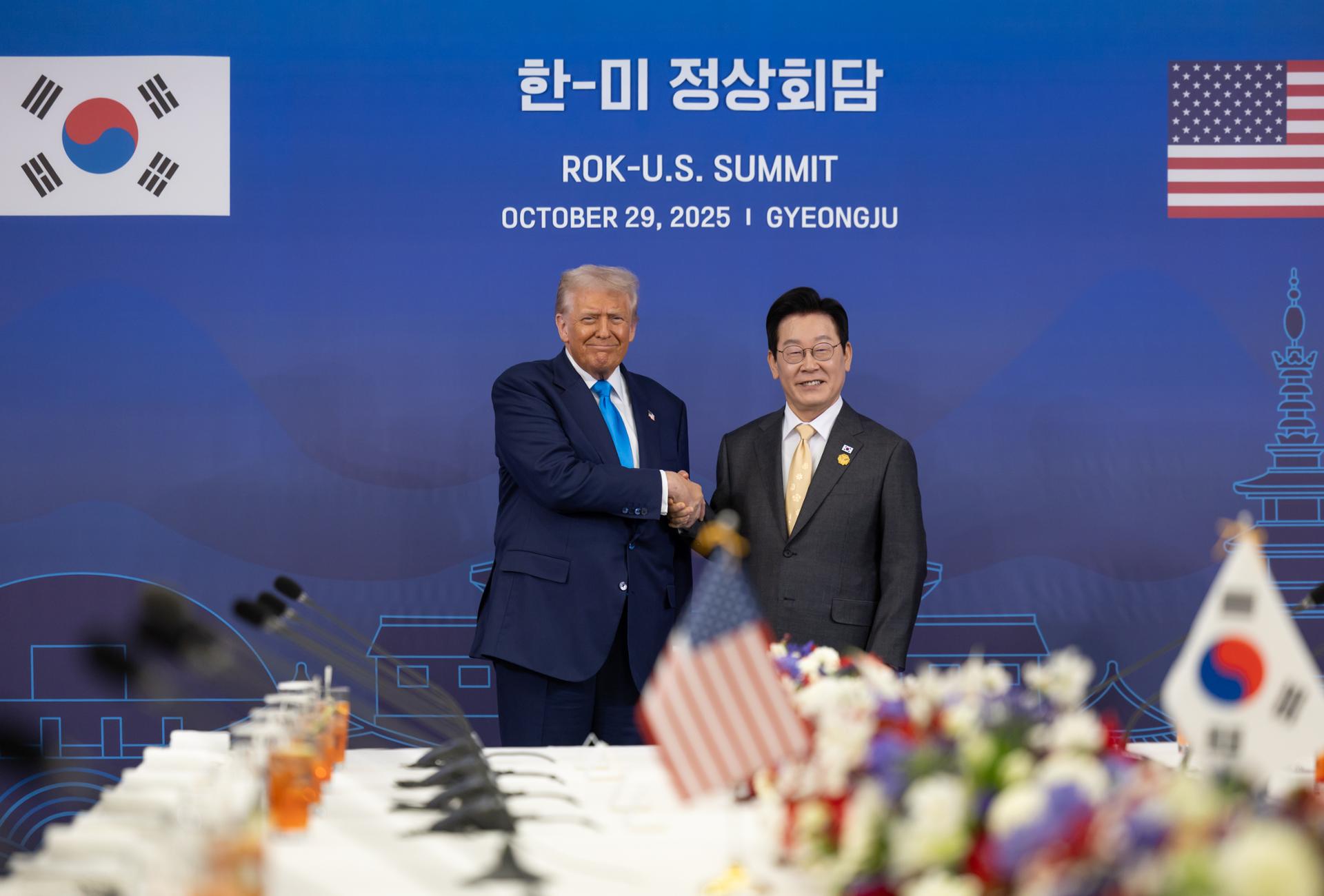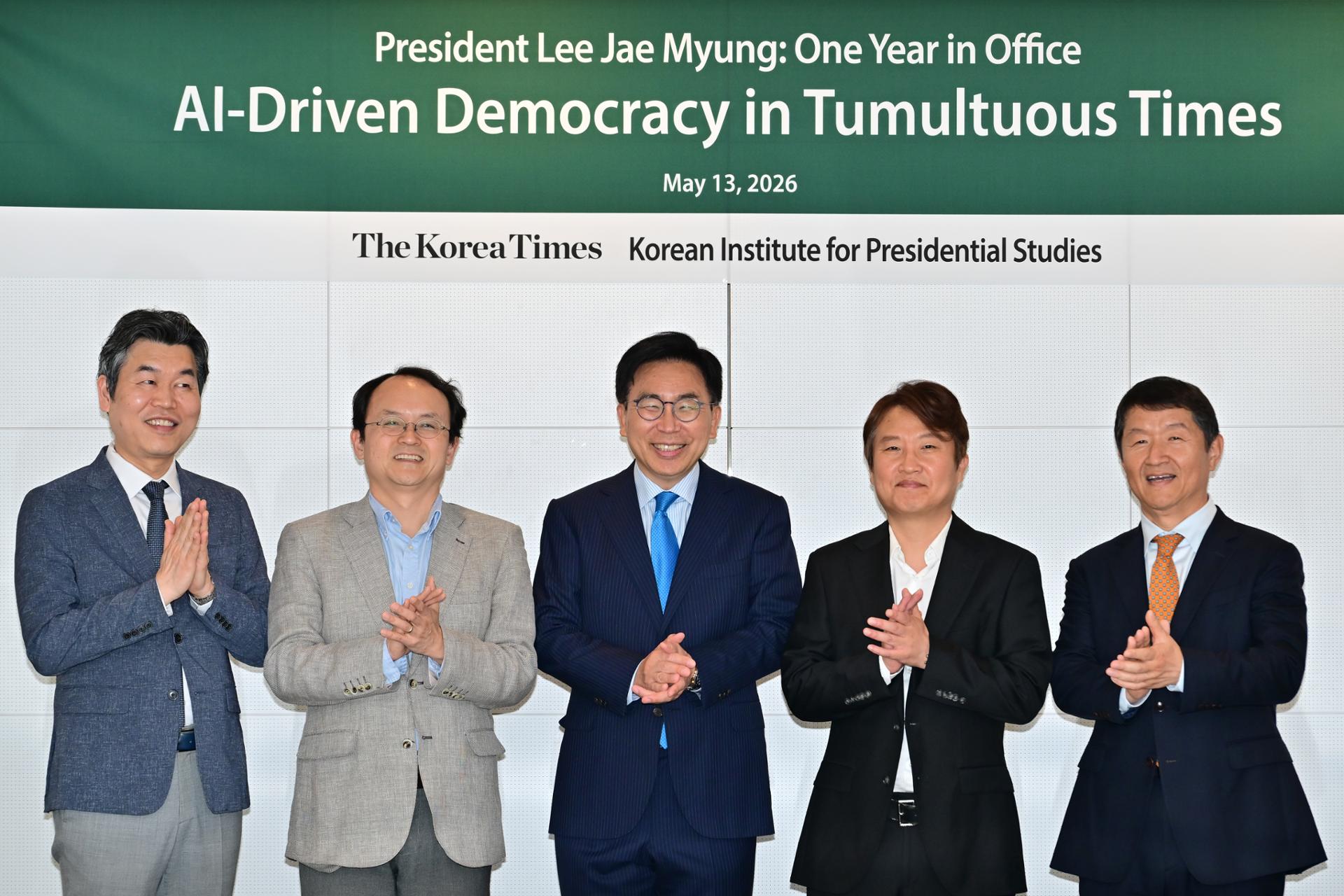
Participants of a roundtable co-hosted by The Korea Times and the Korean Institute for Presidential Studies, titled “AI-driven Democracy in Tumultuous Times,” pose at the newspaper's headquarters in Seoul, May 13. From left are Shin Hyun-ki, professor at the Catholic University of Korea; Ha Shang-eung, professor at Sogang University; Hahm Sung-deuk, dean of the Graduate School of Political Studies at Kyonggi University; author and critic Lee Dong-hyung; and Oh Young-jin, president-publisher of The Korea Times. Korea Times photo by Choi Won-sukEditor’s noteThis is the last in a series of articles examining economic, political, diplomatic and social changes that have occurred during the Lee Jae Myung administration since the president’s inauguration on June 4, 2025. When former President Yoon Suk Yeol declared martial law on Dec. 3, 2024, then-opposition leader Lee Jae Myung launched a Facebook livestream as he scaled a wall to reach the National Assembly and vote to block the decree. The footage made headlines for offering a raw, firsthand look at the crisis — a scene only people on the ground could have captured and exactly the kind of unmediated moment that has defined Lee's political brand.A year into his presidency, that instinct for direct communication remains central to how Lee governs. Long before taking office, Lee built his political brand on X, formerly Twitter, using the platform's speed and reach to bypass mainstream outlets that paid little attention to a politician who rose from a local government post rather than a major political party. As president, he carried that habit into Cheong Wa Dae, generating engagement and using the platform to build public momentum for his policy agenda.At a roundtable co-hosted by The Korea Times and the Korean Institute for Presidential Studies on May 13, experts assessed Lee's first year of social media-driven governance through the "ubiquitous presidency" framework developed by scholars Joshua M. Scacco and Kevin Coe, which examines presidential communication across three dimensions: accessibility, personalization and pluralism. Panelists credited Lee with improving government transparency, but warned that his approach risks deepening political polarization and falls short of fostering pluralism in an already divided society.President Lee Jae Myung takes a selfie with Chinese President Xi Jinping during their summit in Beijing, Jan. 5, using a Xiaomi smartphone Xi gave Lee during their previous meeting on the sidelines of the Korea-hosted APEC summit in 2025. Korea Times photo by Wang Tae-seogNew standard of openness The discussion, moderated by Hahm Sung-deuk, dean of the Graduate School of Political Studies at Kyonggi University, drew on a study co-authored by Hahm and Shin Hyun-ki, a professor at the Catholic University of Korea. The pair analyzed 514 posts on Lee's X account for the 10-month period from his inauguration through the end of March, finding that 52 percent concerned presidential duties, 24 percent addressed policy, 17 percent responded to current issues and just 3 percent touched on personal or daily life. Shin said Lee initially used X mainly to promote his presidential activities, but pivoted toward building public rapport and promoting key agendas such as housing reform once his administration found its footing in 2026. “Other presidents didn’t directly post on social media, but public aides polished what they said. But Lee is very good at directly communicating with the public as a heavy user of X, meaning he doesn’t rely much on mass media to deliver his message,” Shin said.He added that every share and like on Lee's posts function as a form of political endorsement, turning routine engagement into a feedback loop between the president and the public. Shin also noted the possibility that Lee uses social media to set the tone for governance, effectively issuing guidelines to public servants through his posts. Lee's preference for X over other platforms is strategic. Political commentator Lee Dong-hyung, whose YouTube channel has more than 800,000 subscribers and who has interviewed the president multiple times, said the platform's speed and editability make it the president's tool of choice. “You can easily publish a post on X and edit it promptly if you make a mistake, whereas in a YouTube livestream, you cannot reverse on-air mistakes,” the commentator noted. He added that the strategy stems from the president's background as a political outsider and reflects a deep-seated distrust of major conservative media outlets that has been shared by other liberal political figures since at least as far back as the presidency of Roh Moo-hyun. Oh Young-jin, president-publisher of The Korea Times, right, gives a welcome speech during a roundtable co-hosted by The Korea Times and the Korean Institute for Presidential Studies on AI and democracy at the newspaper's headquarters in Seoul, May 13. Korea Times photo by Choi Won-sukHahm argued that the most significant outcome of Lee's approach is in government transparency. Citing the administration's introduction of livestreaming government meetings, he said the Korean public can now witness the decision-making process in real time. “The advantage of Lee’s 'ubiquitous presidency' is that it enhances transparency in state administration, meaning that no future leader can easily roll back this standard of openness. It has also boosted public participation, fostering a sense among citizens that they are active stakeholders in governance,” Hahm said.Hahm added that Lee executes this model more effectively than U.S. President Donald Trump, who is known for his prolific social media use but whose political decisions are largely made behind closed doors.Cost of direct communication But the panelists also identified risks associated with Lee's communication style. Shin warned that while sharing personal thoughts online can be seen as a form of "political personalization," weaponizing one's private life as a political asset erodes presidential gravitas and could undermine legitimacy. Ha Shang-eung, a professor at Sogang University, argued that the president's social media activity may be less about communicating with the public and more about leveraging public opinion to effectively issue guidelines to public servants.“While we often assume that administrators simply follow whenever the president orders, the reality is far more complicated,” Ha said."It is very common for the bureaucracy to engage in passive resistance or actively put the brakes on a president's agenda. Therefore, we cannot rule out the possibility that the president’s social media messaging could be less about public communication and more about weaponizing public opinion to pressure reluctant officials, saying, 'The public wants this, so why aren't you acting?'"Lee Dong-hyung argued that the president's communication style falls short of political pluralism. Social media algorithms create echo chambers, he noted, where users only encounter content that reinforces their existing views while opposing perspectives are filtered out."The nature of social media is making people take sides. Social media is not used to persuade the masses; it is to influence supporters … The algorithm breeds confirmation bias. People continue to see similar content and the (online) environment could thoroughly exclude those who have opposing political views," he said.He urged the president and the broader public to consider whether it is desirable for a leader who represents 50 million people to share narratives that end up circulating only among his supporters.AI and democracy The roundtable also touched on the intersection of artificial intelligence (AI) and democracy. Hahm suggested AI could strengthen direct public participation and boost democracy. "AI inherently equals big data," he said. "By leveraging these massive, verified datasets, AI has the potential to power a system of direct democracy that will exclude misinformation."Ha took a more skeptical view. "AI and democracy still feel fundamentally mismatched. If you look at how AI is currently being developed, it stands in direct opposition to resolving economic inequality — in fact, it is far more likely to exacerbate it," he said."Furthermore, a critical question remains: Who actually controls this tool? My greatest concern is that a big administration will weaponize AI to tighten state control over its citizens. I find it hard to imagine a world where ordinary people successfully leverage AI to keep politicians in check. It seems far more likely that AI will ultimately evolve in a direction that undermines democratic systems."
[LEE'S 1ST YEAR IN OFFICE] President turns social media into governing tool to boost transparency - The Korea Times
When former President Yoon Suk Yeol declared martial law on Dec. 3, 2024, then-opposition leader Lee Jae Myung launched a Facebook livestream as he...
1,328 words~6 min read