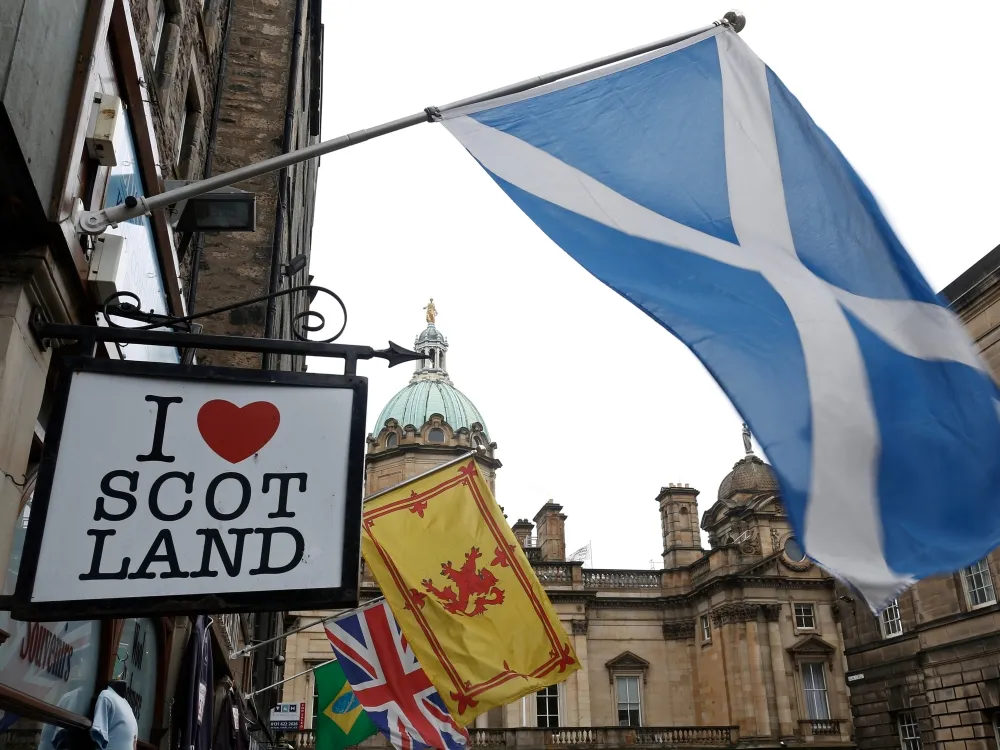
Skip to Content Subscribe Our Offers My Account Manage My Subscriptions FAQ Newsletters Canada Canadian True Crime Canadian Politics Health World Israel & Middle East Financial Post NP Comment Longreads Puzzmo Diversions Comics NP News Quiz New York Times Crossword Horoscopes Life Eating & Drinking Style Sponsored Play for Ontario Travel Travel Canada Travel USA Travel International Cruises Travel Essentials Culture Books Celebrity Movies Music Theatre Television Business Essentials Advice Lives Told Tails Told Shopping Buy Canadian Home Living Outdoor Living Kitchen & Dining Tech Style & Beauty Personal Care Entertainment & Hobbies Gift Guide Travel Guide Amazon Prime Day Deals Savings National Post Store More Sports Hockey Baseball Basketball Football Soccer Golf Tennis Driving Vehicle Research Reviews News Gear Guide Obituaries Place an Obituary Place an In Memoriam Classifieds Place an Ad Celebrations Working Business Ads Archives Healthing Epaper Manage Print Subscription Profile Settings My Subscriptions Saved Articles My Offers Newsletters Customer Service FAQ Newsletters Canada World Financial Post NP Comment Longreads Puzzmo Diversions Life Shopping Epaper Manage Print Subscription HomeNP CommentGeoff Russ: No, Scottish soccer fans. Scotland wasn't an oppressed colonyYet thousands in the Highlands and Lowlands claim to be oppressed by a colonial powerLast updated 19 minutes ago You can save this article by registering for free here. Or sign-in if you have an account.An "I love Scotland" sign hangs beneath flags, including from left, the national flag of Brasil, the Union flag, the Royal Standard of Scotland, and the St. Andrew's or Saltire flag, the national flag of Scotland, outside a souvenir store in Edinburgh, U.K., on Wednesday, Sept. 17, 2014. Photo by Simon Dawson/BloombergArgentina is going to the World Cup final, and soccer is not coming home.Enjoy the latest local, national and international news.Exclusive articles by Conrad Black, Barbara Kay and others. Plus, special edition NP Platformed and First Reading newsletters and virtual events.Unlimited online access to National Post.National Post ePaper, an electronic replica of the print edition to view on any device, share and comment on.Daily puzzles including the New York Times Crossword.Support local journalism.Enjoy the latest local, national and international news.Exclusive articles by Conrad Black, Barbara Kay and others. Plus, special edition NP Platformed and First Reading newsletters and virtual events.Unlimited online access to National Post.National Post ePaper, an electronic replica of the print edition to view on any device, share and comment on.Daily puzzles including the New York Times Crossword.Support local journalism.Create an account or sign in to continue with your reading experience.Access articles from across Canada with one account.Share your thoughts and join the conversation in the comments.Enjoy additional articles per month.Get email updates from your favourite authors.Create an account or sign in to continue with your reading experience.Access articles from across Canada with one accountShare your thoughts and join the conversation in the commentsEnjoy additional articles per monthGet email updates from your favourite authorsSign In or Create an AccountorLa Albiceleste wanted it more, and it showed as they defeated England. After a rough, scoreless first half, the Argentines stormed forward in the second, with seemingly boundless energy and determination to dominate England and win 2-1.After a thuggish first half, a skilled second half redeemed the game and made the victory honourable. Strangely, Scotland’s nationalists also celebrated England’s downfall, politicians included, as if they were among the jubilant throngs in Buenos Aires. Separatist Scottish politicians had urged households to “raise a glass to Argentina” and “rejoice with our Argentinian friends.” The virulent anti-Englishness of Scottish nationalists requires validation from others because their own soccer team is incapable of providing it.It also requires a heady dram of ignorance poured over blockheads filled with cognitive dissonance regarding their own history as colonists and conquerors. That may be the only way for Scots to have any solidarity with the Latin American soccer powerhouse.The National Post newsletter that doesn’t hold back, giving readers the unvarnished truth on media, politics and culture.By signing up, you consent to receive the above newsletter from Postmedia Network Inc.A welcome email is on its way. If you don't see it, please check your junk folder.The next issue of Right? will soon be in your inbox.We encountered an issue signing you up. Please try againInternational rivalries make sports infinitely more compelling and watchable. However, turning Argentina into a proxy army for imaginary wars against imperialism is embarrassing for Scotland and its diaspora. In this regard, Scotland has no common cause with India, Zambia, or the like.Scotland was never a colony and has no need for liberation, least of all through South American soccer. Yet thousands in the Highlands and Lowlands claim to be oppressed by a colonial power. Without context, you’d think that Scottish men had died in a brutal anti-English insurgency within living memory. They will never be spiritually part of the Global South, despite their attempts to claim otherwise.In fact, the Scots were an essential pillar of British imperialism, playing an outsized role in the British Empire’s military, political, and commercial affairs, especially in Canada.Largely due to that, Scotland is a rich European country that benefits immensely from British public spending, not unlike how Quebec receives equalization payments. Considering that Britain’s individual and corporate tax base is overwhelmingly English, it is a rather unusual plantation system that so many Scots are determined to escape.Even Scotland’s own nationalism is largely stripped of culture and tradition, being content to embrace “undifferentiated global anticulture” in a kilt.At least Argentina has repeatedly earned the right to have some swagger in soccer. Lionel Messi is one of soccer’s all-time greats and far more of a gentleman than Diego Maradona, his roguish and brilliant predecessor.If Argentina’s victory deserves respect, the country’s political ideology is more suspect. The country has never gotten over its failed attempt to seize the Falkland Islands, which Argentina calls “Las Malvinas,” in 1982, when it invaded a British overseas territory it had long claimed.The invasion, ordered by a right-wing military junta that brutalized Argentina’s own people, was swiftly crushed by a British counterattack.At the 1986 World Cup, before playing England, Diego Maradona motivated his team with the following words: “Come on, lads, they killed a bunch of our kids,” as if Britain were expected to take an invasion lying down. After defeating England on Wednesday, Argentina’s team gleefully waved a banner reading “Las Malvinas son argentinas.”Thousands of British troops fought to liberate the Falklands, and hundreds died, Scots among them. For Scottish nationalists to drape themselves in Argentine colours and wave the bloody flag of anti-imperialism to spite England is not merely childish; it insults both veterans and the fallen.Argentina remembers the Falklands War as an anti-colonial struggle against a European power, all while touting its unusually European culture and heritage to punch down at its Latin American counterparts. However, whenever the Falklands or international soccer rear their head, the Argentines demand solidarity from their neighbours. There is a reason so many Mexicans were backing England on Wednesday.Whether it is West Indian cricket teams touring Britain or Morocco playing France at the World Cup, there is always the temptation to use sports to exact a small vengeance against enemies or former colonial masters, and the result is not always peaceful. Argentina’s fans assaulted their English counterparts in the streets of Mexico City during the 1986 World Cup.You can almost taste the desire among many Scottish nationalists to do the same, fuelled by bad history and poor impulse control. Scotland’s national soccer team is best described as a recurring joke, and after it exited this year’s World Cup long ago without winning a match, Scottish nationalists found the perfect surrogate.Part of this, I will admit, is personal. Families that migrate tend to preserve something of their old country as it existed when they left. I am glad mine left Scotland for Upper Canada in 1838.I cannot know for certain what they thought of the English, but given my family’s history of soldiering for the Crown, I can only assume they saw the English as comrades and close kin. I take great pride in having that much more in common with Scottish Canadians such as Sir John A. Macdonald, the explorer Alexander Mackenzie, and so many more great men and heroes who shaped Canada so profoundly.Modern Scotland has little use for Macdonald, whose legacy it once modestly celebrated, and has taken steps to erase his good name from its records. At least similar attempts in Canada have been met with fierce resistance in the pages of this newspaper and elsewhere. If it wishes to cast off its rich legacy in Canada, I wish to be no more than a tourist in Edinburgh or the Highlands.Buenos Aires is far more appealing. For all its contradictions and sillier impulses, Argentina is gorgeous, fascinating and alive. And, unlike modern Scotland’s soccer establishment, the Argentines win.National Post Join the Conversation This website uses cookies to personalize your content (including ads), and allows us to analyze our traffic. Read more about cookies here. By continuing to use our site, you agree to our Terms of Use and Privacy Policy.
Geoff Russ: No, Scottish soccer fans. Scotland wasn't an oppressed colony
Yet thousands in the Highlands and Lowlands claim to be oppressed by a colonial power
1,501 words~7 min read