Skip to content
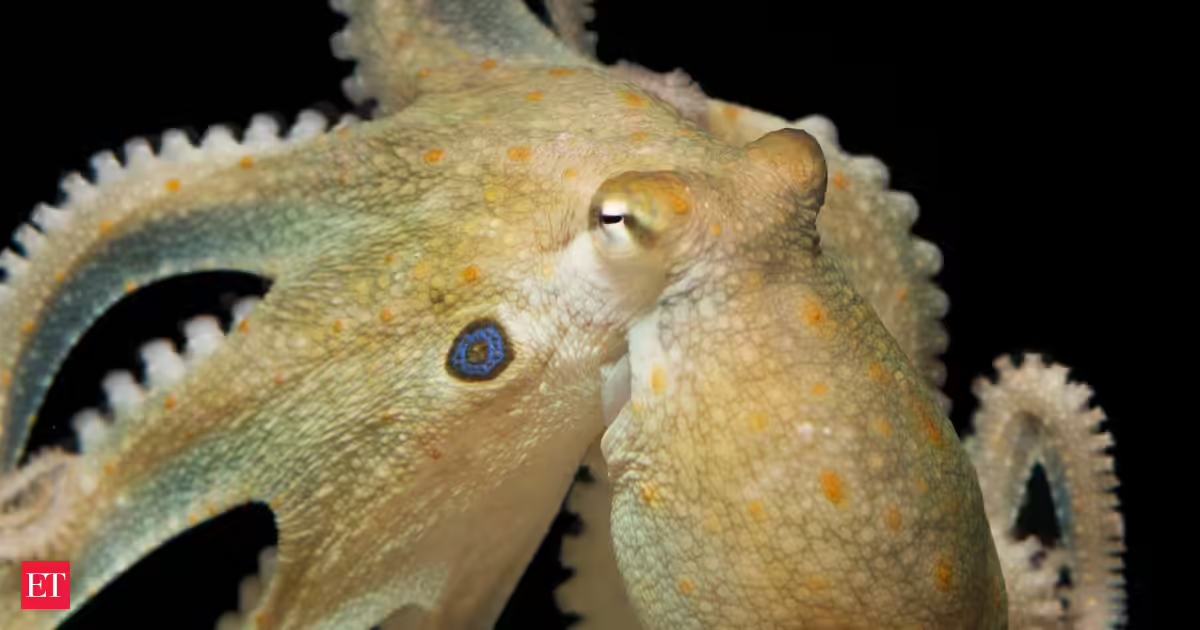
A fascinating aspect in evolutionary biology is that of convergent evolution — whereby similar structures and functions evolve independently from each other. The highly advanced nervous system of octopuses is a good example here, displaying levels of intelligence and capabilities far beyond those of other cephalopods and matching that of primates, despite no evolutionary link here. Exactly how octopuses developed this rather unique capability remained a mystery, though recent research by [Rishav Mitra] points at the rather unique ribosomes in these animals.
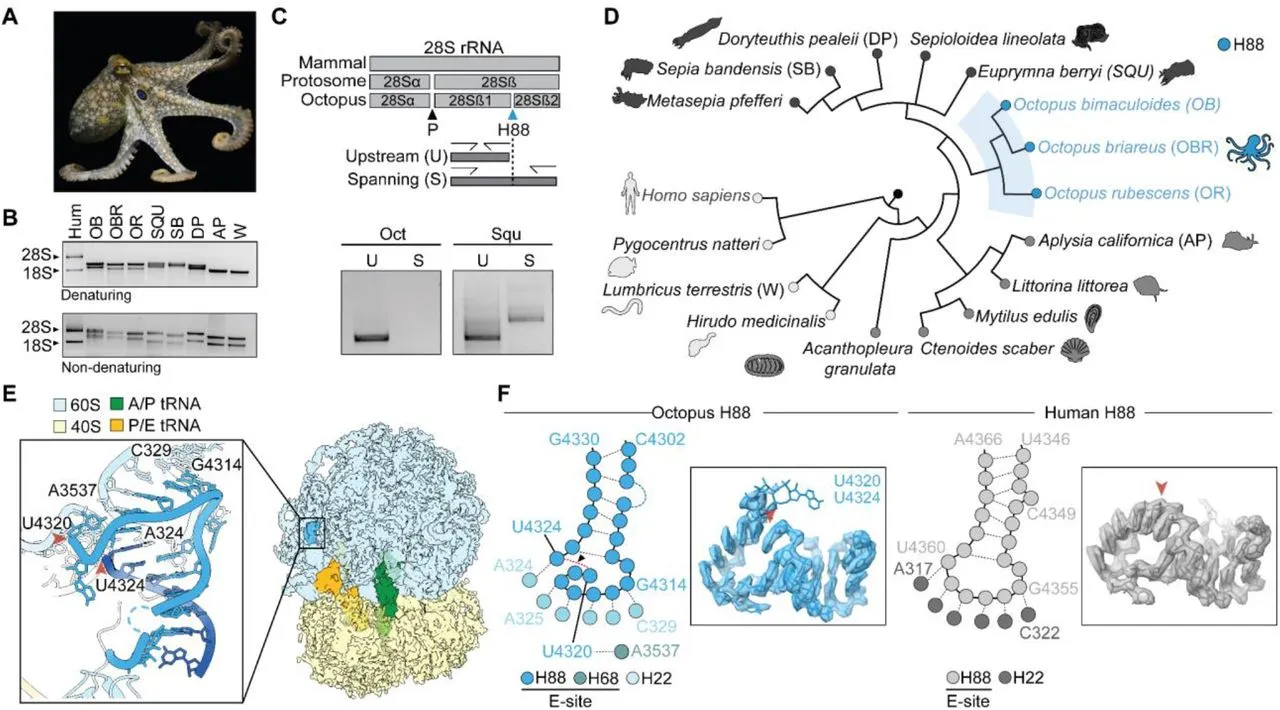
Ribosomes are the molecular machinery at the core of each cell that enable the synthesis of proteins. Due to their highly crucial role, they tend to remain evolutionary unchanged, which makes the big change observed in the octopus (i.e. order Octopoda) in the form of this H88 rRNA break quite remarkable.
Common octopus (Octopus vulgaris). (Credit: Albert Kok, Wikimedia)
This H88 break increases the accuracy of translated proteins, something that is essential for complex nervous systems as it reduces cases of misfolded proteins (proteinopathy). Because of how well-preserved ribosomes are across species, the researchers were able to run a number of experiments including a similar rRNA break in E. coli that confirmed many of the assumptions about how these octopus ribosomes performed.