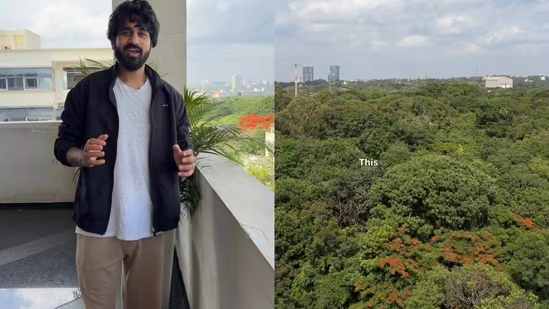
Dr Sankara Rao is clearly obsessed with the arboreal world. His narrow desk at the Centre for Ecological Sciences (CES), Indian Institute of Science (IISc), is covered with botanical texts, including Pradip Krishen’s Jungle Trees of Central India and Trees of Delhi,Endemic Vascular Plants of India published by the Botanical Survey of India and his own two-volume field guide, Trees of Bangalore.“Trees are my natural abode,” laughs Rao, dapper in a tweed jacket, recalling how, as a child, he would often spend his time amidst canopies, nestled between leafy branches. Not only are trees “nature’s exceptional creations”, but they also support immense biodiversity, explains the Visiting Professor and Distinguished Fellow at CES. “They shelter 80% of terrestrial biodiversity. On a tree, there are birds, butterflies, insects, lichens, mosses, and small mammals,” he says. And yes, trees also protect understory vegetation, giving shrubs and herbs a chance of survival, he says.While being amid trees gives him an incomparable high, he is also deeply disturbed these days ― not just by the stupendous loss of green cover in the country, but also by the “afforestation” practices currently being pursued by policymakers.“Tree planting schemes have lately become carbon-centric, particularly single-species plantations, which are further threatening tropical biodiversity,” he says, pointing out that although there is a large pool of native arboreal species available, only a few indigenous species are commonly used for planting.
This new website integrates knowledge about India’s tree wealth into one platform
Dr Sankara Rao, Visiting Professor and Distinguished Fellow at the Centre for Ecological Sciences (CES), Indian Institute of Science (IISc), talks about the reasoning behind India Trees and Vegetation Types, a brand-new digital resource that can help develop a more scientific approach to afforestation
863 words~4 min read