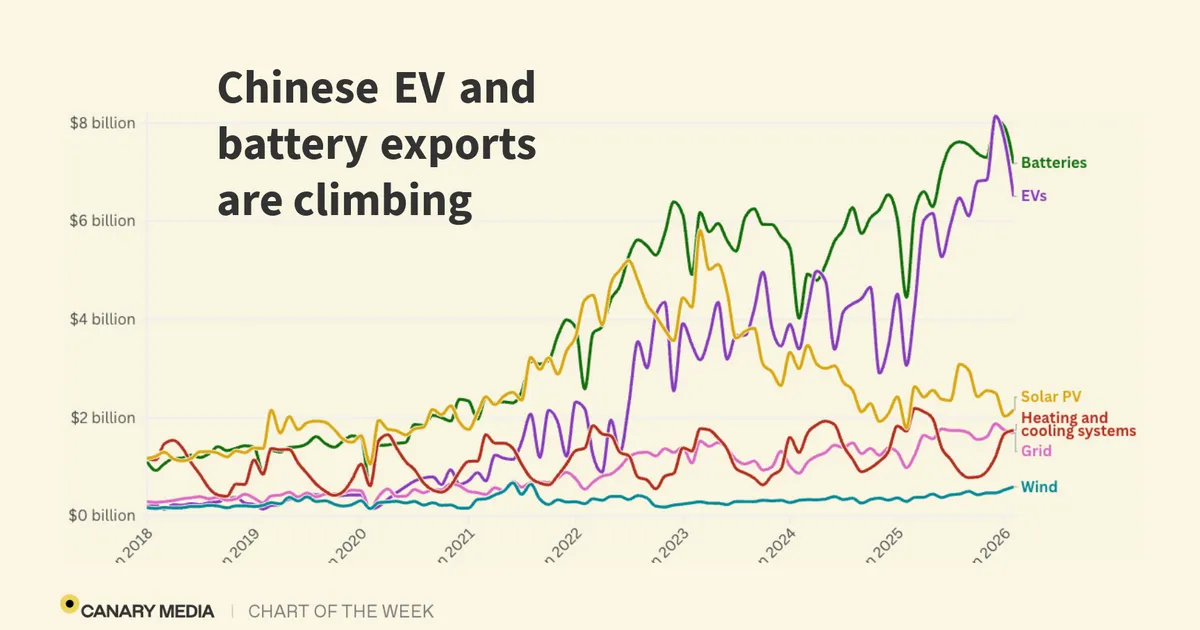
The global oil and gas supply squeeze has accelerated a debate in many economies about whether to continue relying on fossil fuel imports from volatile parts of the world or to shift more quickly to electrified mobility and renewable power. With energy security emerging as a top priority worldwide amid the ongoing conflict in the Mideast Gulf, data is increasingly showing a push toward low-carbon energy technology. Underpinning this push is China and the strides it has made in manufacturing and exporting cost-effective electric vehicles (EVs), solar kit and lithium batteries — a trio China has dubbed its "new three" export sectors. China appears more than capable of meeting global demand for these products — indeed, it relies on export markets to ease domestic supply gluts. Still, global buyers are wary about swapping a dependency on costly fuel imports from conflict areas for a dependency instead on cleantech supply chains largely controlled by a single country. "New three" exports from China topped $96 billion in January-May this year, up 47% from a year earlier and roughly double 2022 levels, according to data from clean energy think tank Ember. China's total exports across low-carbon sectors, including wind and grid equipment, reached $116 billion in that period — a new high, and 39% more than a year earlier. Developed markets remain the primary destinations, with OECD countries taking 60% of China's combined EV, solar and lithium battery exports, although emerging economies are comprising an ever-greater market share. The EU and UK alone accounted for more than 37% of these exports from China by value over the first five months. Chinese brands' share of Europe's new EV sales climbed to 17% year to date in the first half of 2026, from just 11% in the first half last year, according to data provider JATO Dynamics. Analysts broadly estimate that China controls 60%-85% of key clean energy supply chains.
China Poised to Cash In on Push for Low-Carbon Tech
China appears capable of meeting increasing global demand for EVs, batteries and solar equipment in the war-driven push for energy security, but consumers are wary.
315 words~1 min read