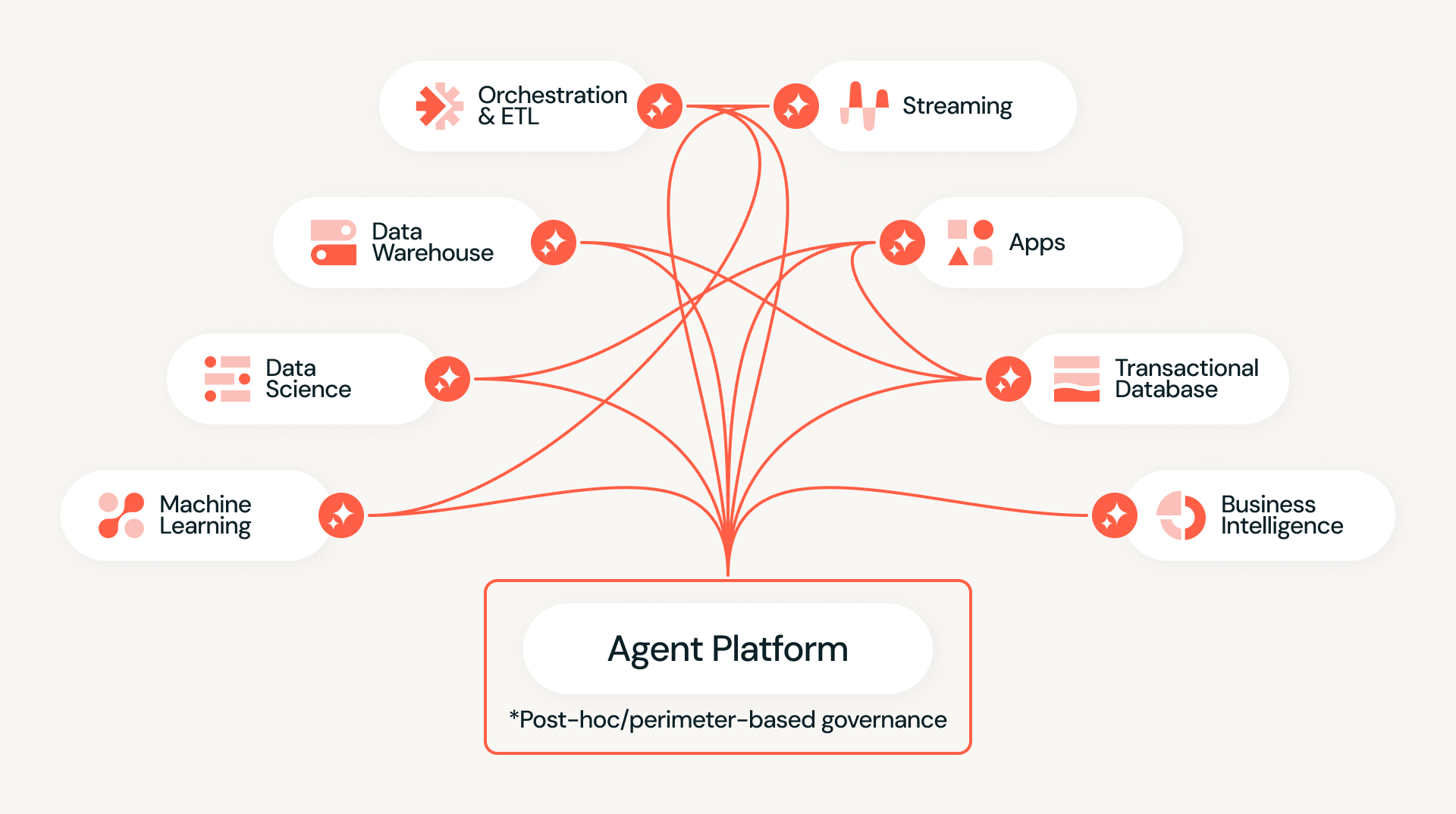
Give an AI agent access to your data warehouse and it will write SQL. It might even write good SQL. But ask two agents the same revenue question and you'll get two different numbers. Neither matches finance's report. That's the core problem: text-to-SQL gives agents access to data, not understanding of it.
A semantic layer for AI agents fixes this by putting a governed metrics layer between the agent and the warehouse. The agent queries defined metrics instead of raw tables. Every consumer, whether it's an AI agent, a dashboard, or an API, gets the same answer because the calculation is fixed, not interpreted per query.
This isn't a new idea. Semantic layers have existed in BI for decades. What's new is that AI agents make the problem worse and the solution more urgent.
What actually goes wrong without a semantic layer?
Three failure modes show up in production. All of them trace back to the same root cause: the agent interprets business logic on every query instead of referencing a shared definition.