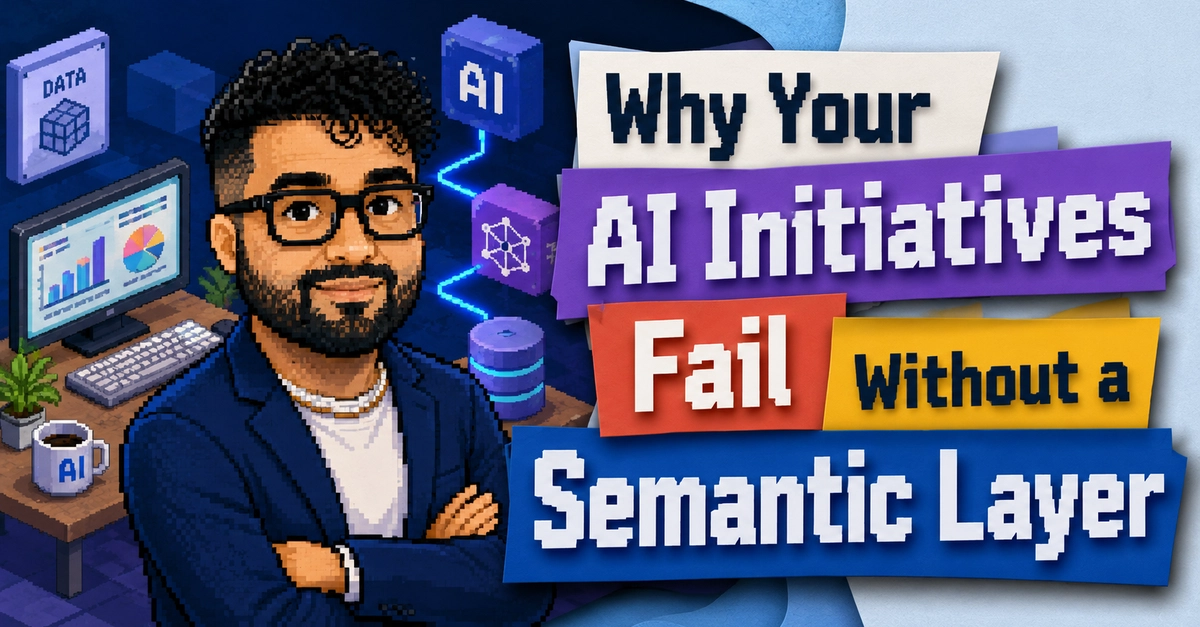
Across financial services, AI is no longer just conducting basic predictive analysis — it's making complex decisions based on vast datasets. Risk models are running autonomously. Agents are answering regulatory queries. Trading systems are acting on signals generated by models that never pause to ask what the underlying data actually means.
That's the problem. AI doesn't operate on raw data and large language models alone. It operates on a semantic layer — the representation of what data means, how concepts relate, and what questions can legitimately be asked of it. When that layer is solid, AI performs. When it isn't, AI doesn't fail loudly. It confidently produces incorrect answers to questions it was never equipped to solve.
For financial services firms accelerating AI adoption, the semantic layer is no longer an architectural footnote. It's a risk surface.
The Open Semantic Interchange (OSI) aims to address this long-standing challenge: how different technologies represent and exchange semantic information. For the first time, we're approaching a world where semantics — not just data — can move across platforms in a consistent way.
That's meaningful progress.