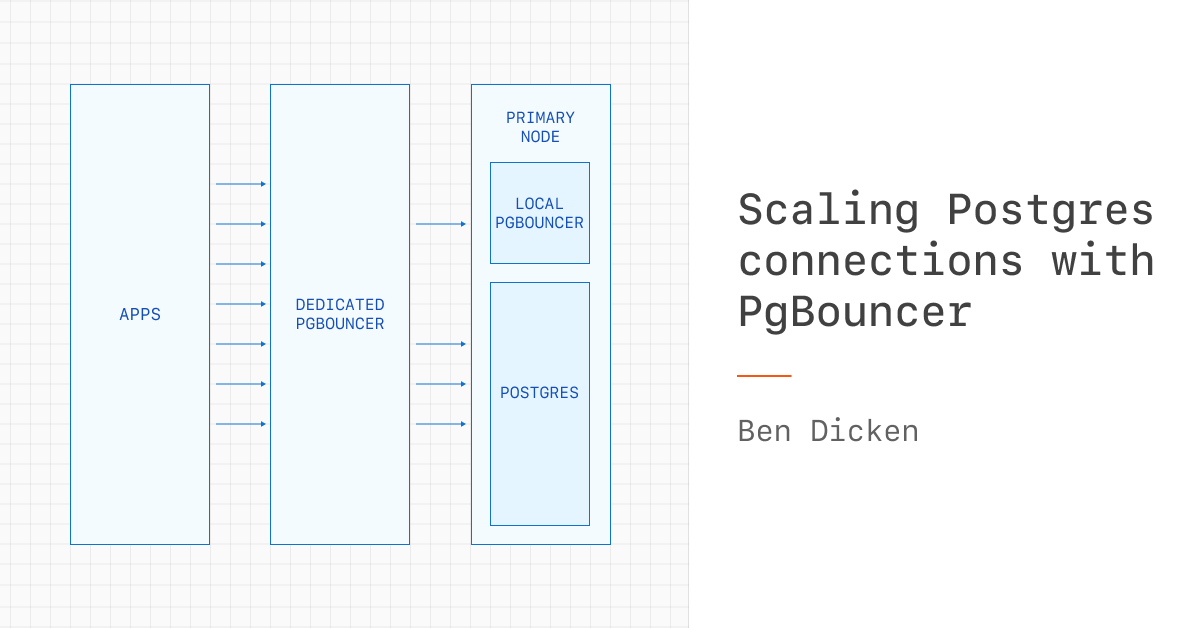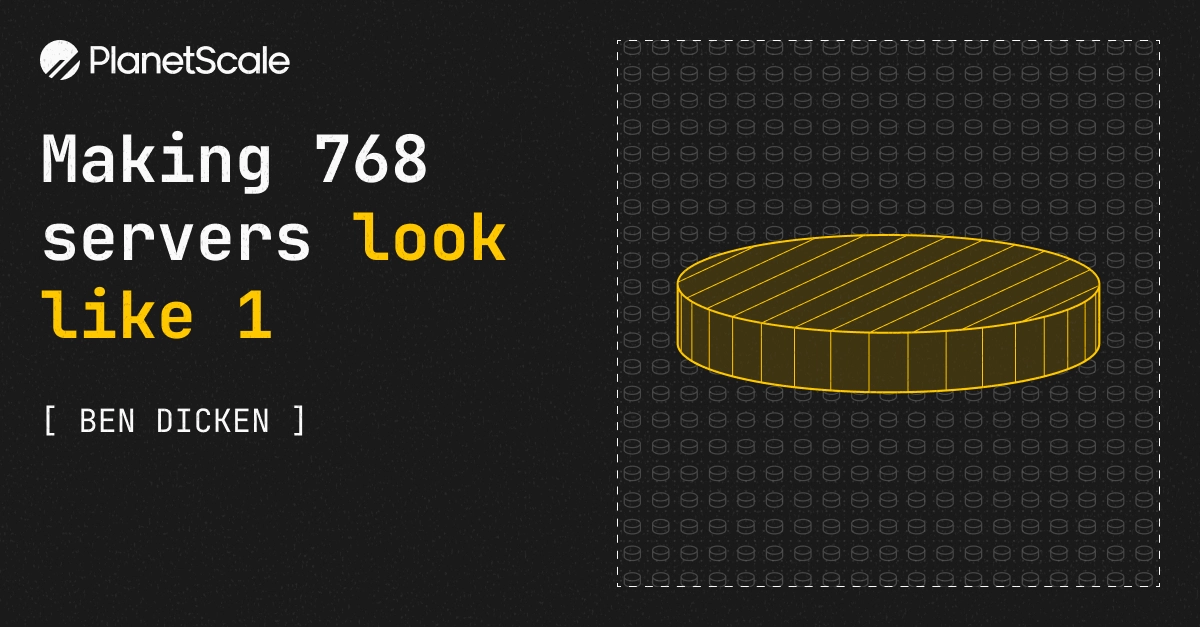
This is 768 servers.To some, that looks like a lot of computers. To those managing the infrastructure for apps with millions of customers, executing millions of queries per second, pretty normal. Products at this scale frequently require thousands of servers working in unison.The most difficult infrastructure component to scale is almost always the database. A single database server cannot handle such demand, so we must spread the queries and data out across many servers with database sharding.Database sharding is the best way to scale a Postgres or MySQL database for anything beyond a few terabytes of data. Let's look at how we go from a small single-node database, to one with a few terabytes spread across four shards, all the way up to one that is sharded across 768 servers and storing a petabyte of data.Growing painsTo understand why sharding is a necessary part of scaling relational databases, we must understand the bottlenecks of less scalable approaches.Consider first a simple application architecture.Most applications you've ever used function in this way, or at least did early in their existence. The software running on a client device connects to an app server over the internet. This app server lives in a data center and handles authentication, page loads, and all the server-side logic for how your application behaves. All the persisted data like user accounts, posts, settings, and messages get stored in and retrieved from the database server (where "database server" is typically Postgres or MySQL, though the focus of this article is Postgres).Even with a large database servers (10s of CPU cores, 100s of gigabytes of RAM) bottlenecks arise pretty quickly. Typically, it is either CPU constraints due to high query volume, or I/O constraints (IOPS) due to a high volume of reads and writes.This is summed up nicely by the Universal Scalability Law:In short, the USL states that resource contention causes scalability to grow sub-linearly with increasing resources, and at a certain point, incoherence causes performance degradation. This is true for Postgres, as with any software system attempting to scale out across many threads or processes on a larger server.One way to solve this, at least in the short terms, is leveraging read-replicas.In this configuration, you maintain the original server as a primary and add additional replicas as shown above.The primary sends a continuous stream of messages to every replica to ensure they stay up-to-date with the data changes on the primary. Writes (INSERT, UPDATE, DELETE) can only go to the primary. If writes were allowed to any server, we could end up with conflicting data. Solving this requires complex and slow consensus algorithms, which is possible, but in most cases not ideal for optimal performance.However, app servers can send read (SELECT) queries to the replicas. Since most apps have a much higher percent of reads compared to writes, this provides a lot more scalability. (Replicas are also necessary for high availability and data durability, even if query traffic does not require them).The database can scale to handle more traffic by adding replicas. An extreme example of this is OpenAI's use of 50 replicas on a single Primary.It turns out, scaling servers vertically (increasing CPU / RAM) and adding replicas can only take you so far. There are several bottlenecks that cannot be solved in this way1) Writes limited to one serverWith high enough write volume, no amount of additional read-only replicas will alleviate an issue. Before Postgres can acknowledge a committed write, it must record the change in its write-ahead log (WAL) and flush that log to durable storage. The WAL is a shared resource amongst all connections on the primary. This is essentially a single write bottleneck across your entire database, even if you have tens of replicas.2) Replicas do not increase data capacityA replica is a full copy of the primary's data, including all indexes. Adding replicas gives us more places to run reads, but it does not distribute the data.3) BackupsBackups are an important part of data durability and RPO / RTO guarantees. Taking a backup of a large, monolithic database to object storage can take hours or even days due to the bandwidth limitations of node-to-storage communication. This is unacceptably long for many organizations that rely on frequent and validated backups.The most proven way to handle this is sharding.Sharding, with a "d"Sharding solves these three bottlenecks by distributing the data and queries across many distinct primaries. For data, it is useful because a single node can only store so much and is limited on write throughput. For queries, this is useful because the network interconnects and CPUs can only process so many queries at a time.Sharding is useful at all scales past a few terabytes of data. For example, with 2 terabytes of data, we may choose a setup with four shards, each storing 500 gigabytes and handling 1/4th of the total query traffic. When we needed to store a petabyte of data (one million gigabytes), we'd need many more shards. In this case, we can use 256 shards, each with a primary + 2 replicas, and each responsible for storing ~4 terabytes. This requires 256 * 3 = 768 servers!Without a good system in place, this adds significant complexity to our app's backend. With so much going on, how does the system...Decide which data goes to which server?Decide which queries go to which server?Handle queries that need to talk to multiple shards simultaneously?Take backups across this spread-out database?Monitor system-wide health?Respond to a failing server?There's a lot that could be said in addressing each one of those concerns. But the question to address here in this article is the following:How can these 768 servers look like 1 cohesive database to our apps?We want to allow the application servers to go from interacting with a complex system, like this:To instead interacting with it over a single connection string, making it appear as if it's interfacing with one large, scalable database:While in reality, utilizing tens or hundreds of shards. Neki for Postgres and Vitess for MySQL solve this. Let's see how.The proxy layerThe most important amongst several critical pieces here is the proxy layer.Proxies are middleware servers that sit between two services. In our case, these two services are the application servers and database servers.Proxies are frequently used with Postgres databases. Even when there's no sharding, they are useful for connection pooling and request queuing. For regular (unsharded) Postgres, PgBouncer is a popular proxy that people use to multiplex 1000s of app connections across fewer direct Postgres connections.PgBouncer has a simple goal. It's built to accept a large number of connections from many clients and route them through a smaller pool of connections that it continually maintains with Postgres. The query queuing is useful for traffic surges and during database failover, so requests can resume when the new primary comes online. We have a whole blog on PgBouncer if you want to learn more.Sharding Postgres requires an even more sophisticated proxy. The biggest difference is that, in addition to multiplexing and buffering, the proxy must understand how data is distributed across servers and route SQL queries to the correct shards. Because of this, we refer to it as a router.When inserting data, the router must be aware of how data is to be distributed. This is known as the sharding strategy.A common approach is to shard incoming rows based on a hash of an id column. When inserting row like this into the database: INSERT INTO users (id, username, email) VALUES
Making 768 servers look like 1 — PlanetScale
How to make 768 distinct Postgres servers look like 1 to your applications.
2,110 words~10 min read