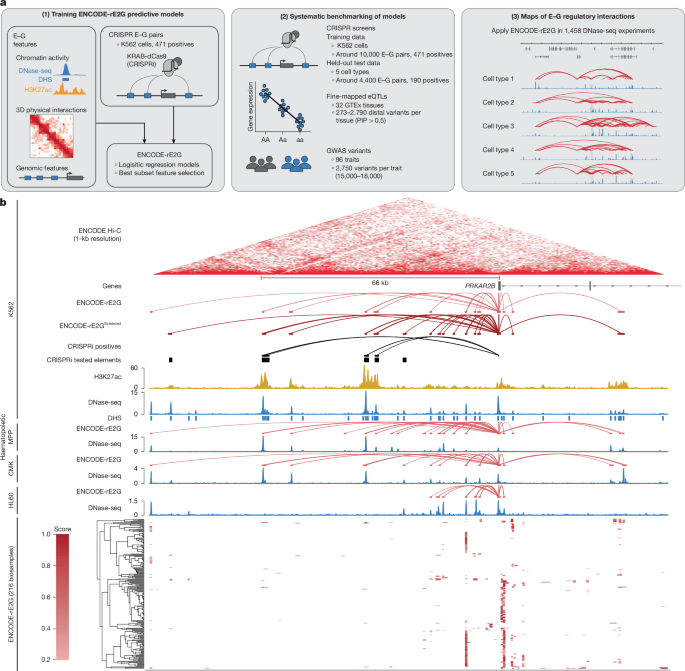
MainNoncoding DNA elements called enhancers have essential functions in controlling cell-type-specific gene regulation and cellular programs, and probably contain most causal variants for common complex diseases4,5,6. Yet, it remains an open challenge to identify accurately which elements act as enhancers in a given cell type and link them to the nearby genes that they regulate (hereafter, ‘enhancer–gene regulatory interactions’ or ‘E–G regulatory interactions’)1,2,3.Towards this goal, the ENCODE Project has conducted thousands of experiments to identify candidate cis-regulatory elements and annotate their chromatin state and three-dimensional (3D) physical interactions across hundreds of cell types and tissues7. Using these and other data, various predictive models have been developed and applied to identify enhancer–gene regulatory interactions8,9,10,11,12,13,14,15,16. Despite recent progress, key challenges remain.Many previous efforts are missing information on the accuracy of predictions, have not been compared systematically using common benchmarks, and/or have known limitations in prediction accuracy6,8,9,10,11,12,16,17. We need larger sets of genetic perturbation data and a community framework to evaluate, compare and develop improved predictive models of enhancer–gene regulatory interactions.Previous predictive models have identified certain features important for prediction accuracy, including the strength of activating chromatin marks at an element (‘enhancer activity’) and the frequency at which an element physically contacts a nearby promoter (‘3D contact’)9. However, further analysis is needed to evaluate the utility of different experimental assays in estimating these features, to compare the relative importance of these or other molecular features and to explore how these features might inform molecular mechanisms of enhancer–promoter communication.Some predictive models are difficult to apply to new cell types because they require analysis of many cell types simultaneously8,11,12 or a large number of experimental inputs in any given cell type10. As such, we are missing a resource of enhancer–gene regulatory interactions across the hundreds of cell types and tissues profiled by the ENCODE Project that can inform fundamental properties of gene regulation, link noncoding variants to genes, integrate with other ENCODE analysis products and expand to new cell types in the future.Data collected in this final phase of the ENCODE Project include CRISPR perturbations of candidate enhancers9,18,19,20, high-resolution Hi-C data (manuscript in preparation) and maps of DNase I hypersensitivity across new cell types21—providing an opportunity to build a common benchmarking framework, build improved predictive models and apply these models to construct maps of enhancer–gene regulatory interactions in the human genome.Encyclopedia of regulatory interactionsHere we present the ENCODE resource of enhancer–gene regulatory interactions (Fig. 1), which includes three components:
An encyclopedia of human enhancer–gene regulatory interactions - Nature
An encyclopedia of more than 92 million enhancer–gene regulatory interactions created as part of the ENCODE4 project provides a valuable resource for future studies of gene regulation and human genetics.
15,926 words~72 min read