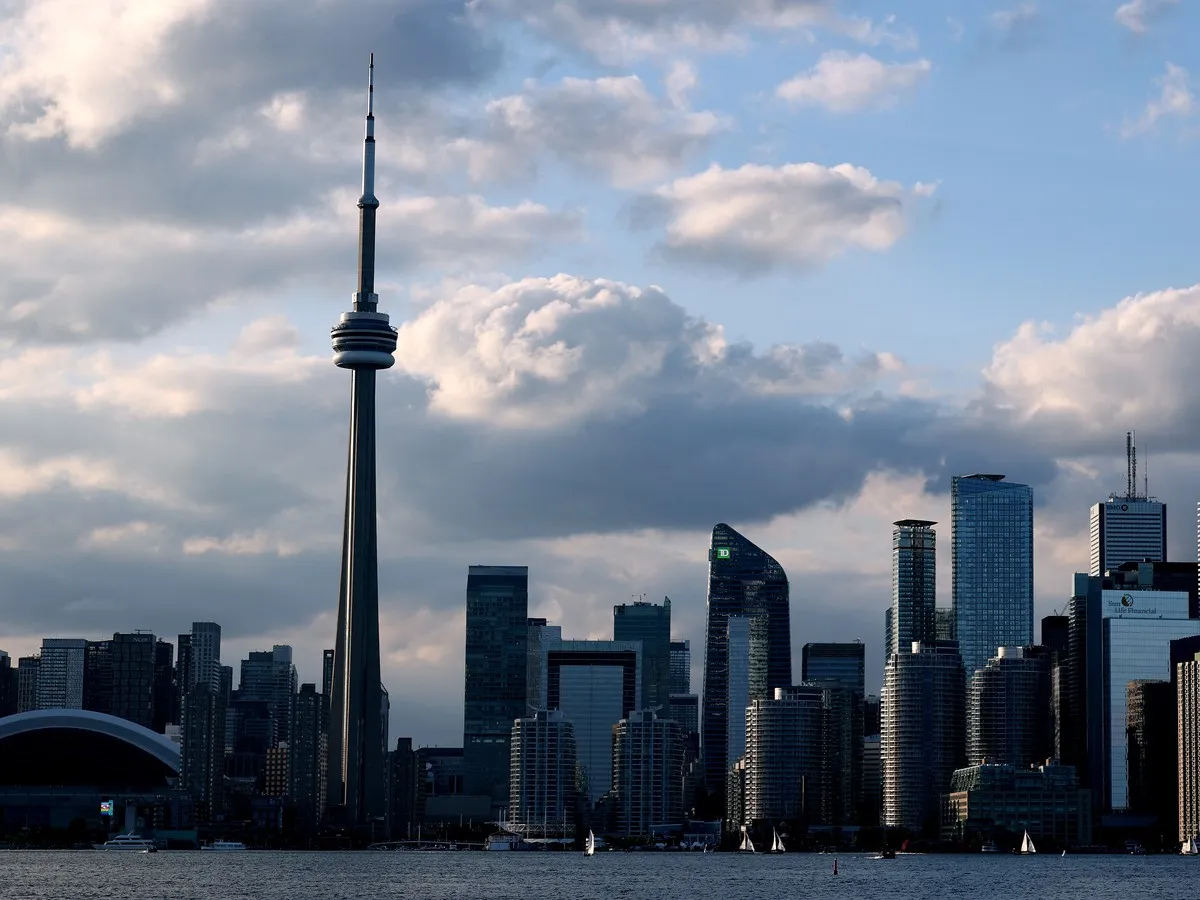
Skip to Content Subscribe Our Offers My Account Manage My Subscriptions FAQ Newsletters Canada Canadian True Crime Canadian Politics Health World Israel & Middle East Financial Post NP Comment Longreads Puzzmo Diversions Comics NP News Quiz New York Times Crossword Horoscopes Life Eating & Drinking Style Sponsored Play for Ontario Travel Travel Canada Travel USA Travel International Cruises Travel Essentials Culture Books Celebrity Movies Music Theatre Television Business Essentials Advice Lives Told Tails Told Shopping Buy Canadian Home Living Outdoor Living Kitchen & Dining Tech Style & Beauty Personal Care Entertainment & Hobbies Gift Guide Travel Guide Amazon Prime Day Deals Savings National Post Store More Sports Hockey Baseball Basketball Football Soccer Golf Tennis Driving Vehicle Research Reviews News Gear Guide Obituaries Place an Obituary Place an In Memoriam Classifieds Place an Ad Celebrations Working Business Ads Archives Healthing Epaper Manage Print Subscription Profile Settings My Subscriptions Saved Articles My Offers Newsletters Customer Service FAQ Newsletters Canada World Financial Post NP Comment Longreads Puzzmo Diversions Life Shopping Epaper Manage Print Subscription HomeNP CommentChris Selley: People are fleeing Toronto and the city doesn't seem to carePublic transit that no one is in charge of; a city council that talks a much bigger game on affordable housing than it actually plays; a resolute aversion to fun and entrepreneurialism; shocking crime. Why wouldn't people leave? You can save this article by registering for free here. Or sign-in if you have an account.TMU’s latest figures released last week show Toronto’s population is decreasing. Photo by Francois Nel /Getty ImagesWhat if Canada’s largest city started shrinking, and it wasn’t all that huge an issue, even with a municipal election just months away? This is the odd situation in which Toronto, forever caught between aspiring to and boasting of “world class” status, may now find itself. Hopefully not.Enjoy the latest local, national and international news.Exclusive articles by Conrad Black, Barbara Kay and others. Plus, special edition NP Platformed and First Reading newsletters and virtual events.Unlimited online access to National Post.National Post ePaper, an electronic replica of the print edition to view on any device, share and comment on.Daily puzzles including the New York Times Crossword.Support local journalism.Enjoy the latest local, national and international news.Exclusive articles by Conrad Black, Barbara Kay and others. Plus, special edition NP Platformed and First Reading newsletters and virtual events.Unlimited online access to National Post.National Post ePaper, an electronic replica of the print edition to view on any device, share and comment on.Daily puzzles including the New York Times Crossword.Support local journalism.Create an account or sign in to continue with your reading experience.Access articles from across Canada with one account.Share your thoughts and join the conversation in the comments.Enjoy additional articles per month.Get email updates from your favourite authors.Create an account or sign in to continue with your reading experience.Access articles from across Canada with one accountShare your thoughts and join the conversation in the commentsEnjoy additional articles per monthGet email updates from your favourite authorsSign In or Create an AccountorFor years, Hogtown has been able to boast of being one of North America’s fastest-growing cities. Over the 12 months ending July 2020, Toronto Metropolitan University’s Centre for Urban Research and Land Development found Toronto’s “census metropolitan area” (CMA) — population over 6.5 million at the time — had grown by more people than any North American urban area except for Dallas and Phoenix.Then in 2023, according to TMU researchers, it led the pack, ahead of Dallas, Houston, Montreal, Vancouver and Calgary.This newsletter from NP Comment tackles the topics you care about. (Subscriber-exclusive edition on Fridays)By signing up you consent to receive the above newsletter from Postmedia Network Inc.We encountered an issue signing you up. Please try againAnd now … not.TMU’s latest figures released last week show Toronto’s not even in the game anymore, having apparently peaked at around 7.1 million people. In 2025, relative to 2024, the city actually lost 1,000 people.A fairly astonishing 77,000 people left the Toronto CMA for (they hope) greener pastures elsewhere in Canada. That’s over one per cent of the population. To put that in some context, the “metropolitan statistical area” comprising Washington, D.C. and suburbs in Virginia, West Virginia and Maryland, lost 24,000 people to other U.S. destinations. That’s roughly 0.3 per cent, and D.C. more than made up for it with births and robust international migration.Of course, plenty of people also moved to the Toronto area from abroad: 53,000 in 2025 alone, according to TMU. But it couldn’t make up for domestic out-migration. In addition to Calgary and Edmonton, the fastest-growing Canadian destinations by percentage in recent years include Moncton, Kitchener-Cambridge-Waterloo, Saskatoon, Regina and St. Catharines-Niagara.Ample priorresearch tells us who Toronto is losing. Specifically: young families, and young couples considering starting a family. (There are other Canadian cities suffering the same problem, but none quite so spectacularly.) Torontonians aren’t just moving to the suburbs, either: The declining CMA includes huge swaths of the Greater Toronto Area, all the way east to Ajax, west to Milton and north to Lake Simcoe. They’re leaving Toronto’s orbit entirely.This is not by any means all bad news. Frankly, the way Toronto has been run in recent years, it ought to shrink. For many Canadians who didn’t grow up here — and an increasing number of those who did — Toronto has always been a bit like New York City is to Americans. It’s a place to make maximum money and have maximum fun (within Upper Canadian tolerances) early in your career, before reassessing things in the light of wanting to raise a family in a home larger than a shoebox (or shoe).Assuming all these Canadian growth hotspots can handle the population growth in terms of schools, health care and affordable housing, it brings the promise of greater and more dispersed prosperity. That’s a big assumption in a place like Moncton, whose population grew by nearly 20 per cent between 2020 and 2024. Problems there include a basic infrastructure deficit and a (somewhat ironic) shortage of skilled trades. While Moncton has grown in recent years, New Brunswick as a whole has actually been pretty flat, even slightly declining.For those escaping Canada’s biggest cities, however, it ought to be a godsend — certainly in the longer term. One of the things Americans have going for them, if they decide New York, Chicago, Los Angeles or some other megalopolis isn’t for them anymore, or never was, is a large variety of smaller cities with ample job opportunities in diverse industries, including at the very tip of the corporate pyramid.Seattle has Amazon, Costco and Microsoft. America’s health-care giants are based in and around Providence, R.I., Indianapolis, Minneapolis, Dallas, Philadelphia, Hartford, Conn. and Columbus, Ohio. JPMorgan Chase, Citigroup, Goldman Sachs and Morgan Stanley are all based in New York, but other banking colossi are based in Charlotte, N.C., San Francisco, Washington and Pittsburgh.Meanwhile, Canadian headquarters are monolithically based in Toronto, Montreal and Calgary (though, of course, they hire nationwide as well). And Montreal is essentially off-limits to the 96-odd per cent of Canadians outside of Quebec who don’t speak French.To a great extent, this difference only stands to reason: The U.S. is a far bigger country than Canada; it’s going to have more big cities to choose from. What it isn’t, or shouldn’t be, is good news for Toronto. Many of the reasons it’s shrinking are entirely preventable: Public transit that no one is in charge of; a city council that talks a much bigger game on affordable housing than it actually plays, and is still beholden to single-family homeowners with backyards; a resolute aversion to fun and entrepreneurialism; and crimes that never (and I mean never) used to happen here, such as home invasions and carjackings.Mayoral candidate Brad Bradford seems to have a handle on the broader issue. “While city hall has been raising taxes and creating more congestion, other cities are pulling ahead, actively attracting the young families and workers Toronto should be winning,” he told the Toronto Sun last week, reacting to the TMU data. As someone who rather likes Toronto — or at least, what it could be — this is encouraging. But as always, I wonder if a critical mass of Torontonians who got theirs and don’t understand what all the fuss is about will yet again carry the day.National Post cselley@postmedia.com Join the Conversation This website uses cookies to personalize your content (including ads), and allows us to analyze our traffic. Read more about cookies here. By continuing to use our site, you agree to our Terms of Use and Privacy Policy.
Chris Selley: People are fleeing Toronto and the city doesn't seem to care
Public transit that no one is in charge of; a resolute aversion to fun and entrepreneurialism; crime. Why wouldn't people leave?
1,425 words~6 min read