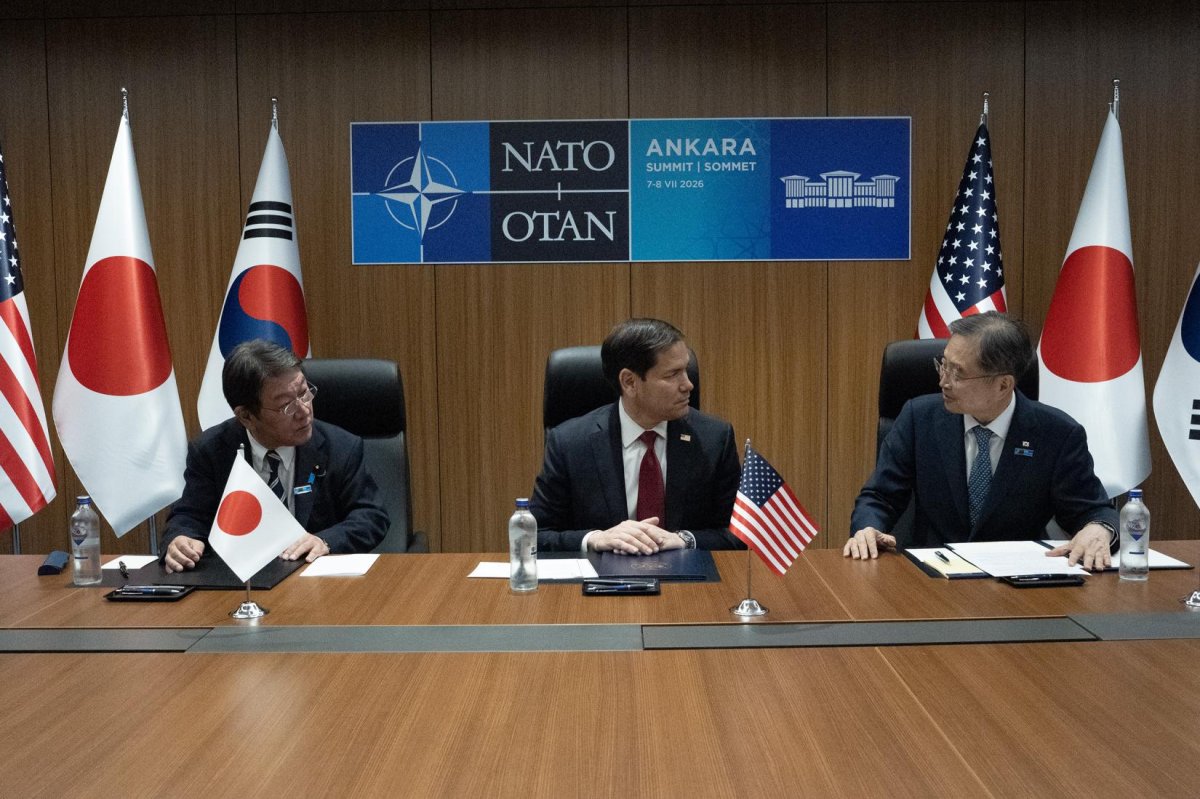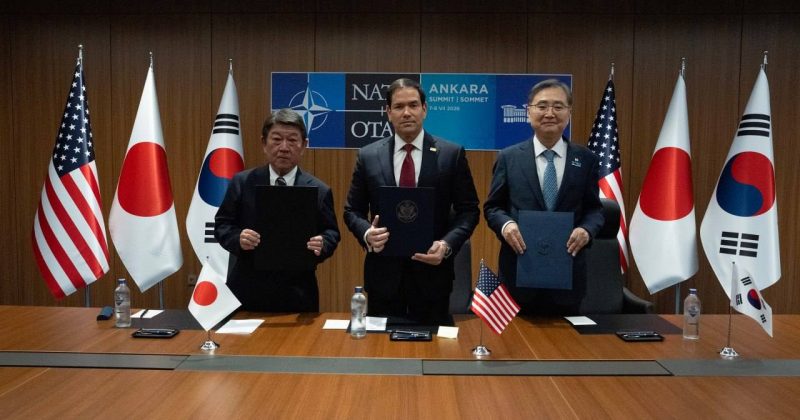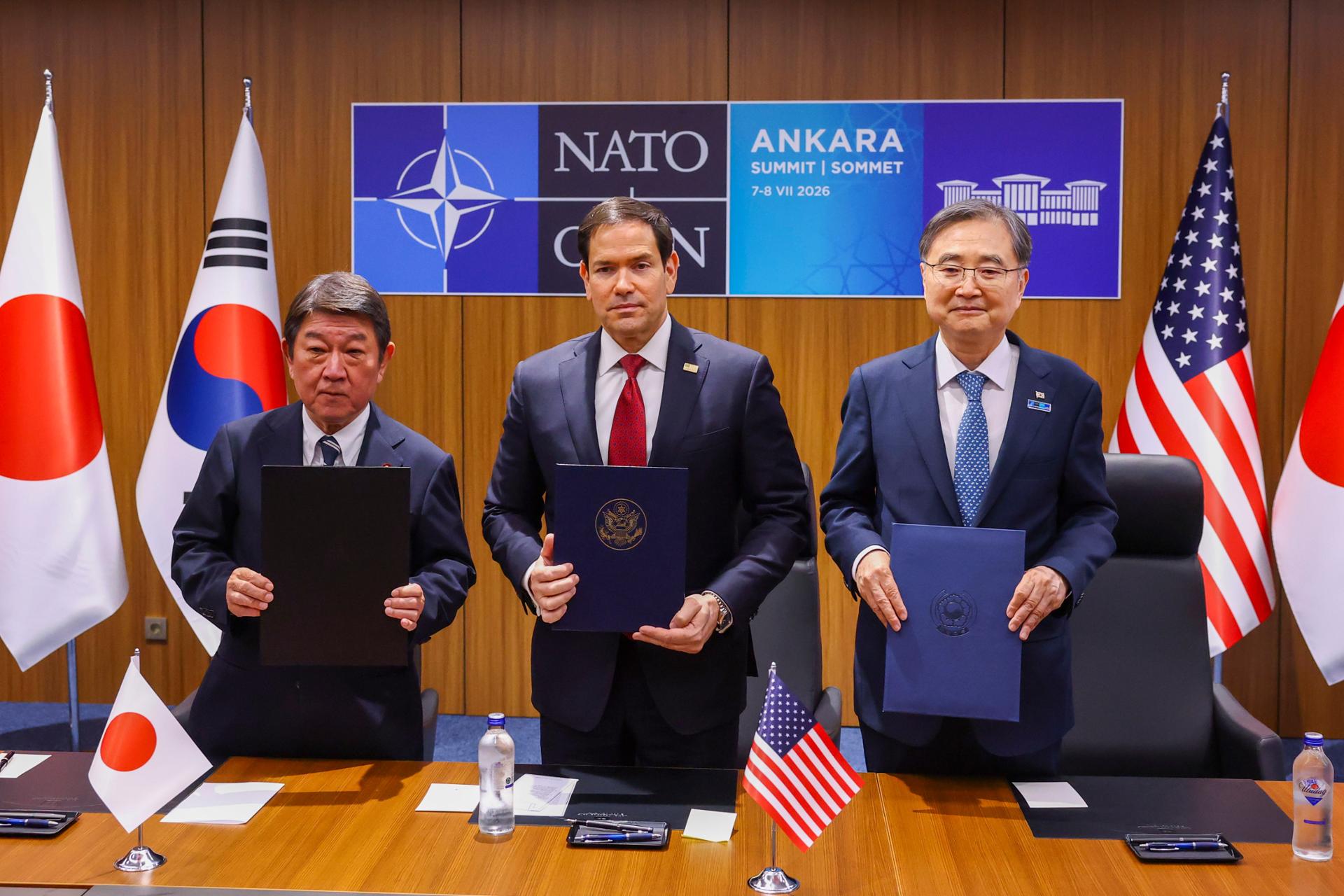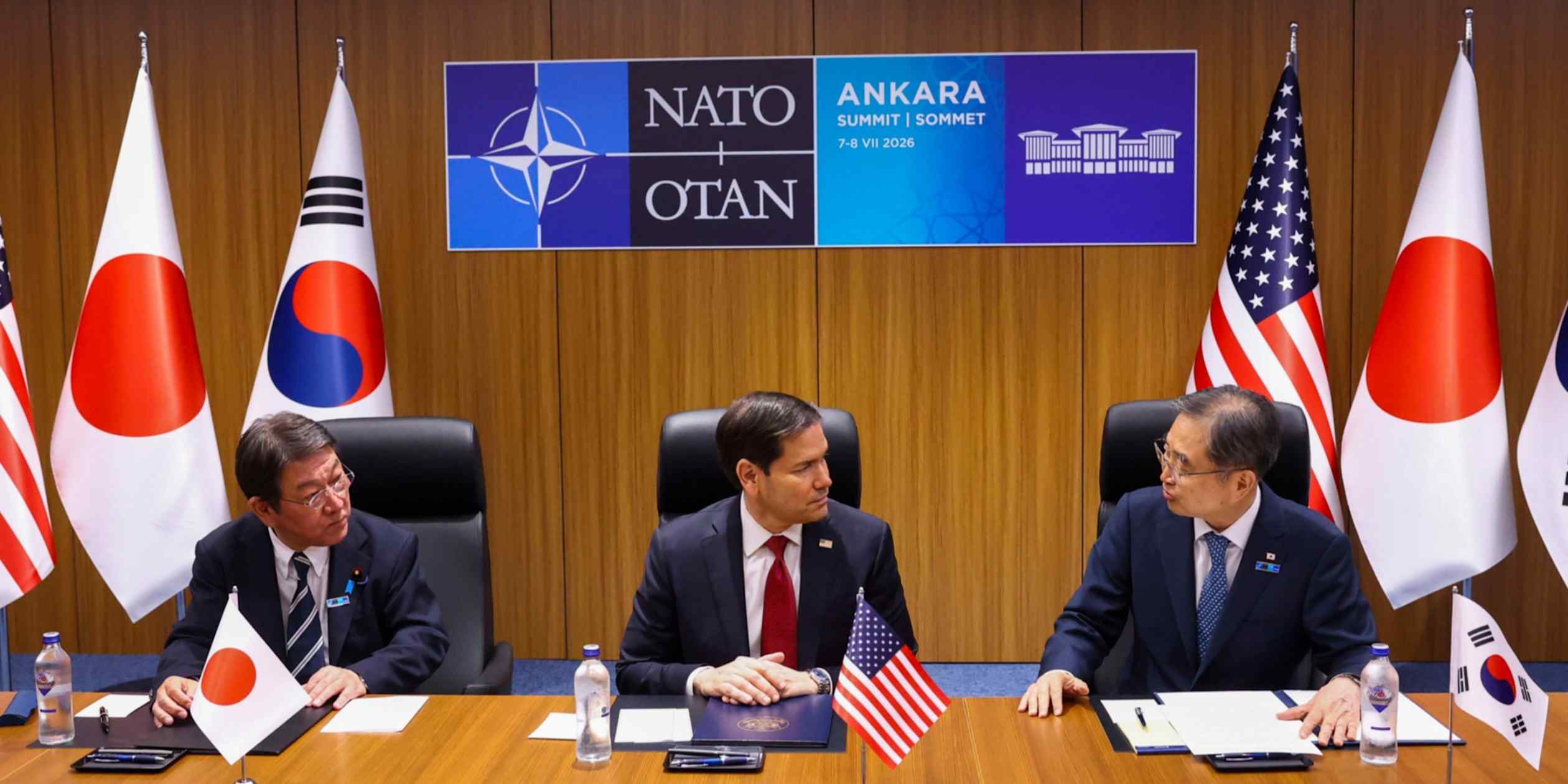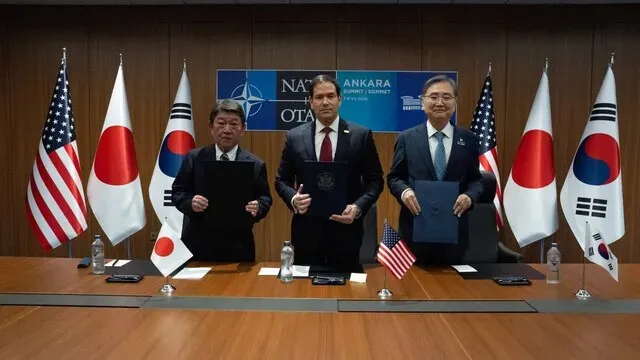
Foreign Minister Toshimatsu Motegi of Japan, US Secretary of State Marco Rubio, and South Korean Foreign Minister Cho Hyun pose for a photo after signing a memorandum of cooperation on small modular reactor deployments in other countries on the sidelines of the NATO summit in Ankara, Turkey, on July 7, 2026. (courtesy ROK Ministry of Foreign Affairs)
Analysts see Korea, the US and Japan’s agreement to launch a small modular reactor (SMR) project as suggesting the emergence of a strategic technological alliance aimed at checking China and Russia’s increasing sway over the global nuclear energy industry.On Monday, an official from Korea’s Ministry of Foreign Affairs commented on a memorandum of cooperation (MOC) about SMR deployment recently signed by the top diplomats from Korea, the US and Japan.“The MOC’s objective is to establish a framework for governmental cooperation on supporting the three countries’ nuclear power industries in jointly entering the global SMR market, starting in the Indo-Pacific region,” the official said.On July 7, Korean Foreign Minister Cho Hyun, US Secretary of State Marco Rubio and Japanese Foreign Minister Toshimitsu Motegi signed the MOC about the deployment of SMRs in the Indo-Pacific on the sidelines of the NATO summit in Ankara, Turkey. This effort is reportedly being organized by the US to counter Russia and China, which are using competitive prices to expand their share of the global nuclear energy market.Seoul, Washington and Tokyo agreed to make the Indo-Pacific the initial focus of SMR exports because multiple countries in the region — including Indonesia, Thailand, Vietnam and Singapore — have already announced plans to adopt SMRs. Notably, Indonesia is already working with the US and Japan on its deployment plans. A push to form a bloc in the nuclear energy supply chainThe US, despite possessing proprietary SMR technology, halted the construction of additional nuclear reactors after the Three Mile Island accident in 1979. Japan also scaled down its nuclear supply chain following the Fukushima nuclear disaster, which was caused by a massive earthquake and tsunami in 2011.Since building Kori-1, its first reactor, in the late 1970s, Korea has continued to expand its capacity for building nuclear reactors. While Korean nuclear suppliers are praised for staying on schedule and within budget, they are at a disadvantage to the US when it comes to SMR technology.Thus, the three countries envision developing a standard for SMR technology through synergy between the US’ design techniques, Japan’s supply chain and Korea’s building capabilities.Since SMRs are expected to account for more than 30% of total supply in the global nuclear industry by 2050, trilateral cooperation in the field goes beyond commercial and economic considerations. Rather, it’s being seen as a move to set up a bloc in the nuclear power supply network. That would mesh with the strategic goal of impeding China and Russia’s rapid expansion in the global nuclear power market, which will have a critical impact on the energy policy of countries around the world.Currently, Russia’s state-owned Rosatom is a leading firm in building nuclear plants, processing spent nuclear fuel and supplying nuclear fuel and raw materials. In short, it’s one of the big players in the world’s market for the construction of large nuclear plants.China has also sought to localize at least 90% of its nuclear supply chain and is regarded as having the potential to rapidly expand overseas. Notably, China reportedly plans to install the world’s first commercial SMR within the year.With so many countries moving to build nuclear reactors that can last for more than a century until they’re decommissioned, the nuclear reactor ecosystem centered on China and Russia is likely to expand. All those factors suggest that the US was behind the MOC it recently signed with Korea and Japan.