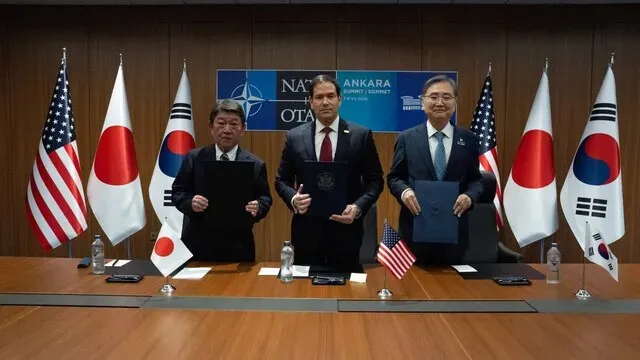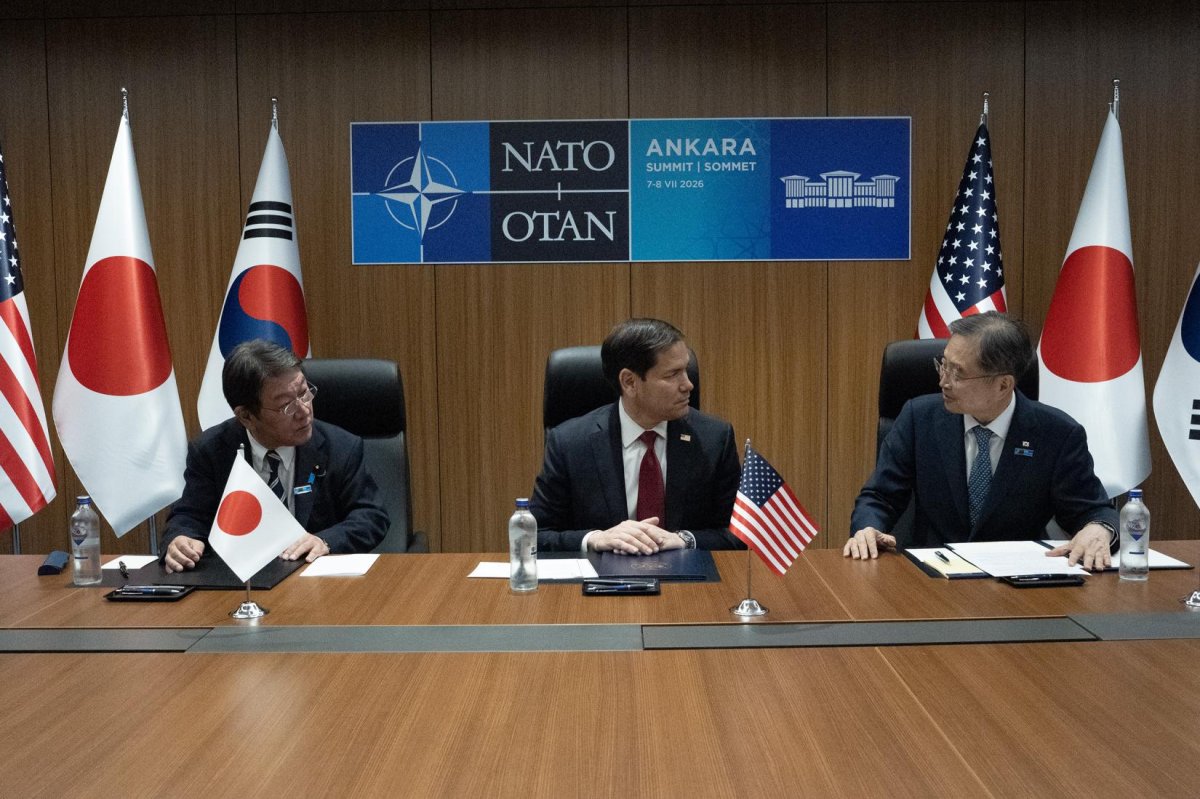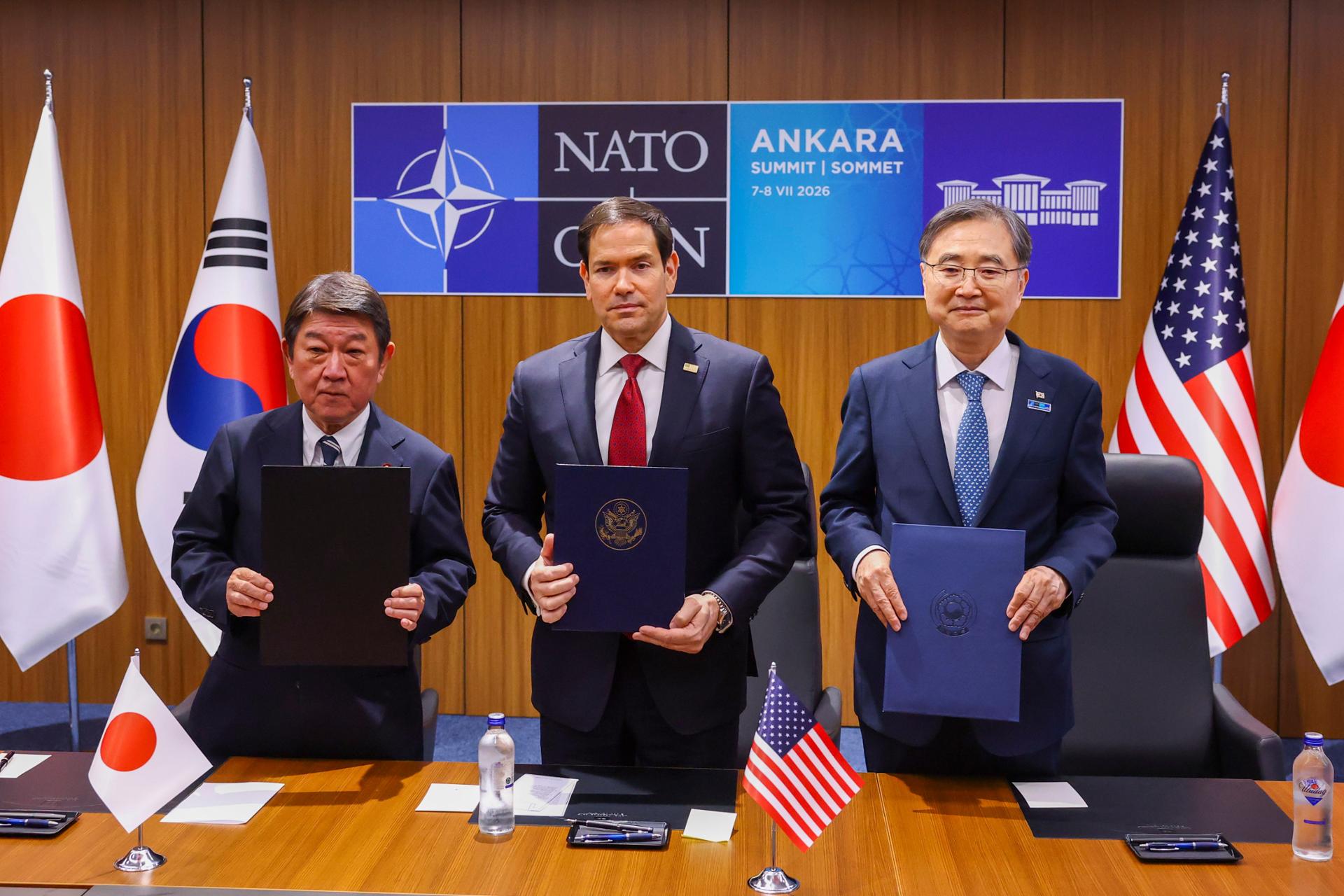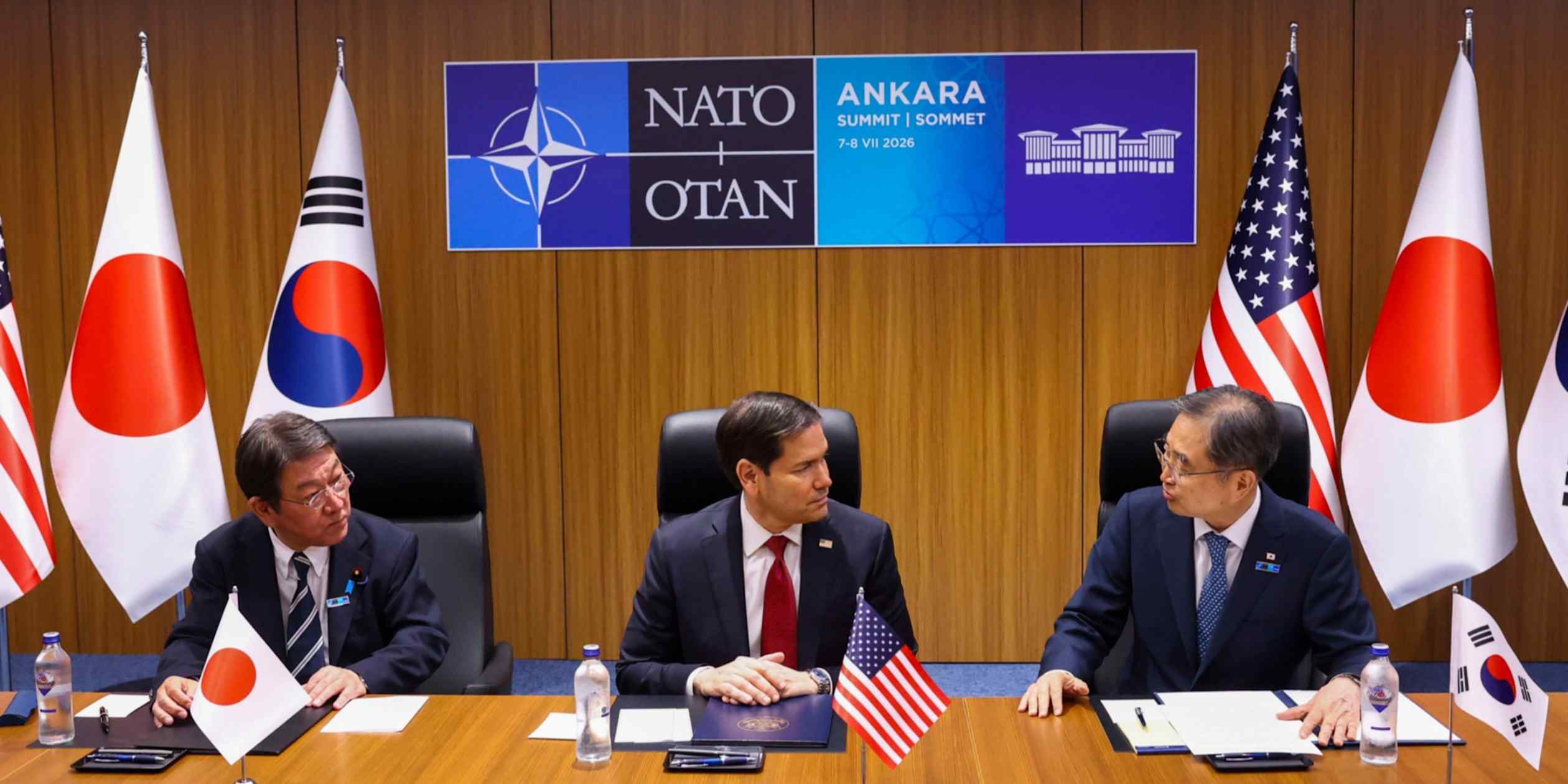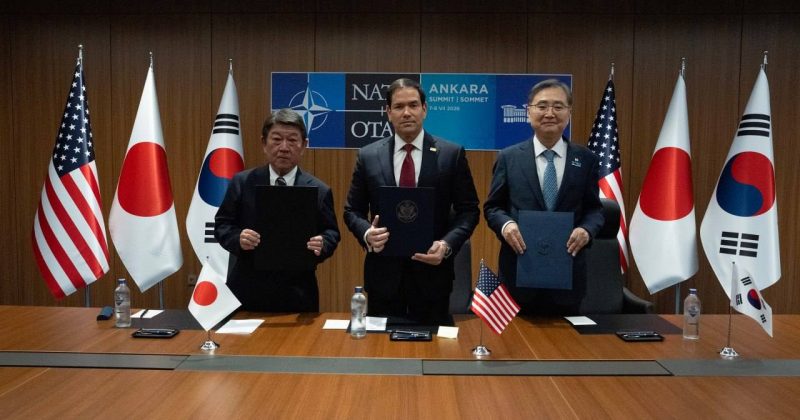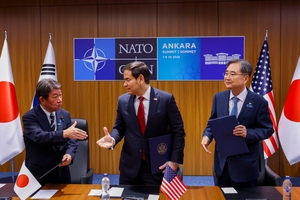
US Secretary of State Marco Rubio (center), Japanese Foreign Minister Motegi Toshimitsu (left) and South Korean Foreign Minister Cho Hyun attend a trilateral meeting on the sidelines of the NATO leaders' summit, in Ankara, Turkey on July 7. (AP via Yonhap) South Korea views its new small modular reactor partnership with the US and Japan as more than an industrial alliance, seeing it as both a strategic response to the growing influence of China and Russia in the global nuclear market and a potential catalyst for broader nuclear cooperation with Washington, a Seoul official indicated Monday.The three countries signed a memorandum of cooperation on SMR deployment on the sidelines of the NATO summit in Ankara, Turkey, on July 7 to jointly support the introduction of next-generation reactors in the Indo-Pacific and pursue opportunities in the global SMR market."The basic purpose of the memorandum of cooperation is to establish a government-level framework that will enable the nuclear industries of South Korea, the United States and Japan to jointly enter the global SMR market, beginning with the Indo-Pacific region," a Foreign Ministry official told reporters Monday.The initiative comes as diplomatic sources say Washington seeks to prevent like-minded Indo-Pacific countries from becoming dependent on Chinese and Russian nuclear supply chains.Although the United States remains the global leader in SMR technology, it has not built a new commercial nuclear plant for decades following the 1979 Three Mile Island accident. Japan's nuclear supply chain also shrank significantly after the 2011 Fukushima disaster.South Korea, meanwhile, has developed strong construction and manufacturing capabilities since building its first commercial reactor in the late 1970s. It has earned an international reputation for delivering nuclear projects on schedule and within budget, though it still trails the United States in some key SMR technologies."The three countries have complementary strengths that can create significant synergies," the official said.Officials also argued that cooperation has become increasingly strategic as SMRs are expected to account for more than 30 percent of global nuclear demand by around 2050.Russia currently dominates much of the overseas large-scale nuclear power market through state-owned Rosatom, which provides reactor construction, financing and spent fuel management. China, backed by a largely self-sufficient domestic nuclear supply chain, is also rapidly expanding its global ambitions and is expected to commission a commercial-scale SMR this year.Against that backdrop, the three countries aim to offer Indo-Pacific partners a competitive alternative before lower-cost Chinese and Russian projects become entrenched in the region, the official indicated."The Indo-Pacific is expected to see the largest increase in demand for new nuclear power plants," the Foreign Ministry official said. "By combining the capabilities of South Korea, the United States and Japan, we expect to offer regional countries a competitive alternative."The cooperation could also position the three countries to shape international standards for SMRs, an emerging sector in which global regulatory frameworks remain under development.Beyond the geopolitical rationale, Seoul also believes the agreement could strengthen its case for expanding civilian nuclear cooperation with Washington.Diplomatic sources said the government hoped closer trilateral cooperation on SMRs would create more favorable conditions for negotiations to revise the bilateral nuclear cooperation agreement, including greater autonomy over uranium enrichment.As deployment of SMRs accelerates, demand is expected to rise for high-assay low-enriched uranium, while commercial production remains limited outside Russia. Seoul argues that expanding South Korea's civilian enrichment capability would help build a more resilient fuel supply chain while reducing dependence on Russia and China.Kim Ji-hoon, deputy representative of the Korea-US Nuclear Cooperation Task Force, recently wrote on LinkedIn that the two countries are discussing ways to expand uranium enrichment capacity in line with the highest standards of nuclear safety, security, safeguards and nonproliferation. He argued that South Korea's enrichment capability could help address potential HALEU shortages while strengthening the energy security of both countries.However, momentum on that front remains uncertain.Seoul and Washington have yet to schedule a second round of security consultations launched in June to discuss expanding South Korea's nuclear fuel cycle capabilities and the possibility of developing a Korean nuclear-powered submarine.Under the current bilateral nuclear cooperation agreement, which remains in force through 2035, South Korea must obtain prior US consent before enriching uranium below 20 percent and is barred from reprocessing spent nuclear fuel. Seoul has long sought broader authority over both activities without requiring case-by-case US approval.
Seoul touts strategic value of trilateral SMR partnership
South Korea views its new small modular reactor partnership with the US and Japan as more than an industrial alliance, seeing it as both a strategic response to
714 words~3 min read